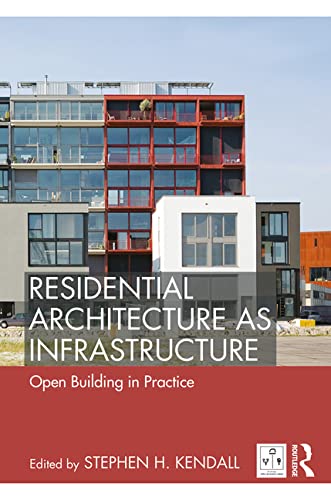

Residential architecture as infrastructure : open building in practice. / edited by Stephen H. Kendall. txt
Series Open buildingEditor: Abingdon, Oxon ; New York : Routledge, 2022Descripción: xxiv, 383 pages : ill. ; photo. ; 25 cmTipo de contenido:- text
- unmediaded
- volume
- 9781003018339
- 9780367863135
- 1000456641
- 9780367863159
- 23 728
- NA7115 R47 2022
| Imagen de cubierta | Tipo de ítem | Biblioteca actual | Biblioteca de origen | Colección | Ubicación en estantería | Signatura topográfica | Materiales especificados | Info Vol | URL | Copia número | Estado | Notas | Fecha de vencimiento | Código de barras | Reserva de ítems | Prioridad de la cola de reserva de ejemplar | Reservas para cursos | |
|---|---|---|---|---|---|---|---|---|---|---|---|---|---|---|---|---|---|---|
| Libro | CARIBET Biblioteca Arquitectura Colección General CARIBET | General NA7115 R47 2022 (Navegar estantería(Abre debajo)) | 1 | Disponible | 91000000074732 |
Descripciones mejoradas de Syndetics:
This edited collection provides an up-to-date account, by a group of well-informed and globally positioned authors, of recently implemented projects, public policies and business activities in Open Building around the world.
Countless residential Open Building projects have been built in a number of countries, some without knowledge of the original theory and methods. These projects differ in architectural style, building industry methods, economic system and social aims. National building standards and guidelines have been promulgated in several countries (Finland, China, Japan, Korea), providing incentives and guidance to Open Building implementation. Businesses in several countries have begun to deliver advanced FIT-OUT systems both for new construction and for retrofitting existing buildings, demonstrating the economic advantages of 'the responsive, independent dwelling.' This book also argues that the 'open building' approach is essential for the reactivation of the existing building stock for long-term value, because in the end it costs less.
The book discusses these developments in residential architecture from the perspective of an infrastructure model of built environment. This model enables decision-makers to manage risk and uncertainty, while avoiding a number of problems often associated with large, fast-moving projects, such as separation and distribution of design tasks (and responsibility) and the ensuing boundary frictions.
Residential Architecture as Infrastructure adds to the Routledge Open Building Series, and will appeal to architects, urban designers, researchers and policy-makers interested in this international review of current projects, policies and business activities focused on Open Building implementation.
Includes bibliographical references and index.
Preface (Stephen Kendall) --
PART 1: RESIDENTIAL OPEN BUILDING PROJECTS IN A NUMBER OF COUNTRIES --
Chapter 1: Basic Principles of an Infrastructure Model of the Building Stock (Stephen Kendall) --
Chapter 2: Open Building's recent developments in the Netherlands (Caroline Kruit) --
Chapter 3: Open Building in Finland (Carolin Franke) --
Chapter 4: Quality Control by Levels - Steering the Design Process using BEA's Project Book (Jia Beisi) --
Chapter 5: Open Building in Russia (Nadezhda Koreneva) --
Chapter 6: Open Building in the Global South (Amira Osman) --
PART 2: THE POLICY ENVIRONMENT FOR RESIDENTIAL OPEN BUILDING --
Chapter 7: The Future of Open Building resides in the Existing Stock (Frank Bijdendijk) --
Chapter 8: Japan's Act Concerning the Promotion of Long-Life Quality Housing (Kazunobu Minami) --
Chapter 9: China's 100-year housing law: It past and future (Liu Dongwei and Wu Zhichao) --
Chapter 10: Korea's 100-year housing program (Soo-am Kim and Hyeonjeong Yang) --
PART 3: DEVELOPMENTS TOWARD A FIT-OUT INDUSTRY: THE KEY TO RESIDENTIAL OPEN BUILDING --
Chapter 11: Infill Systems: A New Industry (John Habraken) --
Chapter 12: How housing renovation is meeting the challenge of oversupply of dwelling units in Japan (Yoshiro Morita and Yongsun Kim) --
Chapter 13: Dualities of Interior Decoration Companies in China (Li ShanShan) --
Chapter 14: Developments Toward A RESIDENTIAL FIT-OUT Industry: The Key to a Sustainable Housing Stock (Stephen Kendall) --
Postscript: A Personal Note (Stephen Kendall) --
Glossary of Open Building Terms --
Index --
This edited collection provides an up-to-date account, by a group of well-informed and globally positioned authors, of recently implemented projects, public policies and business activities in Open Building around the world. Countless residential Open Building projects have been built in a number of countries, some without knowledge of the original theory and methods. These projects differ in architectural style, building industry methods, economic system and social aims. National building standards and guidelines have been promulgated in several countries (Finland, China, Japan, Korea), providing incentives and guidance to Open Building implementation. Businesses in several countries have begun to deliver advanced FIT-OUT systems both for new construction and for retrofitting existing buildings, demonstrating the economic advantages of 'the responsive, independent dwelling.' This book also argues that the 'open building' approach is essential for the reactivation of the existing building stock for long-term value, because in the end it costs less. The book discusses these developments in residential architecture from the perspective of an infrastructure model of built environment. This model enables decision-makers to manage risk and uncertainty, while avoiding a number of problems often associated with large, fast-moving projects, such as separation and distribution of design tasks (and responsibility) and the ensuing boundary frictions. Residential Architecture as Infrastructure adds to the Routledge Open Building Series, and will appeal to architects, urban designers, researchers and policy-makers interested in this international review of current projects, policies and business activities focused on Open Building implementation.
Description based on print version record.
Notas de autor provistas por Syndetics
Stephen H. Kendall, Ph.D., R.A. is Emeritus Professor of Architecture at Ball State University and co-founder and vice president of the Council on Open Building. Dr. Kendall's career in architectural practice, research and education spans more than 40 years. His research focuses on the Open Building approach needed to make buildings more adaptable, easier to customize to meet changing preferences and thus more sustainable. His work recognizes the increasing size and complexity of projects and the dynamics of living environments, the workplace and the marketplace where design must go beyond short-term uses and where control is distributed not only during initial planning but also over time.