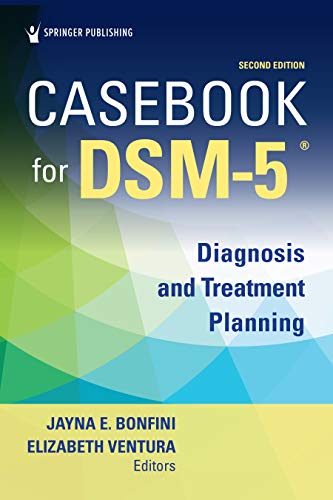

Casebook for DSM5®: Diagnosis and treatment planning / Jayne E. Bonfini and Elizabeth M. Ventura, editors.
Fecha de copyright: New York : Springer Publishing Company, 2022Edición: Second editionDescripción: xxi, 308 pages ; 23 cmTipo de contenido:- text
- unmediated
- volume
- 9780826186331
- RC531 .C36 2021
| Imagen de cubierta | Tipo de ítem | Biblioteca actual | Biblioteca de origen | Colección | Ubicación en estantería | Signatura topográfica | Materiales especificados | Info Vol | URL | Copia número | Estado | Notas | Fecha de vencimiento | Código de barras | Reserva de ítems | Prioridad de la cola de reserva de ejemplar | Reservas para cursos | |
|---|---|---|---|---|---|---|---|---|---|---|---|---|---|---|---|---|---|---|
| Libro | Biblioteca de Mayagüez Sala de Referencia mb | RC531 .C36 2021 (Navegar estantería(Abre debajo)) | c. 1 | Disponible | 50000003281598 | |||||||||||||
| Libro | Biblioteca Encarnación Valdés Sala de Referencia bev | R 616.8522 C3371 2022 (Navegar estantería(Abre debajo)) | Disponible | 80000002598780 |
Descripciones mejoradas de Syndetics:
Distinguished by its use of real-world case examples to help students link DSM-5 criteria with client symptoms
This practical casebook for graduate-level programs in mental health masterfully demonstrates how to put the DSM-5 into practice. It is designed to help students understand why a particular diagnosis is given based on the individual client's specific background and personal history. This book is distinguished from other casebooks through the presentation of complex,real-life case studiesthat discuss pairing the DSM-5 criteria with symptomatology and offers in-depth analyses of treatment interventions and client management. Each case is consistently formatted to include an overview of the client, symptoms/problems, diagnosis, and treatment interventions, including components, applications, and results/prognosis. Readers will have an opportunity to formulate their own reactions and diagnostic impressions for each case before the commentary reveals the correct conclusion. An ideal text to enhance courses in psychopathology and diagnosis, as well as practicum and internship, the casebook will diversify and broaden the classroom experience by enlightening students with compelling clinical cases that have been experienced by practicing professionals.
The second edition has been expanded to feature additional cases for each category, a more detailed table of contents to better organize the book around disorder categories, additional discussion questions for each case,as well as a final review chapter, making this text a helpful supplement to a variety of undergraduate and graduate courses.By fully exploring the rationale behind diagnostic criteria, the book provides trainees in counseling, marriage and family therapy, counseling psychology, and social work an opportunity to examine their own ideas on symptom presentation, diagnosis, and treatment planning with a full complement of disorders and conditions covered in the DSM-5.Purchase also includes digital access for use on most mobile devices or computers.
New to the Second Edition:
Presents additional cases in each diagnostic category Reorganizes table of contents to facilitate easy access to diagnostic categories Presents cases with expanded range of settings for a diverse mental health workforce Dedicated chapter onCultural Considerations in Treatment Contains additional discussion questions and notes to promote critical thinking Presents a new final review chapter that can serve as an assessmentKey Features:
Encompasses in-demand DSM-5 content for all helping professions Provides breadth and depth of coverage including multiple cases in each DSM-5 category Covers symptoms, diagnosis, and treatment planning Follows a consistent format in each chapter for ease of use Structures cases so students can apply DSM-5 criteria and understand why and how to make diagnosis based on symptom presentation Considers cultural and social implications in each case Includes diverse range of evidence-based treatment recommendationsChapter 1. Neurodevelopmental Disorders -- Chapter 2. Schizophrenia Spectrum and Other Psychotic Disorders -- Chapter 3. Bipolar and Related Disorders -- Chapter 4. Depressive Disorders -- Chapter 5. Anxiety Disorders -- Chapter 6. Obsessive Compulsive and Related Disorders -- Chapter 7. Trauma and Stressor Related Disorders -- Chapter 8. Dissociative Disorders -- Chapter 9. Somatic Symptom and Related Disorders -- Chapter 10. Feeding and Eating Disorders -- Chapter 11. Elimination Disorders -- Chapter 12. Sleep- Wake Disorders -- Chapter 13. Sexual Dysfunctions -- Chapter 14. Gender Dysphoria -- Chapter 15. Disruptive, Impulse-Control, and Conduct Disorders -- Chapter 16. Substance-Related and Addictive Disorders -- Chapter 17. Neurocognitive Disorders -- Chapter 18. Personality Disorders -- Chapter 19. Paraphilic Disorders -- Chapter 20: Cultural Considerations in Treatment -- Chapter 21: Final Review: Your Skills in Practice.
This practical casebook for graduate-level programs in mental health masterfully demonstrates how to put the DSM-5 into practice. It is designed to help students understand why a particular diagnosis is given based on the individual client’s specific background and personal history. This book is distinguished from other casebooks through the presentation of complex, real-life case studies that discuss pairing the DSM-5 criteria with symptomatology and offers in-depth analyses of treatment interventions and client management. Each case is consistently formatted to include an overview of the client, symptoms/problems, diagnosis, and treatment interventions, including components, applications, and results/prognosis. Readers will have an opportunity to formulate their own reactions and diagnostic impressions for each case before the commentary reveals the correct conclusion. An ideal text to enhance courses in psychopathology and diagnosis, as well as practicum and internship, the casebook will diversify and broaden the classroom experience by enlightening students with compelling clinical cases that have been experienced by practicing professionals. The second edition has been expanded to feature additional cases for each category, a more detailed table of contents to better organize the book around disorder categories, additional discussion questions for each case, as well as a final review chapter, making this text a helpful supplement to a variety of undergraduate and graduate courses. By fully exploring the rationale behind diagnostic criteria, the book provides trainees in counseling, marriage and family therapy, counseling psychology, and social work an opportunity to examine their own ideas on symptom presentation, diagnosis, and treatment planning with a full complement of disorders and conditions covered in the DSM-5.