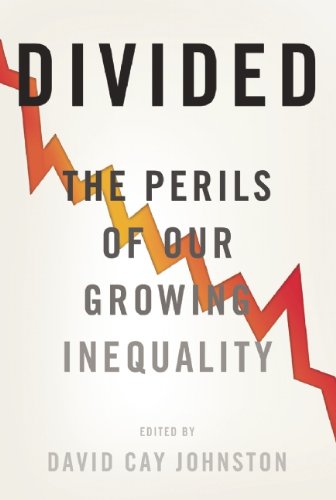

Divided : The Perils of Our Growing Inequality / edited by David Cay Johnston.
Editor: New York : New Press, The, 2014Fecha de copyright: ©2014Descripción: 1 online resource (234 pages)Tipo de contenido:- text
- computer
- online resource
- 9781595589446
- 305
- HM821 .D585 2014
| Imagen de cubierta | Tipo de ítem | Biblioteca actual | Biblioteca de origen | Colección | Ubicación en estantería | Signatura topográfica | Materiales especificados | Info Vol | URL | Copia número | Estado | Notas | Fecha de vencimiento | Código de barras | Reserva de ítems | Prioridad de la cola de reserva de ejemplar | Reservas para cursos | |
|---|---|---|---|---|---|---|---|---|---|---|---|---|---|---|---|---|---|---|
| Libro electrónico | Biblioteca de Mayagüez Acceso en línea | HM821 .D585 2014 (Navegar estantería(Abre debajo)) | Ebook c. 1 | Disponible | 50000003285805 | |||||||||||||
| Libro electrónico | Biblioteca Encarnación Valdés Acceso en línea | 305 (Navegar estantería(Abre debajo)) | Disponible | EBC1340964 |
Descripciones mejoradas de Syndetics:
Essays on the dangers of the wealth and income gap, collected by the New York Times -bestselling author of It's Even Worse Than You Think .
This collection includes writings by a wide range of voices--including Adam Smith, Elizabeth Warren, Barbara Ehrenreich, Joseph E. Stiglitz, Studs Terkel, Paul Krugman, Barack Obama, and David Cay Johnston--illuminating the reality of economic inequality in America, where in spite of the fury that followed the 2008 financial crisis, little has to been done to address the gulf between the one percent and the ninety-nine percent.
Pulitzer Prize-winning journalist David Cay Johnston explains that in this most unequal of developed nations, every aspect of inequality remains hotly contested and poorly understood. These writings, from leading scholars, journalists, and activists, offers a multifaceted look at the problem, exploring its devastating--and dangerous--implications in areas as diverse as education, justice, health care, social mobility, and political representation. Provocative and eminently readable, here is an essential resource for anyone who cares about the future of America--and compelling evidence that inequality can be ignored only at the nation's peril.
Cover -- Title Page -- Copyright -- Contents -- Introduction -- Insights on Inequality -- OVERVIEW -- Inequality and Democracy -- The Vanishing Middle Class -- Necessaries -- INCOME INEQUALITY -- How Gains at the Top Injure the Middle Class -- Inequality Is Holding Back the Recovery -- Wage Theft -- Home Depot's CEO-Size Tip -- Why Do So Many Jobs Pay So Badly? -- In the Heart of Our Economy and Our Lives -- Household Wealth Inequality -- Inequality Across Generations -- "I Didn't Do It Alone" -- Arthur A. Robertson and the 1929 Crash -- Graduates v. Oligarchs -- EDUCATION -- No Rich Child Left Behind -- Achievement Gap -- Back to School -- Educational Quality and Equality -- HEALTH CARE INEQUALITY -- Health and Income Inequalities Are Linked -- Unequal Quality of Care -- Reducing Health Care Disparities -- Universal Health Care -- U.S. Health Care Costs the Most-by Far -- Inequality Kills -- DEBT AND POVERTY -- Jailed for Being in Debt -- America's Poverty "Tax" -- Hunger in America -- Georgia's Hunger Games -- Living Down to Expectations -- POLICY -- How Economics Is Biased Toward the Rich -- Don't Drink the Kool-Aid -- Social Security Reduces Inequality-Efficiently, Effectively, and Fairly -- Arguments For and Against Income Inequality -- Inequality of Hazard -- A Different Kind of Epidemic -- Prison's Dilemma -- FAMILY -- Men and Their Underpaid Women -- Race, Gender, Family Structure, and Poverty -- Employed Parents Who Can't Make a Living -- Contributors -- Additional Reading -- Permissions.
The issue of inequality has irrefutably returned to the fore, riding on the anger against Wall Street following the 2008 financial crisis and the concentration of economic and political power in the hands of the super-rich. The Occupy movement made the plight of the 99 percent an indelible part of the public consciousness, and concerns about inequality were a decisive factor in the 2012 presidential elections. How bad is it? According to Pulitzer Prize-winning journalist David Cay Johnston, most Americans, in inflation-adjusted terms, are now back to the average income of 1966. Shockingly, from 2009 to 2011, the top 1 percent got 121 percent of the income gains while the bottom 99 percent saw their income fall. Yet in this most unequal of developed nations, every aspect of inequality remains hotly contested and poorly understood. Divided collects the writings of leading scholars, activists, and journalists to provide an illuminating, multifaceted look at inequality in America, exploring its devastating implications in areas as diverse as education, justice, health care, social mobility, and political representation. Provocative and eminently readable, here is an essential resource for anyone who cares about the future of America-and compelling evidence that inequality can be ignored only at the nation's peril.
Description based on publisher supplied metadata and other sources.
Electronic reproduction. Ann Arbor, Michigan : ProQuest Ebook Central, 2021. Available via World Wide Web. Access may be limited to ProQuest Ebook Central affiliated libraries.