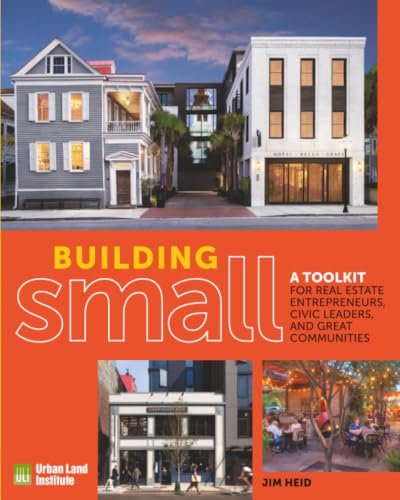

Building Small : a toolkit for real estate entrepreneurs, civic leaders, and great communities. / Jim Heid, FASLA. txt
Washingtong, DC : Urban Land Institute , 2021Descripción: 264 p. ill. ; photo. ; col. ; 26 cmTipo de contenido:- text
- unmediaded
- volume
- 9780874204681
- 0874204682
- Toolkit for real estate entrepreneurs, civic leaders, and great communities txt
- 23 333.7315
- HD255 H45 2021
| Imagen de cubierta | Tipo de ítem | Biblioteca actual | Biblioteca de origen | Colección | Ubicación en estantería | Signatura topográfica | Materiales especificados | Info Vol | URL | Copia número | Estado | Notas | Fecha de vencimiento | Código de barras | Reserva de ítems | Prioridad de la cola de reserva de ejemplar | Reservas para cursos | |
|---|---|---|---|---|---|---|---|---|---|---|---|---|---|---|---|---|---|---|
| Libro | CARIBET Biblioteca Arquitectura Colección General CARIBET | General HD255 H45 2021 (Navegar estantería(Abre debajo)) | 1 | Disponible | 91000000064469 |
Descripciones mejoradas de Syndetics:
Small-scale, incremental real estate development is gaining momentum as an alternative to more conventional approaches. Small-scale development helps create authentic places, acts as a magnet for new investment, and helps attract talent-based employment, all while fostering a more resilient local economy. This, in turn, helps communities better differentiate themselves when seeking new investment in an increasingly competitive landscape. Despite those virtues, entrepreneurial developers working to "build small" face jurisdictional and capital barriers that impede bringing this approach to scale. Drawing on extensive research and using case studies, interviews with over 100 developers, and first-hand knowledge gained from tours of several U.S. cities, author Jim Heid articulates what small-scale development means, why it is essential to communities of every size and in every location, and how entrepreneurial developers and community leaders can help remove obstacles to small--delivering successful projects and resulting in a better approach to building community.
Foreword : A Few Small Words 2 --
Preface : Why This Book ? 5 --
How to Use This Book 10 --
PART I: THE WHAT AND WHY OF SMALL --
CHAPTER 1 What Is Small? 14 --
CHAPTER 2 Why Build Small? Answers for Developers, Civic Leaders, and Communities 22 --
PART II: THE HOW OF SMALL: THE TOOLKIT --
CHAPTER 3 Getting Started 48 --
CHAPTER 4 Site Control and Project Feasibility 56 --
CHAPTER 5 What to Build: Small Uses That Work 66 --
CHAPTER 6 Protecting Yourself: Legal Basics 86 --
CHAPTER 7 Financing Small 94 --
CHAPTER 8 Assessing Market Potential 108 --
CHAPTER 9 Winning Small: Agency and Neighbor Approvals 118 --
CHAPTER 10 Managing the Design and Construction Process 130 --
CHAPTER 11 Small in Your Community: Tips for Regulators and Civic Leaders 145 --
PART III: THE PROJECTS AND PEOPLE BUILDING SMALL --
CHAPTER 12 Small Success Stories 166 --
Keeping It Small: Guerrilla Development, Portland, Oregon 168 --
Building a Firm: Pivot Project, Oklahoma City, Oklahoma 176 --
Regulatory Change: Office of Customer Advocacy, Phoenix, Arizona 182 --
The Nonprofit Entrepreneur: Midtown Detroit, Detroit, Michigan 188 --
Big Agency Embraces Small: MassDevelopment, Boston, Massachusetts 194 --
Funding Small: Small Change, Pittsburgh, Pennsylvania 202 --
CHAPTER 13 I Small Case Studies 210 --
Rethinking Residence: Oslo, Washington, DC 212 --
Granular Infill: Chophouse Row, Seattle, WA 220 --
Cultural Icon Reborn: The Newton, Phoenix, AZ 230 --
Financing Adaptation: AF Bornot Dye Works, Philadelphia, PA 240 --
Innovation Catalyst: Tomorrow Building, Chattanooga, TN 250 --
Notes 256 --
Epilogue: Small and the Pandemic of 2020 257 --
Acknowledgments 259 --
Resources and References 262 --
About the Author 264 --