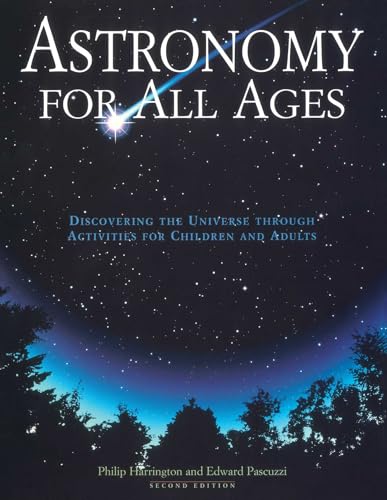

Astronomy for all ages : discovering the universe through activities for children and adults / by Philip Harrington and Edward Pascuzzi.
Detalles de publicación: Guilford, Conn. : Globe Pequot Press, c2000.Edición: 2nd edDescripción: ix, 214 p. : ill., maps ; 28 cmTipo de contenido:- 0762708093
- Astronomy
- 520.7 H311a2 23
- QB63 .H317 2000
| Imagen de cubierta | Tipo de ítem | Biblioteca actual | Biblioteca de origen | Colección | Ubicación en estantería | Signatura topográfica | Materiales especificados | Info Vol | URL | Copia número | Estado | Notas | Fecha de vencimiento | Código de barras | Reserva de ítems | Prioridad de la cola de reserva de ejemplar | Reservas para cursos | |
|---|---|---|---|---|---|---|---|---|---|---|---|---|---|---|---|---|---|---|
| Libro | Biblioteca Encarnación Valdés Colección General bev | 520.7 H311a2 (Navegar estantería(Abre debajo)) | Disponible | 80000002597477 |
Descripciones mejoradas de Syndetics:
Kids and adults can explore outer space from their own backyards with this handy book of unusual and engaging activities. By simply looking up at the sky- with the unaided eye- parents, camp counselors, and other group leaders can help children identify, understand, and appreciate the inhabitants of the Milky Way and galaxies beyond. With this book, amateur star-gazers will become acquainted with the constellations, planets, and phases of the moon; how compasses, sundials, and telescopes work; and what causes shooting stars and other galactic phenomena. Down-to-earth explanations of astronomical events and concepts helps readers navigate their way through the stars.
Includes bibliographical references (p. 197) and index.
Tabla de contenidos provista por Syndetics
- Preface(p. vii)
- Acknowledgments(p. ix)
- Section I The Naked-Eye Sky(p. 1)
- 1 Finding Your Way in the Sky(p. 1)
- 2 Using a Star Map to Read the Sky(p. 2)
- 3 Locating the Constellations and Bright Stars of the Circumpolar Sky(p. 5)
- 4 Locating the Constellations and Bright Stars of Spring(p. 9)
- 5 Locating the Constellations and Bright Stars of Summer(p. 12)
- 6 Locating the Constellations and Bright Stars of Autumn(p. 15)
- 7 Locating the Constellations and Bright Stars of Winter(p. 18)
- 8 Which Stars Can I See Tonight?: Building Your Own Planisphere(p. 22)
- 9 Star Brightness I: How Bright Is That Star?(p. 25)
- 10 Star Brightness II: Don't Judge a Book by Its Cover(p. 28)
- 11 Telling Time by the Stars(p. 31)
- 12 Where Am I?: Using an Astrolabe to Find Your Latitude(p. 35)
- 13 "It Was This Big!": Measuring Sizes in the Sky(p. 39)
- 14 Spotting Artificial Satellites(p. 43)
- 15 How Dark Is Your Backyard?: Understanding Light Pollution(p. 45)
- Section II The Moon(p. 49)
- 16 "Jack and Jill" and the Moon's Phases(p. 49)
- 17 Oceans on the Moon?: Looking for Lunar "Seas"(p. 54)
- 18 Potholes on the Moon?: Looking for Lunar Craters(p. 56)
- 19 Where Did the Astronauts Land on the Moon?(p. 62)
- 20 Observing the Odd Lunar Crescents of Summer and Winter(p. 66)
- 21 Observing Lunar Eclipses(p. 69)
- Section III The Sun(p. 75)
- 22 How Not to Look at the Sun(p. 75)
- 23 Estimating the Sun's Period of Rotation(p. 77)
- 24 Electricity in the Sky: The Northern Lights(p. 80)
- 25 Making a Sundial(p. 84)
- 26 Figure Eight in the Sky: Making an Analemma(p. 89)
- 27 Chasing Solar Eclipses(p. 96)
- Section IV The Solar System(p. 103)
- 28 Hide and Seek: Finding Elusive Mercury(p. 103)
- 29 Following the Phases of Venus(p. 106)
- 30 The "Dizzy" Planet: Following the Backward Motion of Mars(p. 109)
- 31 Jupiter: A Dynamic Planet(p. 113)
- 32 Jupiter's Family of Satellites(p. 116)
- 33 Ring around the Planet: Observing Saturn(p. 119)
- 34 Weighing Yourself on Other Planets(p. 122)
- 35 Looking for Meteors, Meteor Showers, and Fireballs(p. 123)
- 36 Looking for Micrometeorites(p. 128)
- 37 Dirty Snowballs?: Observing Comets(p. 129)
- 38 What Are the Planetary Paths?: Making Ellipses(p. 133)
- 39 Building a Pocket Solar System(p. 136)
- Section V Deep Space(p. 141)
- 40 Seeing Double: Observing Double Stars(p. 141)
- 41 Families of Stars: Observing Star Clusters(p. 144)
- 42 Clouds in Space: Observing Nebulae(p. 150)
- 43 Distant Islands of Stars: Observing Galaxies(p. 155)
- Section VI Telescopes and Photography(p. 161)
- 44 Fun with Optics(p. 161)
- 45 A Telescope and Binocular Primer(p. 163)
- 46 Building Your Own Reflecting Telescope(p. 169)
- 47 Discovering Roy G. BIV: Building Your Own Spectroscope(p. 178)
- 48 Understanding Your Camera: The World of Astrophotography(p. 180)
- 49 Showing That Earth Spins: Making Photographic Star Trails(p. 185)
- 50 Building a Camera-Tracking Platform(p. 187)
- 51 Shoot the Moon(p. 192)
- Appendices
- 1 Bibliography(p. 197)
- 2 Resource List and Dealers of Astronomy Equipment(p. 198)
- 3 Lunar Phase Dates (2000-2010)(p. 199)
- 4 Planet Positions (2000-2010)(p. 202)
- 5 Seasonal Star Atlas(p. 205)
- 6 Astronomy Web Sites(p. 210)
- Index(p. 213)
- About the Authors(p. 214)
Notas de autor provistas por Syndetics
Philip Harrington is the author of Touring the Universe through Binoculars and Starware, published by John Wiley & Sons, and regularly contributes to Sky and Telescope and Astronomy magazines. He teaches courses in astronomy at the Vanderbilt Museum Planetarium and at Hofstra University and is a frequent lecturer at astronomy clubs and conventions worldwide. Edward Pascuzzi, a high school physics and earth science teacher, holds a bachelors degree in theoretical astrophysics and a masters degree in physics education. For the past decade he had lectured and taught astronomy at the Vanderbilt Museum Planetarium.