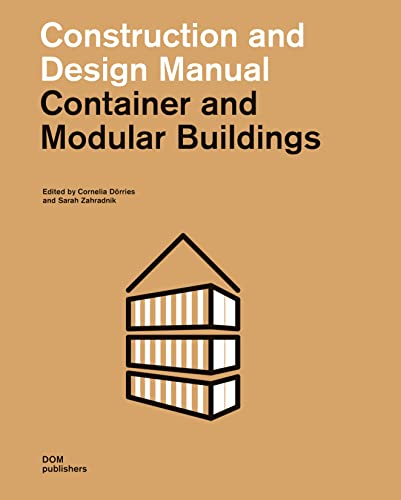

Container and modular buildings / edited byCornelia Dörries and Sarah Zahradnik. txt
Series Construction and Design Manual. Container and modular buildingsBerlín DOM Publishers 2019Descripción: 255 p. ill.; photo.; plans.; col. 29 cmTipo de contenido:- text
- unmediaded
- volume
- 9783869223018
- 3869223014
- 712.02
- NA2542.4 D67 2019
| Imagen de cubierta | Tipo de ítem | Biblioteca actual | Biblioteca de origen | Colección | Ubicación en estantería | Signatura topográfica | Materiales especificados | Info Vol | URL | Copia número | Estado | Notas | Fecha de vencimiento | Código de barras | Reserva de ítems | Prioridad de la cola de reserva de ejemplar | Reservas para cursos | |
|---|---|---|---|---|---|---|---|---|---|---|---|---|---|---|---|---|---|---|
| Libro | CARIBET Biblioteca Arquitectura Colección General CARIBET | General NA2542.4 D67 2019 (Navegar estantería(Abre debajo)) | 1 | Disponible | 91000000063289 |
Descripciones mejoradas de Syndetics:
Prefabricated housing is a pressing issue--for those looking for affordable homes as well as for refugees fleeing wars or natural disasters. In common with politicians, architects were caught unawares by the largest wave of migration since the end of the Second World War. However, are tent cities and containers the best solution for cheap, dignified, and quickly assembled accommodation for displaced persons? This challenging situation, along with the changing urban landscape, with its ever diminishing space, calls into question existing standards in relation to serial housing. Bold and unconventional ideas are called for if architects are to offer high-quality solutions.
From eccentric experiments all the way to projects that have already been realized, international design teams present their work between the twin poles of unconventional developments and life-saving shelters in this volume spanning more than 250 pages. Introduced with articles on design principles, and divided into three sections according to the form the structures take when delivered - cuboid, panels and custom units - the book covers everything from playful follies to architectural constructions for the homeless and outpatient medical stations which offer a response to social problems and space shortages. The text, photographs and plans put forward ideas as to how more can be done than the mere assembling of containers. Should we not first consider notions bordering on the absurd in order to come up with workable solutions for housing today?
Includes bibliographical references.
Introduction -- The new system theory -- Architecture in the spirit of prefabrication, Cornelia Dörries -- Making containers -- Production, transport and assembly, Sarah Zahradnik -- Typologies and design parameters -- Ten parameters of architectural design, Philipp Meuser -- Fundamentals of construction techniques -- Wood / Concrete / Steel, Jutta Albus -- Buildings and Projects -- Cuboid -- Triskelion -- Container House -- The Quik House -- Casa Oruga -- Push Button House 1 -- Cuboid -- Man -- Devil’s Corner -- Plug-In House -- Universal Rooms -- Tuk -- Asylum Camp Tübingen -- Asylum Camp Havelland -- Schleich Office -- Koda -- Maxmodul System -- Panels -- $1,000 House -- Kindergarten Prototype -- Staff Quarters Nouakchott -- Solar House -- Haus 4.0 -- Custom Units -- Rolling Master Plan -- Sleepbox -- Ecounit -- Mercury House One -- Mercury House Two.
Prefabricated housing is a pressing issue?-?for those looking for affordable homes as well as for refugees fleeing wars or natural disasters. In common with politicians, architects were caught unawares by the largest wave of migration since the end of the Second World War. However, are tent cities and containers the best solution for cheap, dignified, and quickly assembled accommodation for displaced persons? This challenging situation, along with the changing urban landscape, with its ever-diminishing space, calls into question existing standards in relation to serial housing. Bold and unconventional ideas are called for if architects are to offer high-quality solutions. From eccentric experiments all the way to projects that have already been realized, international design teams present their work between the twin poles of unconventional developments and life-saving shelters in this volume spanning more than 250 pages. Introduced with articles on design principles, and divided into three sections according to the form the structures take when delivered - cuboid, panels and custom units - the book covers everything from playful follies to architectural constructions for the homeless and outpatient medical stations which offer a response to social problems and space shortages. The text, photographs and plans put forward ideas as to how more can be done than the mere assembling of containers. Should we not first consider notions bordering on the absurd in order to come up with workable solutions for housing today?