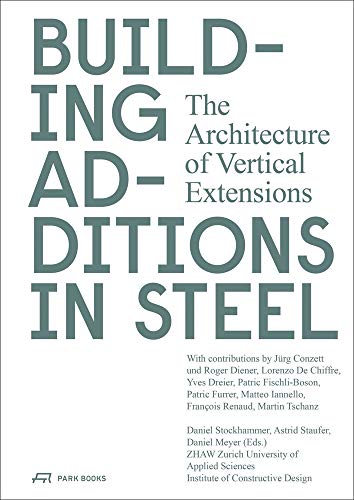

Building additions in steel : the architecture of vertical extensions. Daniel Stockhammer, Astrid Staufer, Daniel Meyer (eds.) ; ZHAW Zurich University of Applied Sciences Institute of Constructive Design ; with contributions by Jürg Conzett [and 8 others] ; translation into English, David Haney, Ian Pepper, Thomas Skelton-Robinson. txt
Zurich, Switzerland : Park Books 2019Descripción: 168 p. : ill.; photo.; col.; plans ; 24 cmTipo de contenido:- text
- unmediaded
- volume
- 9783038601463
- 3038601462
- 23 693.71
- NA4135 B85 2019
| Imagen de cubierta | Tipo de ítem | Biblioteca actual | Biblioteca de origen | Colección | Ubicación en estantería | Signatura topográfica | Materiales especificados | Info Vol | URL | Copia número | Estado | Notas | Fecha de vencimiento | Código de barras | Reserva de ítems | Prioridad de la cola de reserva de ejemplar | Reservas para cursos | |
|---|---|---|---|---|---|---|---|---|---|---|---|---|---|---|---|---|---|---|
| Libro | CARIBET Biblioteca Arquitectura Colección General CARIBET | General NA4135 B85 2019 (Navegar estantería(Abre debajo)) | 1 | Disponible | 91000000062992 |
Descripciones mejoradas de Syndetics:
Since the introduction of steel as a building material in the early twentieth century, its superior performance has challenged conventional wisdom about construction, enabling designs of surprising lightness and span. Steel offered the opportunity to significantly expand buildings vertically and thus emerged as a symbol of the conflict between technological progress and the architectural ideal. More recently, the use of exposed steel elements in modern architecture ushered in a rediscovery of buildings' metamorphoses.
Building Additions in Steel looks at the largely ignored topic of steel additions in architecture and engineering, documenting an ambitious, interdisciplinary research project by architects, engineers, teachers, and students at the Zurich University of Applied Sciences, Institute of Constructive Design. The book offers basic theoretical and technical information on a selection of outstanding steel additions alongside more than one hundred illustrations, including plans and photographs.
Includes bibliographical references.
Acknowledgments Oya Atalay Franck --
Foreword François Renaud --
Vertical Extension as Concept and Construct: From an Ideal of Completion to Reforming Existing Structures Daniel Stockhammer --
COMPOUNDING OF EPOCHS --
Geneva–for Centuries, an Experimental Laboratory for Vertical Urban Development Yves Dreier --
New Construction Dressed in an Old Coat: Philipp Jakob Manz's "Lightning Architecture" for the Salamander Shoe Factory in Kornwestheim, 1927 Daniel Stockhammer --
PROCESSES OF REPLACEMENT --
Constructing Vertical Extensions- Reassessing Italian Postwar Modernism Matteo Iannello --
Design through Constructive Thinking: The Extension of the Faculty of Architecture in Hannover by Friedrich Spengelin and Horst Wunderlich (1961–1966) Daniel Stockhammer
--TECHNOLOGICAL EUPHORIA --
The Psychology of the High-Flyer- On the Vertical Extension of Vienna since Deconstructivism Lorenzo De Chiffre --
Taming the Future in the Tube: The Design for the Extension of the Kunst- akademie Düsseldorf by Karl Wimmenauer, Lyubo-Mir Szabo, and Ernst Kasper in 1968 Martin Tschanz --
REDISCOVERY OF METAMORPHOSIS --
Forme forte and the Picturesque Manner of Vertical Extension at the Turn of the Millennium Patric Furrer --
History of Mining, Mining of History: The Design for the Reconstruction of the Zollverein Coal Mine, Shaft XII Jürg Conzett and Roger Diener --
HOW TO BUILD ON? --
Ways towards Ambiguity and Multivalence Astrid Staufer --
On the New Potentials of Steel Construction Patric Fischli-Boson
Since the introduction of steel as a building material in the early twentieth century, its superior performance has challenged conventional wisdom about construction, enabling designs of surprising lightness and span. Steel offered the opportunity to significantly expand buildings vertically and thus emerged as a symbol of the conflict between technological progress and the architectural ideal. More recently, the use of exposed steel elements in modern architecture ushered in a rediscovery of buildings' metamorphoses.
Building Additions in Steel looks at the largely ignored topic of steel additions in architecture and engineering, documenting an ambitious, interdisciplinary research project by architects, engineers, teachers, and students at the Zurich University of Applied Sciences, Institute of Constructive Design. The book offers basic theoretical and technical information on a selection of outstanding steel additions alongside more than one hundred illustrations, including plans and photographs.