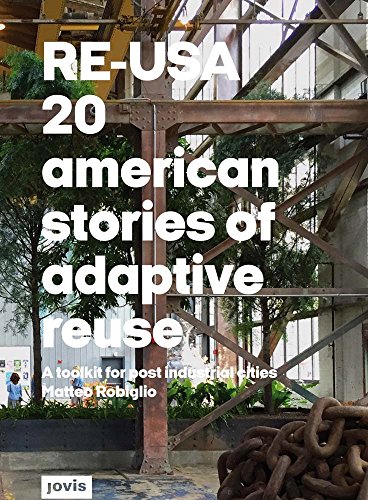

RE-USA 20 American stories of adaptive reuse, a toolkit for post-industrial cities Matteo Robiglio ; foreword by Donald K. Carter. txt
Berlin Jovis Verlag GmbH 2017Descripción: 238 p. ill.; photo.; map; plans; col. 20 cmTipo de contenido:- text
- unmediaded
- volume
- 9783868594737
- 3868594736
- RE-USA 20 American stories of adaptive reuse txt
- RE-USA Twenty American stories of adaptive reuse txt
- City planning -- Chicago, Illinois. -- Washington D.C. -- Philadelphia, Pennsylvania. -- Pittsburgh, Pennsylvania. -- New York. -- Detroit, Michigan
- Community development -- Chicago, Illinois. -- Washington D.C. -- Philadelphia, Pennsylvania. -- Pittsburgh, Pennsylvania. -- New York. -- Detroit, Michigan
- Urban renewal -- Chicago, Illinois. -- Washington D.C. -- Philadelphia, Pennsylvania. -- Pittsburgh, Pennsylvania. -- New York. -- Detroit, Michigan
- Architecture and Planning
- City planning
- Community development
- Urban renewal
- Illinois -- Chicago
- Detroit -- Michigan
- New York Region
- Philadelphia -- Penssylvania
- Pittsburgh Pa. -- Penssylvania
- Washington (D.C.)
- 23 720
- NA9031 R63 2017
| Imagen de cubierta | Tipo de ítem | Biblioteca actual | Biblioteca de origen | Colección | Ubicación en estantería | Signatura topográfica | Materiales especificados | Info Vol | URL | Copia número | Estado | Notas | Fecha de vencimiento | Código de barras | Reserva de ítems | Prioridad de la cola de reserva de ejemplar | Reservas para cursos | |
|---|---|---|---|---|---|---|---|---|---|---|---|---|---|---|---|---|---|---|
| Libro | CARIBET Biblioteca Arquitectura Colección General CARIBET | General NA9031 R63 2017 (Navegar estantería(Abre debajo)) | 1 | Disponible | 91000000062109 |
Descripciones mejoradas de Syndetics:
Featuring case studies in Philadelphia, Washington DC, Pittsburgh, Chicago, Detroit and New York, RE USA offers inspiration and guidance for how cities can use their industrial legacies for innovative development
As the global economy has changed over the past decades, it has left an architectural legacy of abandoned factories, warehouses and docks in its wake. But these spaces need not remain empty; the history of post-industrial society is still being written. All over the world, abandoned industrial infrastructure is being creatively repurposed. Culture, leisure, sport, research, education, design, services, production, housing and even agriculture are finding new spaces, and, in the process, breathing life back into abandoned factories and their surrounding communities. Known as adaptive reuse, this process can occur at grassroots and official levels alike, sparked by whoever feels the power of the industrial past and dares to imagine a future for its legacy--whether it's professionals, activists, decision-makers, entrepreneurs or committed citizens.
RE-USA provides a toolkit for adaptive reuse grounded in practical examples. Cities and cases are selected to illustrate the power of innovative processes and projects based on private-public partnerships, bottom-up initiatives, community involvement and smart design despite difficult conditions, from declining demography to weak real estate values and scarce investment.
Looking at the different ways several major post-industrial cities in the United States have tackled these challenges, architect Matteo Robiglio develops an eight-step procedure for making adaptive reuse work. Featuring case studies in New York (the High Line, Brooklyn Bridge Park), Philadelphia (Urban Outfitters at Navy Yard, Onion Flats), Washington, DC (Union Market), Pittsburgh (Ohiopyle, Monongahela, Bakery Square, Penn Street, Keystone Commons), Chicago (The Plant, 606, Rebuilding Exchange) and Detroit (Shinola headquarters, Slow BBQ, Eastern Market, Russell, Packard, Charlie O'Green), RE-USA offers inspiration and guidance for how cities can use their industrial legacies for innovative future development.
Part one 20 american stories of adaptive reuse
Philadelphia
1. Rebranding the Navy Yard
2. Urban acupuncture in Fishtown
Washington, D.C.
3. The capital's new food chain
Pittsburgh
4. Rust and hope in the Mon Valley
5. The cathedral of electrics
6. From biscuits to bits at Bakery Square
7. Penn Avenue, one plot at a time
8. Food drives reuse on the Strip
9. Robots in the steel mill
Chicago
10. The Plan(t) to feed the city
11. Inclusion and leisure along the 606
12. Stuff to reuse at Rebuilding Exchange
13. The proudest home in town
Detroit
14. Russell's creative outlaws
15. The jobs of Shinola
16. BBQ remaking Corktown
17. The art of reuse in Klinger Street
18. Packard, or the next big thing
New York
19. High-end along the High Line
20. The people of Brooklyn Bridge
Part two The adaptive reuse toolkit
a. Explore possibilities
b. Assess potential
c. Envision the future
d. Involve partners
e. Colonize the place
f. Design to reuse
g. Placemaking and funding
h. Run and evolve
Part three Adaptive reuse architecture
Old is the new new. Architecture and the adaptive reuse of industrial legacy
Adaptive reuse architecture: selected readings and timeline by Elena Vigliocco
"Based on best-practice examples in American cities such as Detroit, New York, or Pittsburgh, this book shows successful cases of adaptive reuse that preserve the legacy of the industrial past while turning it into a key ingredient for urban regeneration. An aquaponics farm in a former meatpacking facility or a freight train railroad converted into a linear park: these are just two successful examples of the creative and effective reuse of abandoned industrial infrastructure. Culture, leisure, sport, research, education, design, services, production, housing, and even agriculture regenerate former factory sites and upgrade cities economically and culturally. Eight steps guide the way through the process of adaptive reuse-from choosing an existing site to the vision, design, and funding, and finally their implementation. Professionals, activists, decision-makers, as well as entrepreneurs and committed citizens worldwide are therefore provided with a practical toolkit to discovering the unused potential of their city."--Site web de l'éditeur.