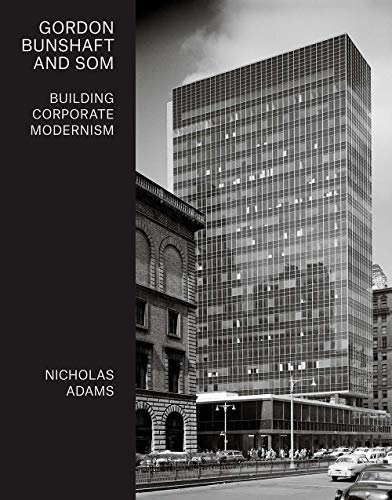

Gordon Bunshaft and SOM : building corporate modernism Nicholas Adams. txt
Editor: New Haven, CT : Yale University Press, 2019Descripción: 288 p. ill.; col.; plans; photo 30 cmTipo de contenido:- text
- unmediated
- volume
- 9780300227475
- 0300227477
- 724.6
- NA680 A33 2019
| Imagen de cubierta | Tipo de ítem | Biblioteca actual | Biblioteca de origen | Colección | Ubicación en estantería | Signatura topográfica | Materiales especificados | Info Vol | URL | Copia número | Estado | Notas | Fecha de vencimiento | Código de barras | Reserva de ítems | Prioridad de la cola de reserva de ejemplar | Reservas para cursos | |
|---|---|---|---|---|---|---|---|---|---|---|---|---|---|---|---|---|---|---|
| Libro | CARIBET Biblioteca Arquitectura Colección General CARIBET | General NA680 A33 2019 (Navegar estantería(Abre debajo)) | 1 | Disponible | 91000000061812 |
Descripciones mejoradas de Syndetics:
A nuanced portrait of the 20th-century architect whose work defined the built aesthetic of corporate America
Gordon Bunshaft's (1909-1990) landmark 1952 design for Lever House reshaped the Manhattan skyline and elevated the reputation of Skidmore, Owings & Merrill (SOM), the firm where he would spend more than 40 years as a partner. Although this enigmatic architect left behind few records, his legacy endures in the corporate headquarters, museums, and libraries that were built in his distinctive modernist style. Bunshaft's career was marked by shifts in material. Glass and steel structures of the 1950s, such as New York's Chase Manhattan Bank, gave way to revolutionary designs in concrete, such as the Beinecke Rare Book and Manuscript Library at Yale University and the doughnut-shaped Hirshhorn Museum in Washington, DC. Bunshaft's collaborations with artists, including Isamu Noguchi, Jean Dubuffet, and Henry Moore, were of paramount importance throughout his career.
Nicholas Adams explores the contested line between Bunshaft's ambition for acclaim as a singular artistic genius and the collaborative structure of SOM's architectural partnership. Bunshaft received the Pritzker Architecture Prize in 1988 and remains the only SOM partner to have achieved this distinction. Adams counters Bunshaft's maxim that "the building speaks for itself" with necessary critical context about this modernist moment at a time when the future of Bunshaft's iconic works is very much in question.
Include index (280-288p.)
Inlcude bibliography 278p.
Gordon Bunshaft's (1909-1990) landmark 1952 design for Lever House reshaped the Manhattan skyline and elevated the reputation of Skidmore, Owings & Merrill (SOM), the firm where he would spend more than 40 years as a partner. Although this enigmatic architect left behind few records, his legacy endures in the corporate headquarters, museums, and libraries that were built in his distinctive modernist style. Bunshaft's career was marked by shifts in material. Glass and steel structures of the 1950s, such as New York's Chase Manhattan Bank, gave way to revolutionary designs in concrete, such as the Beinecke Rare Book and Manuscript Library at Yale University and the doughnut-shaped Hirshhorn Museum in Washington, DC. Bunshaft's collaborations with artists, including Isamu Noguchi, Jean Dubuffet, and Henry Moore, were of paramount importance throughout his career. Nicholas Adams explores the contested line between Bunshaft's ambition for acclaim as a singular artistic genius and the collaborative structure of SOM's architectural partnership. Bunshaft received the Pritzker Architecture Prize in 1988 and remains the only SOM partner to have achieved this distinction. Adams counters Bunshaft's maxim that "the building speaks for itself" with necessary critical context about this modernist moment at a time when the future of Bunshaft's iconic works is very much in question.