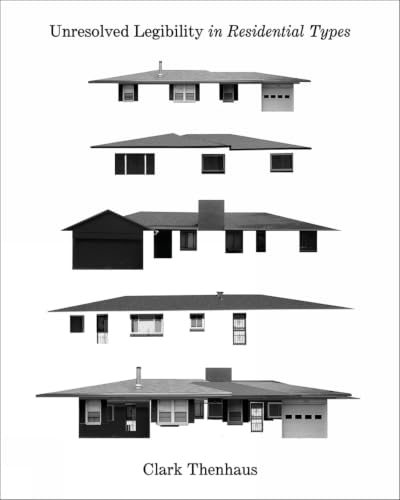

Unresolved legibility : in residential types. / Clark Thenhaus ; edited by Ryan Roark. txt
San Francisco : Applied Research and Design Publishing, an imprint of ORO Editions , 2019Edición: 1st edDescripción: 219 p. ill. ;plans. ;photo. ; 26 cmTipo de contenido:- text
- unmediaded
- volume
- 9781943532391
- 1943532397
- 23 728.370222
- NA7205 T44 2019
| Imagen de cubierta | Tipo de ítem | Biblioteca actual | Biblioteca de origen | Colección | Ubicación en estantería | Signatura topográfica | Materiales especificados | Info Vol | URL | Copia número | Estado | Notas | Fecha de vencimiento | Código de barras | Reserva de ítems | Prioridad de la cola de reserva de ejemplar | Reservas para cursos | |
|---|---|---|---|---|---|---|---|---|---|---|---|---|---|---|---|---|---|---|
| Libro | CARIBET Biblioteca Arquitectura Colección General CARIBET | General NA7205 T44 2019 (Navegar estantería(Abre debajo)) | 1 | Disponible | 91000000061614 |
Descripciones mejoradas de Syndetics:
Architectural legibility requires both visual clarity of a building's appearance such that its formal, spatial, and material compositions can be comprehended, as well as a certain clarity of its social, cultural, and political histories. While the term legibility carries a connotation of conclusiveness or objective qualifications, legibility in architecture is most often inconclusive and unresolved. Such unresolved legibility is particularly visible in houses, which are the source of inquiry in this project. This book proposes new understandings and interpretations of American residential architecture by investigating and graphically illustrating the forms, spaces, and histories of ten residential types.Perhaps no genre of architecture has been written about more than 'the house'. As long-standing subjects of architectural discourse, cultural reflection, and experimentation, houses represent a confluence of architectural and broader cultural phenomena. The house is not only susceptible to, but in fact requires renewal and re-imagination; as an architectural type it reflects shifting societal values and the constant reconstruction of meaning that this shifting entails. Such social, cultural, political and contextual circumstances can best be evaluated under the rubric of legibility. While this might at first seem like an objective undertaking, legibility in architecture is indeterminate and unresolved, revealing the intertwining of architectural expressions with broader cultural circumstances.
Include Bibliography
An introduction to unresolved legibility in residential types --
Character & contradiction in cabin architecture --
Context-amending & context-offending in the mountain house --
Dramas of the Purlieu & Strange frontality in the farmhouse --
Odd façades & social transformation in the Queen Anne house --
Kit homes & the mathematics of the American foursquare --
Receding façades & traditional cosmetics in the ranch house --
Parenthetical & hyphenated symmetry in the federal-style house --
Points, partitions, rooms & enfilades (or not) in the shotgun house --
Party walls & other interiors in the row house --
Mixed-up stacks & cut corners in mixed-use --
Disciplinary whimsy & darlings.
Architectural legibility requires both visual clarity of a buildings appearance such that its formal, spatial, and material compositions can be comprehended, as well as a certain clarity of its social, cultural, and political histories. While the term legibility carries a connotation of conclusiveness or objective qualifications, legibility in architecture is most often inconclusive and unresolved. Such unresolved legibility is particularly visible in houses, which are the source of inquiry in this project.
This book proposes new understandings and interpretations of American residential architecture by investigating and graphically illustrating the forms, spaces, and histories of ten residential types. Perhaps no genre of architecture has been written about more than "the house." As long-standing subjects of architectural discourse, cultural reflection, and experimentation, houses represent a confluence of architectural and broader cultural phenomena. The house is not only susceptible to, but in fact requires renewal and re-imagination; as an architectural type it reflects shifting societal values and the constant reconstruction of meaning that this shifting entails. Such social, cultural, political, and contextual circumstances can best be evaluated under the rubric of legibility. While this might at first seem like an objective undertaking, legibility in architecture is indeterminate and unresolved, revealing the intertwining of architectural expressions with broader cultural circumstances.