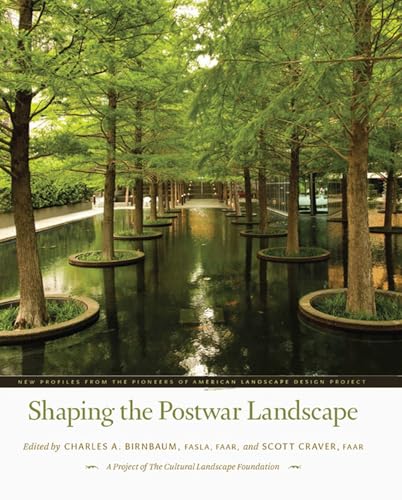

Shaping the postwar landscape new profiles from the pioneers of the American Landscape Design Project edited by Charles A. Birnbaum, FASLA, FAAR, and Scott Craver, FAAR. txt
Editor: Charlottesville : University of Virginia Press, 2018Edición: First Published 2018Descripción: xv, 248 p. : ill.; col.; 25 cmTipo de contenido:- text
- unmediated
- volume
- 9780813941738
- 0813941733
- 23 712.092/273
- SB469.9 S53 2018
| Imagen de cubierta | Tipo de ítem | Biblioteca actual | Biblioteca de origen | Colección | Ubicación en estantería | Signatura topográfica | Materiales especificados | Info Vol | URL | Copia número | Estado | Notas | Fecha de vencimiento | Código de barras | Reserva de ítems | Prioridad de la cola de reserva de ejemplar | Reservas para cursos | |
|---|---|---|---|---|---|---|---|---|---|---|---|---|---|---|---|---|---|---|
| Libro | CARIBET Biblioteca Arquitectura Colección General CARIBET | General SB469.9 S53 2018 (Navegar estantería(Abre debajo)) | 1 | Disponible | 91000000060921 |
Descripciones mejoradas de Syndetics:
Shaping the Postwar Landscape is the latest contribution to the Cultural Landscape Foundation?s well-known reference project, Pioneers of American Landscape Design, the first volume of which appeared nearly a quarter of a century ago. The present collection features profiles of seventy-two important figures, including landscape architects, architects, planners, artists, horticulturists, and educators.
The volume focuses principally on individuals whose careers reached their height during the period between the end of World War II and the American Bicentennial. In that postwar era, landscape architects played an important part in the revitalization of American cities, introducing new typologies for public spaces in the civic realm. Among these were parks that capped freeways, plazas and gardens atop buildings, promenades on revitalized waterfronts, "vest pocket" parks on tiny urban plots and derelict sites, and pedestrian-friendly downtown malls. Practitioners were also active on the new suburban frontier, their influence extending as far as Levittown and mobile-home communities. They created new outdoor living environments tailored to the California climate, and their work shaped landscaped in the American South, East, West, and Heartland.
At a time when interest in midcentury architecture is flourishing, Shaping the Postwar Landscape offers a substantial parallel contribution to the field of landscape studies. It belongs not only on the bookshelves of serious students and scholars but in the office of every landscape architect sensitive to significant works of the recent past.
"A project of The Cultural Landscape Foundation."
Includes bibliographical references and index.
"'Shaping the Postwar Landscape' is the latest contribution to the Cultural Landscape Foundation's well-known reference project, Pioneers of American Landscape Design, the first volume of which appeared nearly a quarter of a century ago. The present collection features profiles of seventy-two important figures, including landscape architects, architects, planners, artists, horticulturists, and educators. The volume focuses principally on individuals whose careers reached their height during the period between the end of World War II and the American Bicentennial. In that postwar era, landscape architects played an important part in the revitalization of American cities, introducing new typologies for public spaces in the civic realm. Among these were parks that capped freeways, plazas and gardens atop buildings, promenades on revitalized waterfronts, 'vest pocket' parks on tiny urban plots and derelict sites, and pedestrian-friendly downtown malls. Practitioners were also active on the new suburban frontier, their influence extending as far as Levittown and mobile-home communities. They created new outdoor living environments tailored to the California climate, and their work shaped landscaped in the American South, East, West, and Heartland. At a time when interest in midcentury architecture is flourishing, 'Shaping the Postwar Landscape' offers a substantial parallel contribution to the field of landscape studies. It belongs not only on the bookshelves of serious students and scholars but in the office of every landscape architect sensitive to significant works of the recent past"--
Reseñas proporcionadas por Syndetics
CHOICE Review
This is the fifth volume that Birnbaum (Cultural Landscape Foundation) and colleagues have published on the work of American landscape architects. Concentrating now on post--WW II designers involves some overlap with the earlier Shaping the American Landscape (2009). This new volume features over 60 landscape architects; only 16 are alive (at the time of publication). Sixty-four contributors supplied the profiles, nine pages of American sites accessible to the public are appended, and the text has many color and black-and-white images. The more interesting of those are original drawings and photographs, some of work that has been lost; portraits of the designers themselves seem far less valuable--it is the work that matters nowadays. There are famous names, well known even to those not specifically concerned with landscape design; but for specialists there are still plenty of surprises to enlarge one's apprehension of the field. Landscape design has always been of international scope, and these days more so. So perhaps another volume could be devoted to international connections between contemporary American practitioners and foreign colleagues--foreign places where Americans have designed or even foreign designers who have made their mark here. Summing Up: Recommended. Advanced undergraduates through faculty and professionals; general readers. --John Dixon Hunt, emeritus, University Of PennsylvaniaNotas de autor provistas por Syndetics
Charles A. Birnbaum, founder, president, and CEO of The Cultural Landscape Foundation, is the editor of Shaping the American Landscape (Virginia), among many other volumes. He is a Fellow of the American Society of Landscape Architects, which in 2017 awarded him the ASLA Medal, its highest honor. He is also a Fellow of the American Academy in Rome. Scott Craver, Ph.D., is the editorial director of the Cultural Landscape Foundation and a Fellow of the American Academy in Rome.