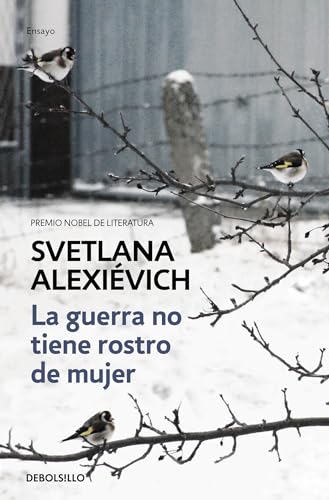

La guerra no tiene rostro de mujer / Svetlana Alexévich ; tradución de Yulia Dobrovolskaia y Zahara García González.
Penguin Random House Grupo Editorial, 2017 Barcelona :Descripción: 365 páginas ; 19 cmTipo de contenido:- 9788466338844
- 940.534709252 A384v E
- Premio Nobel de Literatura
| Imagen de cubierta | Tipo de ítem | Biblioteca actual | Biblioteca de origen | Colección | Ubicación en estantería | Signatura topográfica | Materiales especificados | Info Vol | URL | Copia número | Estado | Notas | Fecha de vencimiento | Código de barras | Reserva de ítems | Prioridad de la cola de reserva de ejemplar | Reservas para cursos | |
|---|---|---|---|---|---|---|---|---|---|---|---|---|---|---|---|---|---|---|
| Libro | Biblioteca Mons. Iñaki Mallona (Arecibo) Colección General ab | 940.534709252 A384v E (Navegar estantería(Abre debajo)) | 1 | Disponible | 60000010165808 |
Descripciones mejoradas de Syndetics:
Una historia oral innovadora de mujeres en la Segunda Guerra Mundial en Europa y Rusia, del ganador del Premio Nobel de Literatura
NOMBRADO UNO DE LOS MEJORES LIBROS DEL AÑO POR The Washington Post * The Guardian * NPR * The Economist * Milwaukee Journal Sentinel * Revisiones de Kirkus
Durante más de tres décadas, Svetlana Alexievich ha sido la memoria y la conciencia del siglo XX. Cuando la Academia Sueca le otorgó el Premio Nobel, citó su invención de " un nuevo tipo de género literario", describiendo su trabajo como "una historia de emociones". . . una historia del alma ".
En La guerra no tiene rostro de mujer, Alexievich narra las experiencias de las mujeres soviéticas que lucharon en el frente, en el frente de casa y en los territorios ocupados. Estas mujeres, más de un millón en total, eran enfermeras y doctoras, pilotos, conductoras de tanques, ametralladoras y francotiradores. Lucharon junto a los hombres y, sin embargo, después de la victoria, sus esfuerzos y sacrificios fueron olvidados.
Alexievich viajó miles de millas y visitó más de cien ciudades para registrar las historias de estas mujeres. En conjunto, esta sinfonía de voces revela un aspecto diferente de la guerra: los detalles cotidianos de la vida en combate que quedan fuera de las historias oficiales.
«[...] por su escritura polifónica, que es un monumento al valor y al sufrimiento en nuestro tiempo.»
Jurado de la Academia Sueca al otorgar a la autora el Premio Nobel de Literatura 2015.
Reseña:
«Gracias a Alexiévich, la historia de un millón de mujeres que participaron en el ejército soviético o como partisanas contra los alemanes es algo menos desconocida.»
Felipe Sahagún, El Cultural de El Mundo
«De la lectura de los libros de Alexiévich (Stanislaviv, 1948) no es posible salir indemne.»
Gabriel Albiac, ABC Cultural
ENGLISH DESCRIPTION
A groundbreaking oral history of women in World War II across Europe and Russia--from the winner of the Nobel Prize in Literature
NAMED ONE OF THE BEST BOOKS OF THE YEAR BY
The Washington Post * The Guardian * NPR * The Economist * Milwaukee Journal Sentinel * Kirkus Reviews
For more than three decades, Svetlana Alexievich has been the memory and conscience of the twentieth century. When the Swedish Academy awarded her the Nobel Prize, it cited her invention of "a new kind of literary genre," describing her work as "a history of emotions . . . a history of the soul."
In The Unwomanly Face of War, Alexievich chronicles the experiences of the Soviet women who fought on the front lines, on the home front, and in the occupied territories. These women--more than a million in total--were nurses and doctors, pilots, tank drivers, machine-gunners, and snipers. They battled alongside men, and yet, after the victory, their efforts and sacrifices were forgotten.
Alexievich traveled thousands of miles and visited more than a hundred towns to record these women's stories. Together, this symphony of voices reveals a different aspect of the war--the everyday details of life in combat left out of the official histories.
Premio Nobel de Literatura
Notas de autor provistas por Syndetics
Svetlana Alexievich was born in Stanislav, Ukraine, Soviet Union on May 31, 1948. She became a journalist and wrote narratives from interviews with witnesses to events such as World War II, the Soviet-Afghan war, the fall of the Soviet Union, and the Chernobyl disaster. Her books include Zinky Boys: Soviet Voices from the Afghanistan War and War's Unwomanly Face. She won the National Book Critics Circle Award in 2005 for Voices from Chernobyl: The Oral History of a Nuclear Disaster and the 2015 Nobel Prize in Literature.(Bowker Author Biography)