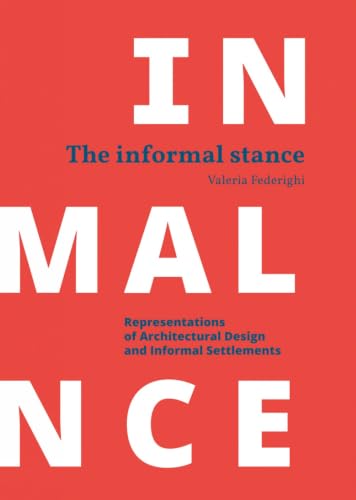

The informal stance : representations of architectural design and informal settlements / Valeria Federighi txt
[San Francisco Bay Area] Applied Research and Design Publishing, an imprint of Oro Editions 2018Edición: First editionDescripción: Pages: 255 illustrations; Maps; plans 24 cmTipo de contenido:- text
- unmediated
- volume
- 9781940743394
- NA2542.4 F43 2018
| Imagen de cubierta | Tipo de ítem | Biblioteca actual | Biblioteca de origen | Colección | Ubicación en estantería | Signatura topográfica | Materiales especificados | Info Vol | URL | Copia número | Estado | Notas | Fecha de vencimiento | Código de barras | Reserva de ítems | Prioridad de la cola de reserva de ejemplar | Reservas para cursos | |
|---|---|---|---|---|---|---|---|---|---|---|---|---|---|---|---|---|---|---|
| Libro | CARIBET Biblioteca Arquitectura Colección General CARIBET | General NA2542.4 F43 2018 (Navegar estantería(Abre debajo)) | 1 | Disponible | 91000000059568 |
Descripciones mejoradas de Syndetics:
This book looks to the moment of encounter between architectural design and informal settlements as the most extreme demonstration of an increasingly evident disciplinary fascination for urban informality. It is an enduring fascination, arising from the need to test the boundaries of the discipline in the hope of finding it adaptable to change and willing to adapt. It is also a fascination that feeds off the gap that exists between the search for a renewed relevance of disciplinary tools, and the wider loss of faith in the project as a way to envision societal change. In fact, such fascination is played out within a seemingly structural contradiction: informal settlements originate as the effect of economic and political strategies that are deployed at the global scale; conversely, when dealing with informality, architecture searches for legitimization at the very small scale of the tactical and ultralocal. A relationship of inverse proportion is in place, between the constrained scope of architectural design and the scale of the issues it sets out to address.
This book looks to the moment of encounter between architectural design and informal settlements as the most extreme demonstration of an increasingly evident disciplinary fascination for urban informality. It is an enduring fascination, arising from the need to test the boundaries of the discipline in the hope of finding it adaptable to change and willing to adapt. It is also a fascination that feeds off the gap that exists between the search for a renewed relevance of disciplinary tools, and the wider loss of faith in the project as a way to envision societal change. In fact, such fascination is played out within a seemingly structural contradiction: informal settlements originate as the effect of economic and political strategies that are deployed at the global scale; conversely, when dealing with informality, architecture searches for legitimization at the very small scale of the tactical and ultra-local. A relationship of inverse proportion is in place, between the constrained scope of architectural design and the scale of the issues it sets out to address
Include Index.
Tabla de contenidos provista por Syndetics
- Foreword(p. 8)
- Introduction(p. 10)
- Chapter 1 The construction of (renewed) disciplinary imaginaries(p. 28)
- Diachronic mapping: positioning discourse
- Synchronic mapping: positioning represented cases
- Worlding the informal city
- Two complementary stances: topographic representation and spatialized dynamics
- Chapter 2 Consolidation through reiteration: models of practice(p. 68)
- Diachronic mapping: positioning discourse
- Synchronic mapping: positioning represented cases
- Slum as discourse
- Spatialized dynamics
- Topographic representations
- Encompassed urbanism
- Chapter 3 Negotiating informal settlements: variation-finding strategies(p. 106)
- Diachronic mapping: positioning discourse
- Synchronic mapping: positioning represented cases
- Positioning discourse
- Informal cities writ large
- Informal: expanded meanings
- Legacy and open issues
- Chapter 4 The here and the now: architectural practice as defined through purpose and effect(p. 142)
- Diachronic mapping: positioning discourse
- Synchronic mapping: positioning represented cases
- Positioning Discourse
- Constructing a common past: informal as morphological and social
- Defining a common disciplinary identity
- Chapter 5 The problem of disciplinary relevance(p. 176)
- Diachronic mapping: positioning discourse
- Synchronic mapping: positioning represented cases
- Positioning discourse
- Spatial Agency
- Critical-Postcritical-Agency
- Disciplinary tools and boundaries
- Chapter 6 Representations as means to an end: deploying critical distance(p. 214)
- Diachronic mapping: positioning discourse
- Positioning discourse
- Synchronic mapping: positioning represented cases
- Overcoming the informal: constructing transversal disciplinary affiliations
- Deploying critical distance
- Conclusions(p. 246)