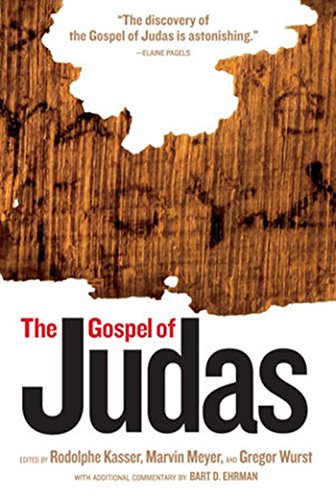

The gospel of Judas from Codex Tchacos / edited by Rodolphe Kasser, Marvin Meyer , and Gregor Wurst.
Washington , DC : National Geographic Society, 2006Descripción: 185[1] pages : illustrations ; 21cmTipo de contenido:- text
- unmediated
- volume
- 9781426200427
| Imagen de cubierta | Tipo de ítem | Biblioteca actual | Biblioteca de origen | Colección | Ubicación en estantería | Signatura topográfica | Materiales especificados | Info Vol | URL | Copia número | Estado | Notas | Fecha de vencimiento | Código de barras | Reserva de ítems | Prioridad de la cola de reserva de ejemplar | Reservas para cursos | |
|---|---|---|---|---|---|---|---|---|---|---|---|---|---|---|---|---|---|---|
| Libro | Biblioteca Encarnación Valdés Colección General bev | 229 G6767 2006 (Navegar estantería(Abre debajo)) | Disponible | 80000002562109 |
Descripciones mejoradas de Syndetics:
For 1,600 years its message lay hidden. When the bound papyrus pages of this lost gospel finally reached scholars who could unlock its meaning, they were astounded. Here was a gospel that had not been seen since the early days of Christianity, and which few experts had even thought existed-a gospel told from the perspective of Judas Iscariot, history's ultimate traitor. And far from being a villain, the Judas that emerges in its pages is a hero.
In this radical reinterpretation, Jesus asks Judas to betray him. In contrast to the New Testament Gospels, Judas Iscariot is presented as a role model for all those who wish to be disciples of Jesus. He is the one apostle who truly understands Jesus.
This volume is the first publication of the remarkable gospel since it was condemned as heresy by early Church leaders, most notably by St. Irenaeus, in 180. Hidden away in a cavern in Middle Egypt, the codex (or book) containing the gospel was discovered by farmers in the 1970s. In the intervening years the papyrus codex was bought and sold by antiquities traders, hidden away, and carried across three continents, all the while suffering damage that reduced much of it to fragments. In 2001, it finally found its way into the hands of a team of experts who would painstakingly reassemble and restore it.
The Gospel of Judas has been translated from its original Coptic in clear prose, and is accompanied by commentary that explains its fascinating history in the context of the early Church, offering a whole new way of understanding the message of Jesus Christ.
Includes bibliographical references (pages 179-181).
Tabla de contenidos provista por Syndetics
- Introduction(p. 1)
- The Gospel of Judas(p. 17)
- Commentary
- The Story of Codex Tchacos and the Gospel of Judas(p. 47)
- Christianity Turned on Its Head: The Alternative Vision of the Gospel of Judas(p. 77)
- Irenaeus of Lyon and the Gospel of Judas(p. 121)
- Judas and the Gnostic Connection(p. 137)
- Endnotes(p. 171)
- Selected Bibliography(p. 175)
- Publisher's Note(p. 179)
Reseñas proporcionadas por Syndetics
CHOICE Review
The National Geographic Society has a hit, or rather two hits, on its hands. Both books are certified best sellers, and the topics of televised specials, along with countless reviews, features, editorials, and Op-Eds. Many are aware of the cloak-and-dagger intrigue that accompanied the discovery and publication of the Gospel of Judas, and of the genuinely startling view it presents of the New Testament archvillain, Judas Iscariot. Since the volumes are reasonably priced and well written, they can be heartily recommended for purchase (preservation of the somewhat breathless attestations of the dust jackets is optional). What is left to ponder is the observation that libraries really do need to purchase both books, the result no doubt of deliberate calculations by National Geographic. In almost all respects, The Gospel of Judas contains everything readers could ask for, including the remarkably prompt publication of a translation of the gospel itself. (The speed of this enterprise--a matter of five years between the first scholarly contact with the document and the public appearance of a translation--contrasts starkly and very favorably with the more than 50 years separating the first discovery of the Dead Sea Scrolls and their complete publication.) This book offers succinct discussions about the modern uncovering of the gospel, its connections with ancient materials, and its "alternative vision" that turns Christianity "on its head."By contrast, The Lost Gospel is devoted almost entirely to the murky circumstances of the gospel's modern discovery and eventual publication. Although well crafted, the detailed narrative that Krosney (an independent scholar) presents is probably far more than most readers require. But this volume does contain a series of extraordinary color photographs that no reader will want to miss. Were they in The Gospel of Judas, readers might not need to purchase The Lost Gospel as well. A new book by Bart Ehrman (scheduled for 2006 publication) may combine all of these useful features. Finally, one might ask why, in all of these words, no place was found for any dissenting opinions--not about whether the gospel is authentically old (surely, it is), but whether its perspective, once branded heretical, deserves all of the attention being lavished upon it now. At this relatively late date in the publicity campaign, such arguments might be moot (or muted), but they also deserve a hearing. ^BSumming Up: Recommended. Both books. Lower-level undergraduates through faculty/researchers; general readers. L. J. Greenspoon Creighton UniversityNotas de autor provistas por Syndetics
Rodolphe Kasser, Ph.D., a professor emeritus on the Faculty of Arts at the University of Geneva, is one of the world's leading Coptologists. He has organized the restoration and prepared the editio princeps of Codex Tchacos, containing the Gospel of Judas and three other Coptic Gnostic texts.Marvin Meyer, Ph.D., Griset Professor of Bible and Christian Studies at Chapman University and Director of the Chapman University Albert Schweitzer Institute, is one of the foremost scholars on Gnosticism, the Nag Hammadi Library and texts about Jesus outside the New Testament.
Gregor Wurst, Ph.D., is professor of Ecclesiastical History and Patristics at the University of Augsburg, Germany.
Bart D. Ehrman, Ph.D., is the James A. Gray Distinguished Professor and Chair of the Department of Religious Studies, University of North Carolina at Chapel Hill, and an expert on early Christianity.