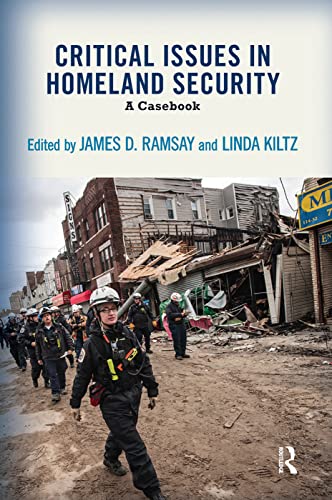

Critical issues in homeland security : a casebook / edited by James D. Ramsay, Embry-Riddle Aeronautical University, Linda A. Kiltz, Walden University.
Idioma: Español Editor: Boulder, Colorado : Westview Press, a member of the Perseus Books Group, ©2014Descripción: xiv, 368 pages : illustrations, maps ; 23 cmTipo de contenido:- text
- unmediated
- volume
- 9780813348278 (pbk.)
- 363.34/560973 23
- HV6432.4 R35 2014
| Imagen de cubierta | Tipo de ítem | Biblioteca actual | Biblioteca de origen | Colección | Ubicación en estantería | Signatura topográfica | Materiales especificados | Info Vol | URL | Copia número | Estado | Notas | Fecha de vencimiento | Código de barras | Reserva de ítems | Prioridad de la cola de reserva de ejemplar | Reservas para cursos | |
|---|---|---|---|---|---|---|---|---|---|---|---|---|---|---|---|---|---|---|
| Libro | Biblioteca Encarnación Valdés Colección General bev | 363.3456 C9343 (Navegar estantería(Abre debajo)) | Disponible | 80000002566373 |
Descripciones mejoradas de Syndetics:
Critical Issues in Homeland Security: A Casebook encourages analytical and careful examination of practical homeland security problems through the presentation of contemporary cases involving major state or national events. Case studies demonstrate the complexity of challenges within the domain of homeland security policy and administration. Editors James D. Ramsay and Linda Kiltz carefully curated fourteen cases, all from top scholars and practitioners, to cover a broad range of legal, policy, and operational challenges within the fieldof homeland security. Timely and interesting cases on such issues as arctic security, the use of drones in targeted killings, cyber security, and the emergency management lessons of the 2010 Haiti earthquake give students a deeper understanding of the relationship between the theories and the practices of homeland security. Discussion questions at the end of each case and an online instructor's manual make Critical Issues in Homeland Security an even more effective learning tool for any homeland security program.
Includes bibliographical references and index.
"Critical Issues in Homeland Security: A Casebook encourages analytical and careful examination of practical homeland security problems through the presentation of contemporary cases involving major state or national events. Case studies demonstrate the complexity of challenges within the domain of homeland security policy and administration. Editors James D. Ramsay and Linda Kiltz carefully curated fourteen cases, all from top scholars and practitioners, to cover a broad range of legal, policy, and operational challenges within the field of homeland security. Timely and interesting cases on such issues as arctic security, the use of drones in targeted killings, cyber security, and the emergency management lessons of the 2010 Haiti earthquake give students a deeper understanding of the relationship between the theories and the practices of homeland security. Discussion questions at the end of each case and an online instructor's manual make Critical Issues in Homeland Security an even more effective learning tool for any homeland security program"-- Provided by publisher.
Tabla de contenidos provista por Syndetics
- Foreword(p. ix)
- Acronyms(p. xi)
- Illustrations(p. xiii)
- Introduction(p. 1)
- Part I Legal and Policy Challenges in Homeland Security
- Chapter 1 Law and Policy(p. 9)
- Case 1.1 The Use of Drones in Counterterrorism: The Case of Anwar al-Awlaki(p. 11)
- Case 1.2 Presidential Declaration of Disaster Decisions: The Case of Turndowns(p. 35)
- Chapter 2 Terrorism(p. 73)
- Case 2.1 The 1993 World Trade Center Bombing: A Success or a Failure for the FBI?(p. 76)
- Case 2.2 Terrorist or Ecosaboteur? The Case of Briana Waters(p. 96)
- Chapter 3 Environmental Security(p. 118)
- Case 3.1 Arctic Security: Oil, Polar Bears, Melting Ice Caps, and US National Security(p. 121)
- Case 3.2 The Impact of Hurricane Katrina on the Environmental Security of the US Gulf Coast Region and Beyond(p. 150)
- Part II Operational Challenges in Homeland Security
- Chapter 4 Intelligence(p. 173)
- Case 4.1 The Attack on Mumbai, India(p. 176)
- Case 4.2 Using a Principal Agent in Intelligence Collection in Afghanistan(p. 192)
- Chapter 5 Critical Infrastructure Protection(p. 208)
- Case 5.1 Catastrophic Pandemic: Cases in Ethical Decision-Making(p. 211)
- Case 5.2 The Impact of Cyber-Security on Critical Infrastructure Protection: The Advanced Persistent Threat(p. 232)
- Chapter 6 Transportation Security(p. 253)
- Case 6.1 The Howard Street Tunnel Fire (Baltimore)(p. 255)
- Case 6.2 The Impact of the 9/11 World Trade Center Attack on Transportation(p. 276)
- Chapter 7 Emergency Management(p. 297)
- Case 7.1 The San Bruno Gas Pipeline Explosion(p. 300)
- Case 7.2 Lessons Learned from the 2010 Haiti Earthquake(p. 315)
- Conclusion(p. 329)
- Further Resources(p. 335)
- Acknowledgments(p. 340)
- About the Editors and Authors(p. 341)
- Index(p. 347)
Reseñas proporcionadas por Syndetics
CHOICE Review
Casebooks add to the body of knowledge of a field, and they are useful pedagogy. This casebook brings an array of new cases to the field of homeland security. It includes two particularly strong chapters: "Presidential Declaration of Disaster Decisions" and "Howard Street Tunnel Fire (Baltimore)." Richard Sylves, the acknowledged expert on presidential disaster declarations, provides a wealth of data and analysis to show how presidents use disaster declarations to bolster their political power. The Howard Street tunnel fire is a riveting account of how a simple train derailment in the wrong place turned into a frightening and costly disaster. Beyond these two chapters, there are the usual cases on topics such as terrorism, intelligence, critical infrastructure, transportation security, and emergency management. Less convincing is the attempt to break new ground by introducing cases that illustrate a new need--the need for environmental security. Whereas traditional homeland security analysts quite properly specify that to achieve homeland security there must be a response to natural disasters, these authors would stretch the homeland security mission to include the problem of melting polar ice caps. This is a bridge too far. --James A. Stever, University of CincinnatiNotas de autor provistas por Syndetics
James D. Ramsay is the chair of the department of Security Studies and International Affairs at Embry-Riddle Aeronautical University. Dr. Ramsay has published widely on environmental security, critical infrastructure protection and homeland security education. He serves on the editorial review boards for Homeland Security Affairs, the Journal of Homeland Security and Emergency Management and Journal of Homeland Security Education. He is also the coauthor, with Keith Gregory Logan, of Introduction to Homeland Security (Westview Press).Linda Kiltz is director of the master's programs in public administration, public policy, and science in nonprofit management and leadership at Walden University. Dr. Kiltz is the author of numerous articles in the Journal of Homeland Security and Emergency Management, Homeland Security Affairs Journal, and Journal of Homeland Security Education.