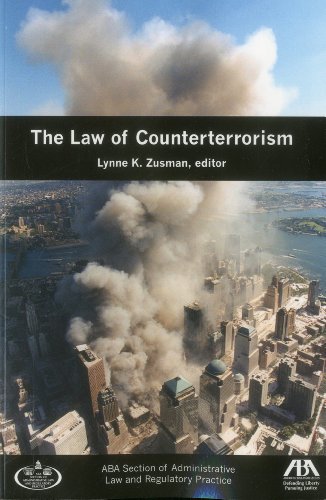

The law of counterterrorism Lynne K. Zusman, editor.
Detalles de publicación: Chicago, Ill. American Bar Association, Section of Administrative Law and Regulatory Practice c2011.Descripción: xxxi, 290 p. ill. 23 cmISBN:- 9781614380375 (pbk.)
- 1614380376 (pbk.)
- 344.7305/32517 23
- KF 9430 .L39 2011
| Imagen de cubierta | Tipo de ítem | Biblioteca actual | Biblioteca de origen | Colección | Ubicación en estantería | Signatura topográfica | Materiales especificados | Info Vol | URL | Copia número | Estado | Notas | Fecha de vencimiento | Código de barras | Reserva de ítems | Prioridad de la cola de reserva de ejemplar | Reservas para cursos | |
|---|---|---|---|---|---|---|---|---|---|---|---|---|---|---|---|---|---|---|
| Libro | Biblioteca de Derecho Mons. Fremiot Torres Oliver Colección General biblioteca derecho | KF 9430 .L39 2011 (Navegar estantería(Abre debajo)) | Disponible | 70000000894738 |
Descripciones mejoradas de Syndetics:
This important and ground-breaking work addresses the multiple facets of legal authority that affect our ability to fight transnational terrorism. Over the last decade, the American public has benefited from the work of many federal agencies. This book examines in detail the roles they play, the highly esoteric nature of counterterrorism law and the importance of adhering to the rule of law when engaged in counterterrorism.
Includes bibliographical references and index.
Combatants / W. Hays Parks -- NYPD : on the front line / Raymond W. Kelly -- Application of the advice of counsel defense in controversial cases / Gregory Huckabee and Michael Davidson -- The revolution of substantive criminal counterrorism law : "material support" and its philosophical underpinnings / Jeffrey Breinholt -- Detention and interrogation / Dick Jackson -- Military commissions / John Altenburg -- The 9/11 commission : "this is a new type of war" / Gordon Lederman -- Intelligence and the law : introduction to the legal and policy framework governing intelligence community counterterrorism efforts / W. George Jameson -- National security reform / Gordon Lederman -- Updating the counterterrorism toolkit : a brief sampling of Post-9/11 surveillance laws and authorities / Philip M. Bridwell and Jamil N. Jaffer.
Tabla de contenidos provista por Syndetics
- Background(p. iii)
- Words and Perspectives(p. v)
- Note from Editor and Dedication(p. xi)
- Acknowledgments(p. xiii)
- Foreword(p. xv)
- About the Editor(p. xxiii)
- About the Contributors(p. xxv)
- Chapter 1 Combatants(p. 1)
- Afghanistan(p. 6)
- Interim History: The British Colonial Period(p. 7)
- Was the Taliban Entitled Legally to Recognition as the Government of Afghanistan?(p. 12)
- Combatant and Prisoner of War Status and the Taliban and Al-Qaeda(p. 15)
- The Martens Clause(p. 19)
- World War II(p. 20)
- 1949 Geneva Diplomatic Conference(p. 21)
- Al-Qaeda(p. 24)
- The Taliban(p. 25)
- Article 4A(1)(p. 25)
- Article 4A(2)(p. 27)
- Article 4A(3)(p. 27)
- Article 4A(6)(p. 29)
- Special Operations Forces in Non-Standard Uniforms(p. 29)
- President Bush's Decision(p. 32)
- Conclusions and Lessons to Be Learned(p. 38)
- Chapter 2 NYPD: On the Front Line(p. 61)
- Chapter 3 Application of the Advice of Counsel Defense in Controversial Cases(p. 69)
- I Introduction(p. 69)
- II Difficult Legal Issues Involving Uncertain Areas of the Law(p. 71)
- A DOJ Torture Memo-Yes, and Then No(p. 72)
- 1 Yes(p. 72)
- 2 Then No(p. 74)
- B Congressional Response-The Military Commissions Act and Wholesale Immunity(p. 75)
- III Theories of the Defenses(p. 77)
- A Advice of Counsel(p. 77)
- B Entrapment-by-Estoppel and Public Authority(p. 79)
- IV Applying the Advice-of-Counsel Defense to the War on Terrorism(p. 80)
- A Intent vs. Reasonable Difference of Opinion(p. 80)
- B Liability(p. 81)
- C Judgment Calls on the Battlefield(p. 82)
- D Interrogation and Treatment of Detainees(p. 82)
- V Conclusion-The Lesson Learned(p. 83)
- Chapter 4 The Revolution of Substantive Criminal Counterterrorism Law: "Material Support" and Its Philosophical Underpinnings(p. 91)
- Philosophy of American Terrorism Crimes-Generally(p. 92)
- Criminalizing Terrorism(p. 93)
- The Narcotics Analogy(p. 93)
- The Counterterrorism Crime Challenge(p. 95)
- Preventive Prosecution-Inchoate Offenses(p. 97)
- The Money-Laundering Paradigm: "Material Support"(p. 98)
- The Underpinnings of the United States Enforcement Program(p. 99)
- Section 2339B and the Designation of Terrorist Groups(p. 101)
- The Overinclusiveness Argument(p. 102)
- Conduct Criminalized by Section 2339B(p. 103)
- "Material Support or Resources"(p. 104)
- Conclusion: The Efficacy of "Material Support"(p. 105)
- Chapter 5 Detention and Interrogation(p. 107)
- Detention Authority(p. 108)
- Who May Be Detained-"Unlawful Combatants"(p. 109)
- Interrogation and Treatment of Detainees(p. 112)
- Other Treatment Issues(p. 119)
- What Process Is Due?(p. 121)
- Conclusion(p. 126)
- Chapter 6 Military Commissions(p. 135)
- War Crimes Jurisdiction(p. 137)
- Global War Crimes Tribunals(p. 139)
- U.S. Military Tribunals(p. 139)
- U.S. Military Commissions-Historical Context(p. 140)
- U.S. Military Commissions-2011(p. 142)
- Comparison of Trial Procedures(p. 145)
- Conclusion(p. 149)
- Chapter 7 The 9/11 Commission: "This Is a New Type of War"(p. 153)
- I The Commissions Functioning(p. 153)
- II The Commissions Narrative of the 9/11 Attacks(p. 156)
- III The Commission's Analysis and Findings(p. 159)
- A Whether the 9/11 Plot Could Have Been Detected(p. 159)
- B Larger U.S. Government Failures vis-à-vis al Qaeda(p. 160)
- IV The Commissions Recommendations(p. 162)
- V The Effect of the Commissions Work(p. 164)
- Chapter 8 Intelligence and the Law: Introduction to the Legal and Policy Framework Governing Intelligence Community Counterterrorism Efforts(p. 167)
- Introduction(p. 167)
- Background: Underlying National Security Principles(p. 169)
- Modern Intelligence Era-Statutory and Policy Framework(p. 172)
- Intelligence Community Organization(p. 172)
- Legislation-The National Security Act and IC Reform(p. 172)
- National Counterterrorism Center(p. 175)
- Intelligence Organization and Structure: Governing through Executive Directives(p. 176)
- Intelligence Community Directives(p. 177)
- Operational Responsibilities and Authorities(p. 177)
- Legislative Framework for Operations of the IC(p. 177)
- General(p. 177)
- Central Intelligence Agency(p. 177)
- Defense Elements(p. 180)
- Non-Defense Elements of the Intelligence Community(p. 181)
- Executive Order 12333: Selected Authorities and Constraints(p. 182)
- Intelligence and Law Enforcement Collaboration(p. 185)
- Statutory and Policy Barriers(p. 185)
- Post-9/11 Actions to Remove Barriers to Counterterrorism Collaboration(p. 187)
- Challenges in Sharing Intelligence with Law Enforcement(p. 189)
- Information Sharing and Protection of Sources and Methods(p. 191)
- Legislation(p. 191)
- Executive Directives Relevant to Sharing and Protecting Intelligence(p. 192)
- Leaks(p. 195)
- Protecting Classified Information in Court(p. 196)
- Covert Action(p. 197)
- Intelligence Oversight(p. 201)
- Executive Oversight(p. 201)
- Judicial Oversight(p. 203)
- Legislative Oversight(p. 204)
- Conclusion(p. 206)
- Chapter 9 National Security Reform(p. 219)
- I 21st-century National Security Threats Require Seamless Integration of Executive Branch Departments and Agencies(p. 218)
- II The National Security Council System(p. 220)
- III The National Security Council System's Inadequacy for 21st-century Threats(p. 222)
- IV Options for Reforming the National Security Council System in Light of the Separation of Powers(p. 225)
- Chapter 10 Updating the Counterterrorism Toolkit: A Brief Sampling of Post-9/11 Surveillance Laws and Authorities(p. 233)
- I General Procedural Requirements for Criminal Surveillance(p. 233)
- A Procedural Requirements to Conduct Criminal Surveillance Have Evolved to Balance Public Safety and Individual Liberty(p. 233)
- II Government Surveillance Laws Prior to 1978(p. 234)
- A Communications Act of 1934(p. 235)
- B Title III of the Omnibus Crime and Control and Safe Streets Act of 1968(p. 235)
- III Foreign Intelligence Surveillance Act of 1978(p. 236)
- A Background(p. 236)
- B FISA Surveillance: 1978-2001(p. 237)
- C Expansion of FISA Surveillance Post-2001: The PATRIOT Act and IRTPA(p. 238)
- 1 Expansion to Permit Roving Wiretaps (PATRIOT Act)(p. 238)
- 2 Expansion to Permit Surveillance of "Lone Wolf" Terrorists (IRTPA)(p. 240)
- 3 Expansion to Permit Collection of "Any Tangible Thing" (PATRIOT Act)(p. 241)
- D Expansion of FISA Surveillance Post-2001: The Protect America Act of 2007 and the FISA Amendment Act of 2008(p. 242)
- 1 The Protect America Act of 2007(p. 243)
- 2 The FISA Amendments Act of 2008(p. 245)
- IV National Security Letters(p. 246)
- A Expansion of NSLs under the PATRIOT Act (Section 505)(p. 246)
- B Controversy over PATRIOT Act Expansion of NSLs(p. 247)
- C Solutions and Amendments to NSL Provisions(p. 247)
- D NSL Procedures and Problems(p. 248)
- VI Conclusion(p. 249)
- Index(p. 273)