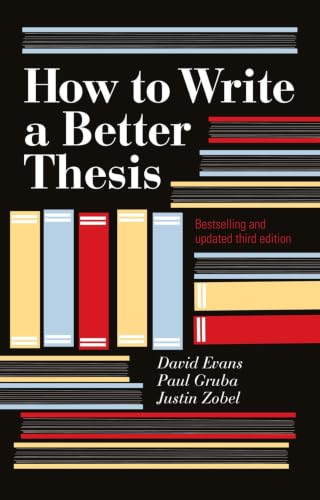

How to write a better thesis David Evans, Paul Gruba, Justin Zobel.
Detalles de publicación: Carlton, Vic. Melbourne University Press c2011.Descripción: xv, 236 p. 21 cmISBN:- 9780522861266
- 808.02 E9242h 22
| Imagen de cubierta | Tipo de ítem | Biblioteca actual | Biblioteca de origen | Colección | Ubicación en estantería | Signatura topográfica | Materiales especificados | Info Vol | URL | Copia número | Estado | Notas | Fecha de vencimiento | Código de barras | Reserva de ítems | Prioridad de la cola de reserva de ejemplar | Reservas para cursos | |
|---|---|---|---|---|---|---|---|---|---|---|---|---|---|---|---|---|---|---|
| Referencia | Biblioteca Encarnación Valdés Sala de Referencia bev | 808.02 E9242h (Navegar estantería(Abre debajo)) | Disponible | 80000002462631 | ||||||||||||||
| Libro | Biblioteca Encarnación Valdés Colección General bev | 808.02 E9242h (Navegar estantería(Abre debajo)) | Disponible | 80000002462623 |
Descripciones mejoradas de Syndetics:
Take an integrated, down-to-earth approach. From proposal to examination, producing a dissertation or thesis is a challenge. Grounded in decades of experience with research training and supervision, this fully updated and revised edition draws on case studies and examples to guide you step-by-step towards productive success.
Early chapters frame the tasks ahead and show you how to get started. From there, practical advice and illustrations take you through the elements of formulating research questions, working with software, and purposeful writing of each of the different kinds of chapters, and finishes with a focus on revision, dissemination and deadlines. How to Write a Better Thesis presents a cohesive approach to research that will help you on the road to success.
Includes bibliographical references and index.
Tabla de contenidos provista por Syndetics
- Preface to the Third Edition(p. ix)
- Introduction(p. xiii)
- Using This Book(p. xiv)
- 1 What Is a Thesis?(p. 1)
- Criteria for Examination(p. 1)
- Types of Thesis(p. 5)
- Look at Other Theses(p. 6)
- Examiners' Reports(p. 7)
- 2 Thesis Structure(p. 11)
- Why We Have Trouble with New Tasks(p. 12)
- Structuring Your Thesis(p. 13)
- The 'Standard' Thesis Structure(p. 14)
- Narrative(p. 18)
- Non-standard Thesis Structures(p. 20)
- 3 Mechanics of Writing(p. 22)
- Writing at a Computer(p. 22)
- Document and Version Management(p. 31)
- Writing Style(p. 34)
- Plagiarism and Research Integrity(p. 48)
- 4 Making a Strong Start(p. 53)
- Creating a Structure(p. 55)
- Initial Efforts(p. 58)
- Writing up at the End(p. 60)
- Starting, and Starting Again(p. 62)
- The Creative Process(p. 64)
- Writing an Individual Chapter(p. 66)
- Literature(p. 73)
- Styles of Working(p. 75)
- Working with Your Supervisor(p. 78)
- 5 The Introductory Chapter(p. 84)
- Establishing a Context(p. 84)
- Stating the Problem, Motivating the Study(p. 87)
- Aim and Scope of the Study(p. 89)
- Significance of the Study(p. 93)
- Overview of the Study(p. 94)
- Research Questions and Hypotheses(p. 96)
- Revising the Aim, Aligning the Conclusion(p. 99)
- 6 Background Chapters(p. 103)
- Developing Critical Thinking(p. 104)
- Establishing Context(p. 107)
- Preliminary Investigations(p. 111)
- Revising(p. 112)
- 7 Establishing Your Contribution(p. 118)
- Kinds of Contribution(p. 119)
- Method(p. 126)
- 'Research Methods'(p. 129)
- Argument(p. 133)
- Organization(p. 135)
- 8 Outcomes and Results(p. 138)
- Quantitative or Qualitative Data?(p. 139)
- From Data to Results(p. 141)
- Quantitative or Qualitative, Revisited(p. 150)
- Illustrations(p. 154)
- 9 The Discussion or Interpretation(p. 162)
- The Task of the Chapter(p. 163)
- Structuring the Discussion(p. 165)
- Writing With Authority(p. 168)
- 10 The Conclusion(p. 172)
- 11 Before You Submit(p. 177)
- From First to Second Draft(p. 178)
- Dotting the 'i's and Crossing the 't's(p. 183)
- Appendices(p. 191)
- Glossary(p. 192)
- 12 Beyond the Thesis(p. 194)
- Disseminating Your Research(p. 195)
- Afterword(p. 214)
- Appendix: Analysis of Examiners' Reports(p. 217)
- Characteristics of a High Quality Thesis(p. 217)
- Characteristics of a Poor Thesis(p. 219)
- Notes on Further Resources(p. 222)
- Index(p. 225)
Notas de autor provistas por Syndetics
David Evans was Reader and Associate Professor in the Faculty of Architecture, Building and Planning, University of Melbourne. Among his many books and articles is Restoring the Land (MUP).Paul Gruba is Senior Lecturer in Communication Skills at the Centre for Communication Skills and English as a Second Language, University of Melbourne.
Justin Zobel is Professor in the Department of Computer Science and Software Engineering, University of Melbourne. He is also the author of Writing for Computer Science.