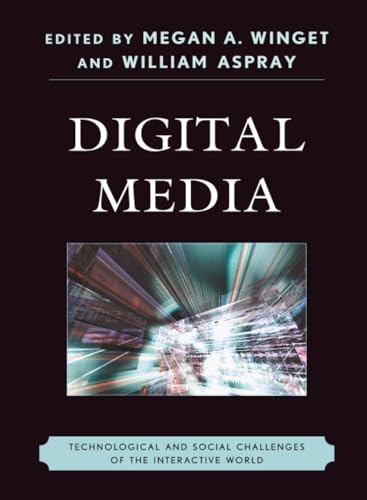

Digital media technological and social challenges of the interactive world edited by Megan A. Winget, William Aspray.
Detalles de publicación: Lanham, Md. Scarecrow Press c2011.Descripción: xi, 237 p. ill. 23 cmISBN:- 9780810881969 (pbk. : alk. paper)
- 006.7 D574 23
- ZA4045 .D54 2011
| Imagen de cubierta | Tipo de ítem | Biblioteca actual | Biblioteca de origen | Colección | Ubicación en estantería | Signatura topográfica | Materiales especificados | Info Vol | URL | Copia número | Estado | Notas | Fecha de vencimiento | Código de barras | Reserva de ítems | Prioridad de la cola de reserva de ejemplar | Reservas para cursos | |
|---|---|---|---|---|---|---|---|---|---|---|---|---|---|---|---|---|---|---|
| Libro | Biblioteca Encarnación Valdés Colección General bev | 006.7 D574 (Navegar estantería(Abre debajo)) | Disponible | 80000002442021 |
Descripciones mejoradas de Syndetics:
Digital media has exploded over the past quarter century, and in particular the past decade. As varieties of digital media multiply, scholars are beginning to examine its origins, organization, and preservation, which present new challenges compared to traditional media. To examine issues from multiple perspectives, experts were invited to an invitation-only workshop on digital media. The participants were carefully chosen to represent a variety of backgrounds and perspectives, ranging from humanities and fine arts to communication theory. The papers collected here are the results of that workshop.
Digital Media: Technological and Social Challenges of the Interactive World is organized in four parts, each representing a different perspective on digital media: preservation, humanities, organizational, and historical. The section on preservation considers the problems of archiving digital media for long-term preservation; the humanities section offers a human-centered view of digital media, focusing on the interaction between technological changes and cultural practices; the section dealing with organization goes beyond the study of digital artifacts in isolation to consider the context, collection, and arrangement of objects; and the historical section examines how our perspectives on digital media have changed over time, looking at how issues such as the digital divide and digital production have changed as technology has changed.
The wealth of varied perspectives in Digital Media provides new light on this topic, beyond the media studies viewpoint that is the most common way of engaging these topics. This collection will be a valuable addition for students and faculty in information studies, communication studies, rhetoric, new media, and more.
The papers in this volume are edited versions of papers presented at a workshop on digital media held at the School of Information at the University of Texas at Austin, February 13-15, 2009.
Includes bibliographical references and index.
Memento mundi : are virtual worlds history? / Henry Lowood -- Collecting the artifacts of participation : videogames, fan-boys, and individual models of collection / Megan Winget -- Prim drift, copybots, and folk preservation : three copyright parables about art in the digital age / Kari Kraus -- Digital copies and a distributed notion of truth in personal archives / Cathy Marshall -- Organization as expression : classification as digital media / Melanie Feinberg -- Personal theory : a method for humanities scholarship in a new media moment / Abigail De Kosnik -- Empowering U.S. citizens through access to IT and digital media : Henry Jenkins meets Larry Snyder / William Aspray -- The impact of new media on music creativity / Bruce Pennycook -- The digital humanities and technocultural innovation / Anne Balsamo.
Tabla de contenidos provista por Syndetics
- Introduction(p. v)
- Part 1 Preserving Digital Media
- 1 Memento Mundi: Are Virtual Worlds History?(p. 3)
- 2 Collecting the Artifacts of Participation: Videogame Players, Fan-Boys, and Individual Models of Collection(p. 27)
- 3 Prim Drift, CopyBots, and Folk Preservation: Three Copyright Parables about Art in the Digital Age(p. 73)
- Part 2 Describing Documents
- 4 Digital Copies and a Distributed Notion of Reference in Personal Archives(p. 89)
- 5 Organization as Expression: Classification as Digital Media(p. 115)
- Part 3 The Personal Nature of Digital Media
- 6 Personal Theory: A Method for Humanities Scholarship in a New Media Moment Abigail De Kosnik(p. 137)
- 7 Empowering U.S. Citizens through Access to Information Technology and Digital Media: Henry Jenkins Meets(p. 161)
- Part 4 Interactions between Technology and Culture
- 8 The Impact of New Media on Musical Creativity Bruce Pennycook(p. 187)
- 9 The Digital Humanities and Technocultural Innovation(p. 213)
- Index(p. 227)
- About the Contributors(p. 235)