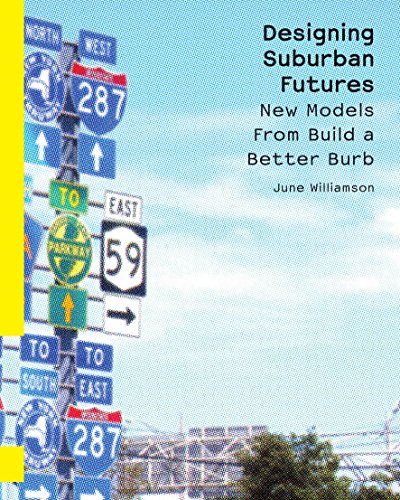

Designing Suburban Futures : new models from build a better burb. / June Williamson. txt
Idioma: Inglés Editor: Washington: Island Press, [2013]Descripción: xvii, 137 p. ill. ; 27 cmTipo de contenido:- text
- unmediaded
- volume
- 9781610911979 (cloth : alk. paper)
- 1610911970 (cloth : alk. paper)
- 9781597262415 (pbk. : alk. paper)
- 1597262412 (pbk. : alk. paper)
- 307.740973 23
- HT352.U6 W55 2013
| Imagen de cubierta | Tipo de ítem | Biblioteca actual | Biblioteca de origen | Colección | Ubicación en estantería | Signatura topográfica | Materiales especificados | Info Vol | URL | Copia número | Estado | Notas | Fecha de vencimiento | Código de barras | Reserva de ítems | Prioridad de la cola de reserva de ejemplar | Reservas para cursos | |
|---|---|---|---|---|---|---|---|---|---|---|---|---|---|---|---|---|---|---|
| Libro Col. General CARIBET | CARIBET Biblioteca Arquitectura Colección General CARIBET | HT352.U6 W55 2013 (Navegar estantería(Abre debajo)) | 1 | Disponible | 91000000033514 |
Descripciones mejoradas de Syndetics:
Suburbs deserve a better, more resilient future. June Williamson shows that suburbs aren't destined to remain filled with strip malls and excess parking lots; they can be reinvigorated through inventive design. Drawing on award-winning design ideas for revitalizing Long Island, she offers valuable models not only for U.S. suburbs, but also those emerging elsewhere with global urbanization.
Williamson argues that suburbia has historically been a site of great experimentation and is currently primed for exciting changes. Today, dead malls, aging office parks, and blighted apartment complexes are being retrofitted into walkable, sustainable communities. Williamson shows how to expand this trend, highlighting promising design strategies and tactics.
She provides a broad vision of suburban reform based on the best schemes submitted in Long Island's highly successful "Build a Better Burb" competition. Many of the design ideas and plans operate at a regional scale, tackling systems such as transit, aquifer protection, and power generation. While some seek to fundamentally transform development patterns, others work with existing infrastructure to create mixed-use, shared networks.
Designing Suburban Futures offers concrete but visionary strategies to take the sprawl out of suburbia, creating a vibrant, new suburban form. It will be especially useful for urban designers, architects, landscape architects, land use planners, local policymakers and NGOs, citizen activists, students of urban design, planning, architecture, and landscape architecture.
Index
Bibliography
Contents :
Preface viii --
Foreword Ellen DDunham Jones x --
Introduction xii --
Vision : a role for design in suburban resilience :
Context for change 2 --
Design culture responds to sprawl : 1960s to 2010s 24 --
Better suburban futures 38 --
Exemplar : building a better burb on Long Island :
Build a better burb 2010 : instructions and commentary 52 --
Winning and noteworthy competition schemes :
Sited in the Setback: Increasing Density in Levittown 64 --
Upcycling 2.0 72 --
AgIsland 76 --
Building C Burbia 80 --
Subhub Transit System 86 --
Long Division 92 --
LIRR : Long Island Radically Rezoned 98 --
Noteworthy Competition Schemes 106 --
Conclusion 120 --
Epilogue : New Roles for Architecture and Urban Design A conversation with Kazys Varnelis 122 --
Selected Bibliography 128 --
Credits 131 --
Index 132 --
"Suburbs deserve a better, more resilient future. June Williamson shows that suburbs aren't destined to remain filled with strip malls and excess parking lots; they can be reinvigorated through inventive design. Drawing on award-winning design ideas for revitalizing Long Island, she offers valuable models not only for U.S. suburbs, but also those emerging elsewhere with global urbanization. Williamson argues that suburbia has historically been a site of great experimentation and is currently primed for exciting changes. Today, dead malls, aging office parks, and blighted apartment complexes are being retrofitted into walkable, sustainable communities. Williamson shows how to expand this trend, highlighting promising design strategies and tactics. She provides a broad vision of suburban reform based on the best schemes submitted in Long Island's highly successful "Build a Better Burb" competition. Many of the design ideas and plans operate at a regional scale, tackling systems such as transit, aquifer protection, and power generation. While some seek to fundamentally transform development patterns, others work with existing infrastructure to create mixed-use, shared networks. Designing Suburban Futures offers concrete but visionary strategies to take the sprawl out of suburbia, creating a vibrant, new suburban form. It will be especially useful for urban designers, architects, landscape architects, land use planners, local policymakers and NGOs, citizen activists, students of urban design, planning, architecture, and landscape architecture." --
Tabla de contenidos provista por Syndetics
- Preface
- Foreword
- Introduction
- Photo Essay
- Part I Vision: A Role for Design in Suburban Resilience
- Chapter 1 Context for Change
- Chapter 2 Design Culture Responds to Sprawl: 1960s to 2010s
- Chapter 3 Better Suburban Futures
- Part II Exemplar: Building a Better Burb on Long Island
- Chapter 4 Build a Better Burb 2010: Instructions and Commentary
- Chapter 5 Winning and Noteworthy Competition Schemes Sited in the Setback: Increasing Density in Levittown
- Upcycling 2.0
- AgIsland
- Building C-Burbia
- SUBHUB Transit System
- Long Division
- LIRR: Long Island Radically Rezoned
- Fourteen Noteworthy Schemes
- Chapter 6 Conclusion
- Epilogue: New Roles for Architecture and Urban Design - A conversation with Kazys Varnelis
- Selected Bibliography
- Index