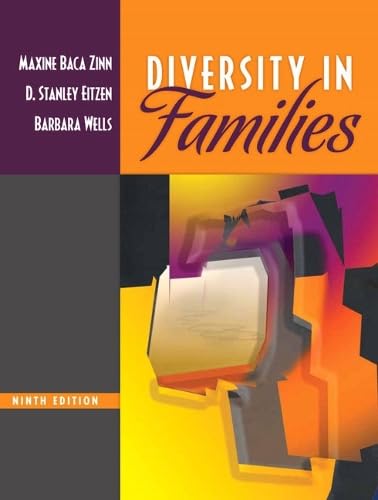

Diversity in families Maxine Baca Zinn, D. Stanley Eitzen, Barbara Wells.
Detalles de publicación: Boston Allyn & Bacon c2011.Edición: 9th edDescripción: xvii, 555 p. ill. (some col.) 27 cmISBN:- 9780205693078
- 0205693075
- 306.850973 22
- HQ536 .Z54 2011
| Imagen de cubierta | Tipo de ítem | Biblioteca actual | Biblioteca de origen | Colección | Ubicación en estantería | Signatura topográfica | Materiales especificados | Info Vol | URL | Copia número | Estado | Notas | Fecha de vencimiento | Código de barras | Reserva de ítems | Prioridad de la cola de reserva de ejemplar | Reservas para cursos | |
|---|---|---|---|---|---|---|---|---|---|---|---|---|---|---|---|---|---|---|
| Libro | Biblioteca Encarnación Valdés Colección General bev | 306.85 Z784d9 (Navegar estantería(Abre debajo)) | Disponible | 80000002482894 |
Descripciones mejoradas de Syndetics:
This award-winning text treats family diversity as the norm, while highlighting how race, class, gender, and sexuality produce varieties of familial relationships.
Diversity in Families looks at families not as "building blocks of societies" but rather, as products of social forces within society. The authors undertake a critical examination of society, asking questions such as, "How do families really work?" and "Who benefits under the existing arrangements, and who does not?" Their goal is to demystify and demythologize the family by exposing existing myths, stereotypes, and dogmas.
Includes bibliographical references and indexes.
Tabla de contenidos provista por Syndetics
- In This Section
- 1 Brief
- 2 Comprehensive
- Brief Table of Contents
- Chapter 1 Images, Ideals, and Myths
- Chapter 2 Preindustrial Families and the Emergence of a Modern Family Form
- Chapter 3 The Historical Making of Family Diversity
- Chapter 4 Macro Forces Affecting Families: the Economy, Immigration, and Aging
- Chapter 5 Class, Race, and Gender
- Chapter 6 Meshing the Worlds of Work and Family
- Chapter 7 The Social Construction of Intimacy
- Chapter 8 Contemporary Marriages
- Chapter 9 Parents and Children
- Chapter 10 Violence in Families
- Chapter 11 Divorce and Remarriage
- Chapter 12 Emergent Families in the Global Era
- Chapter 13 Family Policy for the Twenty-First Century
- Comprehensive Table of Contents
- Chapter 1 Images, Ideals, and Myths
- Images and Ideals
- Family as Haven
- Family as Fulfillment
- Family as Encumbrance
- Images and Reality
- The Mythical U.S. Family
- The Myth of a Stable and Harmonious Family of the Past
- The Myth of Separate Worlds
- The Myth of the Monolithic Family Form
- The Myth of a Unified Family Experience
- The Myth of Family Consensus
- The Myth of Family Decline as the Cause of Social Problems
- A New Framework for Understanding Families
- The Sociological Perspective
- The Paradigm Shift in Family Studies
- The Structural Diversity Approach
- Chapter 2 Preindustrial Families and the Emergence of a Modern Family Form
- Family and the New Social History
- What Is "New" about Family History?
- Overview of Family History Themes
- Family Life in Colonial America
- Agricultural Communities and Families
- Family Structure and Household Composition
- Wives and Husbands
- Children
- The Emergence of Modern Family Life
- Industrialization and Families
- Agency, Adaptation, and Change
- Household Size and Composition
- Wives and Husbands
- Children
- Challenging a Uniform Definition of the Family
- Chapter 3 The Historical Making of Family Diversity
- Industrialization and Family Life
- New Work Arrangements
- Work and Family in Industrial Society
- Accordion Households
- Immigration and Family Life
- The Social Breakdown Perspective
- Industrial Work and Immigrant Families
- Racial Control and Family Life
- New Thinking about Minority Families
- Race, Labor, and Family Life
- African American Families in Slavery and Freedom
- Chicano Families in the Southwest
- The Great Depression and Family Change
- Chapter 4 Macro Forces Affecting Families: the Economy, Immigration, and Aging
- Globalization and the Structural Transformation of the Economy, the Great Recession, and Families
- Globalization
- Structural Changes in the United States Because of Globalization
- The Great Recession (2007-?)
- Downward Social Mobility
- Shifting Family Forms
- The New Immigration and the Changing Racial Landscape
- Demographic Trends and Increasing Diversity
- Structural Diversity of Immigrant Families
- The Effects of Immigration on Immigrant Families
- Immigration and Agency
- The Effects of Immigration on Family Dynamics
- The New Second Generation
- The Aging of Society
- The Demographics of an Aging Society
- The Consequences of an Aging Society on Families and the Elderly
- Role Transitions
- Responses by the Elderly: Human Agency
- The Three Structural Transformations of Society
- Chapter 5 Class, Race, and Gender
- Class, Race, and Gender as Structural Inequalities
- Class
- The Cultural Approach
- The Structural Approach
- Race
- Racial-Ethnic Families
- Structural Inequalities and Racial-Ethnic Families
- African American Families in the New Century
- Latino Families in the New Century
- More Racial Ethnic Diversity in Families: Asians, Native Americans, and Middle Easterners
- Human Agency and Family Formation
- Gender
- The Traditional gender Roles Approach
- Shortcomings of the Gender Roles Approach
- The Family as a Gendered Institution
- Chapter 6 Meshing the Worlds of Work and Family
- The Changing Work Patterns of Women, Men, and Teens
- Women's Employment
- Men's Employment
- Teens' Employment
- Integrating Work and Family
- Diverse Work-Family Contexts
- Gender Inequality
- Work Characteristics
- Family Characteristics
- Invisible and Unpaid Family Work
- Gendered Labor in the Household
- Other Forms of Family Work
- Coping with Work and Family
- Family Coping Strategies
- Family-Supportive Government and Employer Responses
- Chapter 7 The Social Construction of Intimacy
- Intimacy in Social Context
- Heterosexual Courtship and Mate Selection
- Variations in "Dating" Practices
- Factors in Mate Selection
- Structural Influences on Mate Selection
- Changing Sexual Behavior
- Society and Sexuality
- Enlarging the Sexuality Frame
- The Sexual Revolution
- Scientific Research on Sexuality
- AIDS
- Teen Sexuality
- Teenage Childbearing
- Differentiated Forms of Intimacy
- Gendered Love and Sex
- Same-Sex Orientation and Intimacy
- Social Class and Intimacy
- Race and Intimacy
- Claiming Control of Intimacy
- Chapter 8 Contemporary Marriages
- Marriage: Private and Public Spheres
- The Private Nature of Marriage
- Macro Influences on Marriage
- Recent Trends
- Unmarried Adults
- Age at First Marriage
- Family Size
- Interracial or Interethnic Marriages
- Racial or Ethnic Mixed Marriages
- Life Span and Marriage
- Are There Benefits to Marriage?
- The Benefits of Marriage
- The Benefits of Marriage Reconsidered
- Micro Aspects of Marriage
- Marital Success
- Communication in Marriage
- The Sexual Relationship in Marriage
- Power and Decision Making in Marriage
- Reconstructing Gender Roles: Building an Egalitarian Marriage
- The Future of Marriage: Changing or Dying?
- Chapter 9 Parents and Children
- The Social Construction of Parenting
- The Social Construction of Childhood
- Demographic Patterns
- Fertility
- Voluntary Childlessness
- Infertility and New Technologies
- Delayed Childbearing
- Family Composition
- The Impact of Children on Marriage
- The Transition to Parenthood
- The Benefits of Parenthood
- The Costs of Parenthood
- Gendered Parenting
- The Impact of Parents on Children and of Children on Parents
- The Structure of the Family Embedded in a Larger Network of Influences
- Parental Time with Children
- Family Structure
- Extrafamilial Factors
- Parents and Children in Dual-Earner Families
- Maternal Employment and Time with Children
- Social Supports for Working Parents
- Single Parents and Their Children
- Reprise: the Duality of Parenting
- Chapter 10 Violence in Families
- Families in a Violent Society
- U.S. Violence Rates in Comparative Perspective
- Institutionally Sanctioned Violence
- Violence in the Media
- Customs and Beliefs
- Violence and the Social Organization of the Family
- Intimate Partner Violence
- Violence Against Women
- Contexts for Intimate Partner Violence
- Types of Partner Violence
- Does She Leave or Stay?
- Domestic Violence in Same-Sex Relationships
- Child Abuse and Neglect
- What Is Child Abuse?
- Incidence of Child Abuse
- Contexts for Child Abuse
- Consequences of Child Abuse
- Incest
- Incidence of Incest
- Explanations for Incest
- Consequences of Incest
- Sibling Abuse
- Battered Elders
- What Is Elder Abuse?
- Incidence of Elder Abuse
- Contexts for Elder Abuse
- Macro and Micro Linkages
- Agency
- The Women's Movement
- The Battered Women's Shelter Movement
- Assessing Progress
- Chapter 11 Divorce and Remarriage
- Divorce Rates
- Trends in Divorce
- Factors Correlated with Divorce
- Predicting the Divorce Rate: Up or Down?
- The Prediction of a Declining or Leveling of the Divorce Rate
- The Prediction of a Rising Divorce Rate
- The Consequences of Divorce for Spouses and Children
- "His" Divorce
- "Her" Divorce
- Adjustment after Divorce for Ex-Spouses
- Children and Divorce
- Remarriage after Divorce
- Statistical Facts about Remarriage
- The Uniqueness of Remarriage
- The Outcomes for Stepchildren
- The Special Case of Remarriage among the Elderly
- The Politics of Divorce
- Is Marriage a Failed Institution?
- Chapter 12 Emergent Families in the Global Era
- The Rise in New Family Arrangements
- Families in Transition
- The Global Revolution in Family Life
- How to Think about Family Diversification
- Single Life
- The Singles Population
- Gender, Race, and Class
- Experiencing Single Life
- Heterosexual Cohabitation
- The Rise of Cohabitation
- Who Are Cohabitors?
- Gender, Class, and Race
- Is Cohabitation a Prelude to Marriage or a Substitute for Marriage?
- Same-Sex Partners and Families
- Who Is Gay and What Are Gay Families?
- Gay Couples and Families
- A Shifting Social Context for Same-Sex Partners
- The Domestic Partner Movement
- Families Separated by Time and Space
- Transnational Families
- Commuter Marriages and Other Long-Distance Relationships
- Chapter 13 Family Policy for the Twenty-First Century
- The Ideological Fault Lines
- The Conservatives
- The Progressives
- The Government's Limits on the Definition of Marriage
- The Government and Reproductive Rights
- Contraceptives
- Abortion
- Welfare
- The Shrinking Welfare State
- The Personal Responsibility and Work Opportunity Reconciliation Act (PRWORA of 1996)
- Is Welfare Reform Working? An Assessment after Ten Years
- The Conservative Solution: Marriage
- The Progressive Solution: A Stronger Safety Net
- Working Parents
- Parental Leave
- Child Care
- Work-Related Policies and Gender Inequality
- Meeting the Needs of Disadvantaged Children
- Poor Children at Risk
- The Societal Response to Disadvantaged Children
- Funding Programs to Help Disadvantaged Children
- Principles to Guide Family Policy: An Immodest Proposal
Notas de autor provistas por Syndetics
Maxine Baca Zinn is professor emerita in the Department of Sociology at Michigan State University. She received her Ph.D. in Sociology from the University of Oregon. Her books include: Women of Color in U.S. Society (with Bonnie Thornton Dill), and Gender Through the Prism of Difference (with Pierrette Hondagneu-Sotelo and Michael Messner). She is the coauthor (with D. Stanley Eitzen) of Social Problems and Diversity in Families , both of which won McGuffey Awards for excellence over multiple editions from the Text and Academic Authors Association, and Globalization: The Transformation of Social Worlds . She has served as president of the Western Social Science Association. In 2000, she received the American Sociological Association's Jessie Bernard Award for expanding the horizons of sociology to include the study of women.
D. Stanley Eitzen is professor emeritus in sociology from Colorado State University, where previously he was the John N. Stern Distinguished Professor. He recieved his Ph.D. from the Unitsity of Kansas. Among his books are: Social Problems , which was awarded the McGuffey Longevity Award for excellence over multiple editions in 2000 by the Text and Academic Authors Association, and Diversity in Families (both co-authored with Maxine Baca Zinn), Solutions to Social Problems: Lessons from Other Societies (with Graig S. Leeham), Paths to Homelessness: Extreme Poverty and the Urban Housing Crisis (with Doug A. Timmer and Kathryn Talley), Sociology of North American Sport (with George H. Sage,) and Fair and Foul: Rethinking the Myths and Paradoxes of Sport. He has served as the president of the North American Society for the Sociology of Sport and as editor of The Social Science Journal.
Barbara Wells is associate professor of sociology at Maryville College, where she is also chair of the Division of Social Sciences. She received her Ph.D. from Michigan State University. She is co-author of Diversity in Families (with Maxine Baca Zinn and D. Stanley Eitzen). Her research and publishing has centered on marriage, rural families, structural transformation and family life, and Latino families. She is presently working on a book manuscript on the work and family lives of Mexican American women who are daughters and granddaughters of immigrant farm workers.