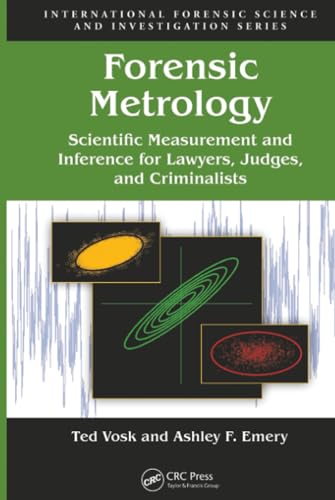

Forensic metrology : scientific measurement and inference for lawyers, judges and criminalists / Ted Vosk, Ashley F. Emery.
Idioma: Español Series International forensic science and investigationEditor: Boca Raton : CRC Press , 2015Descripción: xlviii, 418 pages illustrations 24 centimeters 1 CD-ROM (4 3/4 in.)Tipo de contenido:- 9781439826195 (hardback : acid-free paper)
- 363.25 23
- HV8073.5 .V67 2015
- LAW026000 | LAW041000
| Imagen de cubierta | Tipo de ítem | Biblioteca actual | Biblioteca de origen | Colección | Ubicación en estantería | Signatura topográfica | Materiales especificados | Info Vol | URL | Copia número | Estado | Notas | Fecha de vencimiento | Código de barras | Reserva de ítems | Prioridad de la cola de reserva de ejemplar | Reservas para cursos | |
|---|---|---|---|---|---|---|---|---|---|---|---|---|---|---|---|---|---|---|
| Libro | Biblioteca de Mayagüez Colección General mb | HV8073.5 .V67 2015 (Navegar estantería(Abre debajo)) | c. 1 | Disponible | 50000003260907 |
Descripciones mejoradas de Syndetics:
Forensic metrology is the application of scientific measurement to the investigation and prosecution of crime. Forensic measurements are relied upon to determine breath and blood alcohol and drug concentrations, weigh seized drugs, perform accident reconstruction, and for many other applications. Forensic metrology provides a basic framework for the performance and critical evaluation of all forensic measurements. It enables forensic scientists to better develop, perform and communicate forensic measurements; lawyers to better understand, present and cross-examine the results of forensic measurements; and judges to better subject testimony and evidence based on forensic measurements to the appropriate gatekeeping analysis.
Forensic Metrology Scientific Measurement and Inference for Lawyers, Judges, and Criminalists sets forth the metrological framework required to reach sound conclusions based on measured results and the inferences those results support . Armed with this knowledge, scientists and nonscientists alike can:
Engage in critical analysis of forensic measurements across a broad spectrum Better understand what measured results represent Successfully prepare and present testimony and/or cases that involve such evidence Recognize poor measurement practices and prevent bad science from undermining the search for truth in the courtroomThe book begins by introducing and developing metrological principles and concepts. Next, it presents advanced and mathematically rigorous principles and methods of inference in metrology. Throughout the book, scientific and legal aspects of measurements are addressed and accompanied by examples. The accompanying CD includes an in-depth Primer on Forensic Metrology and provides practice materials for legal and forensic professionals that include court decisions, legal motions, and expert reports.
A basic understanding of forensic metrology will improve the practices of both legal and forensic professionals, helping to ensure the integrity of the legal system, its fact-finding functions, and the practice of justice in the courtroom.
CD-ROM disponible en el libro.
Includes bibliographical references (pages 365-371) and index.
"With contributions from professionals in forensic science, law, and engineering, this book serves as an introduction to the field of metrology, its application to the forensic sciences, and its use in the courtroom. Written for professionals and students, the text begins at a general level, demonstrating that the principles of metrology are familiar to all. It then builds a more sophisticated level of coverage, combining the scientific machinery of metrology and forensics with the practice of law so practitioners will be able to apply the principles discussed. Examples, case studies, and diagrams are included for ease of understanding and application"--
"Foreword Facts are inherently nonexplanatory. A report of "70 degrees" means nothing without some context: Is it January or July? Juneau or Jakarta? Celsius or Fahrenheit? Shewhart's dictum ("Data has no meaning apart from its context") is central to all sciences, including--perhaps particularly--forensic science. A few assumptions underly this concept. First is that the context trumps the data in that, as Deming said, "Experience without theory teaches nothing. In fact, experience can not even be recorded unless there is some theory, however crude. . . " (Deming, 1986, p. 317). If you must be "this tall" to ride this roller coaster, then in the context (the roller coaster's safety design), height (the measurement) is important because it is ultimately based on theory (human biological height is predictably proportional to age and weight): Children of a certain age are large enough to be protected by the coaster's safety mechanisms, which were designed with bodies of a minimal size in mind. Simply saying a child is 40 inches tall means very little. The second assumption is that there are data, that is, plural. Science is based on reproducibility and with that comes the collection of multiple data points, either by ourselves to ensure accuracy or by others to check validity. In each measurement is a minor bit of error (in the statistical sense) and multiple measurements help us capture, understand, and control that error. Twenty one different Six Flags Amusement Parks exist and each one has different roller coasters, ranging from children's coasters to Mega Coasters, all with different height requirements (Table 0.1). Multiple measurements are taken, recorded, and communicated to each of Six Flags' parks to ensure that the requirements are consistent between parks"--
Tabla de contenidos provista por Syndetics
- Science, Metrology, and the Law
- Introduction to Measurement: The Measurand
- Weights and Measures
- Validation and Good Measurement Practices
- Result Interpretation-I: Metrological Prerequisites to Knowledge
- Result Interpretation-II: Measurement Error
- Result Interpretation-III: Measurement Uncertainty
- Epistemological Structure of Metrology
- Models and Uncertainty
- Logic, Plausibility, and Probability
- Bayes' Relation
- Statistics and the Characterizing of Uncertainties
- Hypothesis Testing, Evidence, Likelihood, Data
- Confidence and Credible Intervals, Statistical Inference
- Least Squares, Parameter Estimation, and Correlation
- Measurements: Errors versus Uncertainty
- Plausibility and the Law
- Reading List
- Example: Effect of a Calibration Constant
- References
- Appendix A Symbols
- Appendix B Glossary
- Appendix C Metrology Organizations and Standards
- Appendix D Legal Authorities
- Appendix E Case Materials
- Index
Notas de autor provistas por Syndetics
Ted Vosk is a criminal defense attorney and legal/forensic consultant. Over the past decade, he has been a driving force behind the reform of forensic practices in Washington State and the laws governing the use of the evidence they produce. His work in and out of the courtroom continues to help shape law in jurisdictions around the country. He has been awarded the President's Award from the Washington Association of Criminal Defense Lawyers and the Certificate of Distinction from the Washington Foundation for Criminal Justice. A Fellow of the American Academy of Forensic Sciences and member of Mensa, he has written, broadcast, presented, and taught around the country on topics ranging from the origins of the universe to the doctrine of constitutional separation of powers. He has been published in legal and scientific media, including the Journal of Forensic Sciences , and his work has been cited in others, including Law Reviews and treatises.
Ashley F. Emery is a professor of mechanical engineering at the University of Washington and an adjunct professor of architecture and of industrial and systems energy. He has been an associate dean of the College of Engineering, chair of the Department of Mechanical Engineering, and director for the Thermal Transport Program of the National Science Foundation. His areas of research interest are heat transfer, fluid dynamics, architectural and building energy, thermal stresses, fracture, design and interpretation of experiments, and Bayesian inference. He has published more than 200 technical papers in refereed journals. He is a fellow of the American Society of Mechanical Engineers and the American Society of Heating, Refrigerating and Air-Conditioning Engineers. He is a recipient of the American Society of Mechanical Engineers Heat Transfer Memorial Award and the 75th Anniversary Heat Transfer Award.