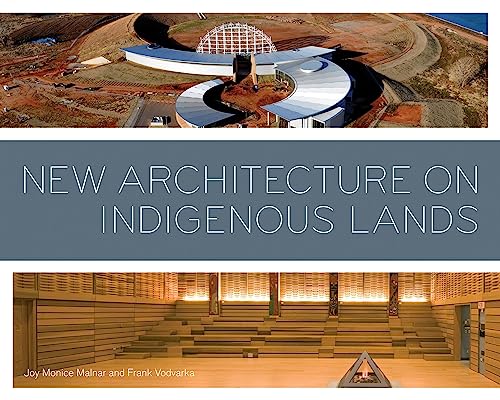

New architecture on indigenous lands Joy Monice Malnar, Frank Vodvarka. txt
Idioma: Inglés Minneapolis: University of Minnesota Press 2013Descripción: 259 p. ill. 21 cmTipo de contenido:- text
- unmediaded
- volume
- 9780816677443 (hardback)
- 9780816677450 (pb)
- Architecture and anthropology -- United States -- History -- 20th century
- ARCHITECTURE / General
- SOCIAL SCIENCE / Ethnic Studies / Native American Studies
- ARCHITECTURE / History / Contemporary (1945-)
- Indian reservations -- United States
- Indian architecture -- United States
- Architecture and society. -- United States -- History -- 20th century
- Architecture and anthropology -- United States -- History -- 21st century
- Architecture and society. -- United States -- History -- 20th century
- 720.89
- NA2543.A58 M35 2013
| Imagen de cubierta | Tipo de ítem | Biblioteca actual | Biblioteca de origen | Colección | Ubicación en estantería | Signatura topográfica | Materiales especificados | Info Vol | URL | Copia número | Estado | Notas | Fecha de vencimiento | Código de barras | Reserva de ítems | Prioridad de la cola de reserva de ejemplar | Reservas para cursos | |
|---|---|---|---|---|---|---|---|---|---|---|---|---|---|---|---|---|---|---|
| Libro | CARIBET Biblioteca Arquitectura Colección General CARIBET | General NA2543.A58 M35 2013 (Navegar estantería(Abre debajo)) | 1 | Disponible | 91000000034561 |
Descripciones mejoradas de Syndetics:
Black Elk speaks of the "square boxes" his people were forced into, and Winona LaDuke of the "boxes of mints" on Native lands. As long as the government was deciding what tribal buildings should look like, Native custom and culture were bound to be boxed in--or boxed out. But in the post-1996 era of more flexible housing policies, Native peoples have assumed a key role in the design of buildings on tribal lands. The result is an architecture that finally accords with the traditions and ideas of the people who inhabit it.
A virtual tour of recent Native building projects in Canada and the western and midwestern United States, New Architecture on Indigenous Lands conducts readers through cultural centers and schools, clinics and housing, and even a sugar camp, all while showing how tribal identity is manifested in various distinctive ways. Focusing on such sites as the Tribal Council Chambers of the Pojoaque Pueblo; the Zuni Eagle Sanctuary in New Mexico; the Nk'Mip Desert Cultural Centre in Osoyoos, British Columbia; and the T'lisalagi'lakw Elementary School, Joy Monice Malnar and Frank Vodvarka offer wide-ranging insights into the sensory, symbolic, cultural, and environmental contexts of this new architecture.
With close attention to details of design, questions of tradition, and cultural issues, and through interviews with designers and their Native clients, the authors provide an in-depth introduction to the new Native architecture in its many guises--and a rare chance to appreciate its aesthetic power.
Include index.
Includes bibliographical references and index.
Tabla de contenidos provista por Syndetics
- List of Projects
- Acknowledgments
- Introduction: Making Sense of Architecture
- 1 Design Alternatives
- 2 A Northwest "Cook's Tour"
- 3 Architectural Expressions of Culture
- 4 New Places of Learning
- 5 Iconic Design Parameters
- 6 Central Plains Images
- 7 Southwest Identity and Traditions
- 8 The Pueblos of the Rio Grande Region
- 9 Cultural and Sustainable Housing
- 10 Forming Indigenous Typologies
- Notes
- Index
Reseñas proporcionadas por Syndetics
CHOICE Review
That "tribal groups are clearly communicating their cultural needs and values to designers who are listening" is the thesis of this work by Malnar (Univ. of Illinois) and Vodvarka (Loyola Univ. Chicago). Over ten chapters, the authors examine the cultural lifestyles of indigenous communities through new architecture, using 56 projects as case studies. Each chapter delves into indigenous architectural history, and meetings held with tribal members as part of the design process. Each then discusses how the new architecture was designed based on these traditions and interactions. This volume raises important questions as to why, for example, indigenous building traditions tended to be ignored in favor of rigid principles set down by HUD and other federal agencies; the authors document the favorable changes after 1996. The text is laced with clear color and black-and-white illustrations. The book has one flaw--the title--which suggests an overview of all indigenous cultures. Yet in the introduction, a disclaimer states that the authors focused on "some" architecture west of the Mississippi "as significant buildings in the East ... do not enjoy quite the same cultural underpinnings as their Western counterparts, and ... are harder to place in a large architectural context." Summing Up: Recommended. Lower-division undergraduates and above; general readers. L. B. Allsopp University of OregonNotas de autor provistas por Syndetics
Joy Monice Malnar, AIA, is associate professor of architecture at the University of Illinois at Urbana-Champaign.