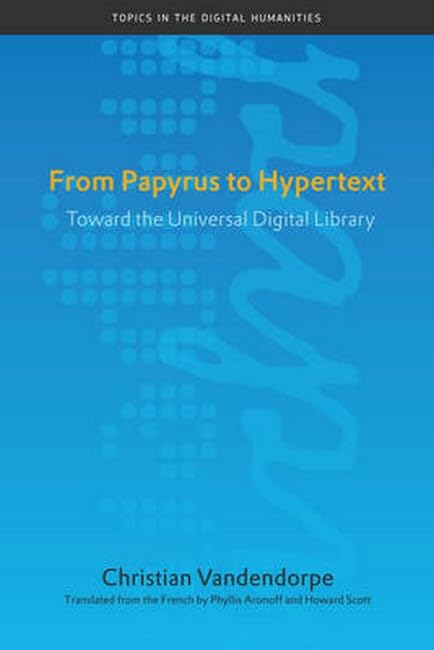
Imagen de portada de Amazon
Imagen de Amazon.com
Imagen de cubierta Syndetics
Portada de Syndetics
Imagen de OpenLibrary

From papyrus to hypertext toward the universal digital library Christian Vandendorpe ; translated from the French by Phyllis Aronoff and Howard Scott.

Por: Idioma: Inglés Lenguaje original: Francés Detalles de publicación: Urbana University of Illinois Press c2009.Descripción: ix, 191 p. 24 cmISBN:
  • 9780252034350 (cloth : alk. paper)
  • 9780252076251 (pbk. : alk. paper)
Títulos uniformes: Tema(s): Clasificación CDD:
  • 302.2244 V227d I 22
Clasificación LoC:
  • P211 .V3613 2009
Recursos en línea:
Valoración
    Valoración media: 0.0 (0 votos)
Existencias
Imagen de cubierta Tipo de ítem Biblioteca actual Biblioteca de origen Colección Ubicación en estantería Signatura topográfica Materiales especificados Info Vol URL Copia número Estado Notas Fecha de vencimiento Código de barras Reserva de ítems Prioridad de la cola de reserva de ejemplar Reservas para cursos
Libro Biblioteca Encarnación Valdés Colección General bev 302.2244 V227d I (Navegar estantería(Abre debajo)) Disponible 80000002490491
Total de reservas: 0

Descripciones mejoradas de Syndetics:

In this study, Christian Vandendorpe examines how digital media and the Internet have changed the process of reading and writing, significantly altering our approaches toward research and reading, our assumptions about audience and response, and our theories of memory, legibility, and context. Reflecting on the full history of the written word, Vandendorpe provides a clear overview of how materiality makes a difference in the creation and interpretation of texts.

Surveying the conventions of reading and writing that have appeared and disappeared in the Internet's wake, Vandendorpe considers various forms of organization, textual design, the use (and distrust) of illustrations, and styles of reference and annotation. He also examines the novel components of digital texts, including hyperlinks and emoticons, and looks at emergent, collaborative genres such as blogs and wikis, which blur the distinction between author and reader. Looking to the future, reading and writing will continue to evolve based on the current, contested trends of universal digitization and accessibility.

Includes bibliographical references (p. [177]-186) and index.

Reseñas proporcionadas por Syndetics

CHOICE Review

This updated edition, and the first English translation, of Vandendorpe's 1999 field-defining survey deserves to inaugurate the "Topics in the Digital Humanities" series. Vanderdorpe (Univ. of Ottawa) contextualizes the digital revolution by situating its communicative technologies, especially hypertext, within the longue duree of reading and writing. In 40 pithy essays, the author considers technological innovations that have transformed writing, altering the activity of reading and the processing of texts, individually and collectively. Developing a distinction between linear and tabular textuality, Vandendorpe notes how a long-term shift toward "tabularity," accelerated by computing, promotes "extensive," selective reading habits that dispel language's authoritative aura and disrupt cognition. Culturally, he contends, humans are becoming less meditative, but digital environments can promote connectivity, generating opportunities for creative collaboration. The book's fragmentary organization--the adroit syntheses can be read in any order--makes it exceptionally accessible and a worthy companion to Walter Ong's classic Orality and Literacy (CH, Apr'83) for the born-digital generation. Seasoned technologists and humanists will also benefit from Vandendorpe's media-ecology approach: by focusing on cognitive processes different "reading situations" require, the author suggests possibilities for building global knowledge networks that productively harness the power of books. Summing Up: Essential. All readers. E. D. Rasmussen Nord-Trøndelag University College

Notas de autor provistas por Syndetics

Christian Vandendorpe is professor of lettres françaises at the University of Ottawa. His publications include Les défis de la publication sur le web: hyperlectures, cybertextes et méta-éditions and other works. Phyllis Aronoff and Howard Scott live and translate in Montreal, Quebec.
Compartir
logopucpr-y-vive

Contáctanos

¡Queremos saber de ti!

Tel. 787.841.2000 Ext. 1801

bibliotecavaldes@pucpr.edu

⁣Búscanos en las redes

© 2026 Desarrollado por Ignite Online • All Rights Reserved • Powered by Koha.