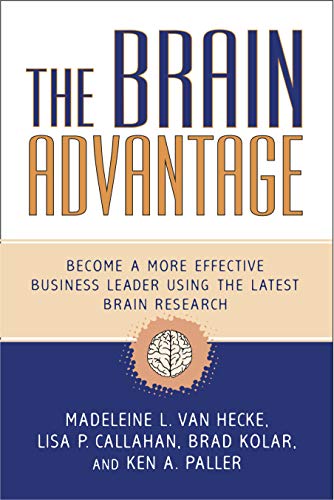

The brain advantage become a more effective business leader using the latest brain research y Madeline L. Van Hecke, Lisa P. Callahan, Brad Kolar, and Ken E. Paller.
Detalles de publicación: New York Prometheus 2010.Descripción: 320 p. 23 cmISBN:- 9781591027645
| Imagen de cubierta | Tipo de ítem | Biblioteca actual | Biblioteca de origen | Colección | Ubicación en estantería | Signatura topográfica | Materiales especificados | Info Vol | URL | Copia número | Estado | Notas | Fecha de vencimiento | Código de barras | Reserva de ítems | Prioridad de la cola de reserva de ejemplar | Reservas para cursos | |
|---|---|---|---|---|---|---|---|---|---|---|---|---|---|---|---|---|---|---|
| Libro | Biblioteca de Mayagüez Colección General mb | HD 57.7 .B726 2010 (Navegar estantería(Abre debajo)) | Disponible | 50000003204814 |
Descripciones mejoradas de Syndetics:
This book does for business leaders what few have time to do for themselves. It combines the latest brain research with insights from psychological studies of how people think. It uses powerful stories to convey that information, and presents it in short, readable chapters, each divided into three parts:· "What's the story?" reports in concise, digestible terms the science behind how the brain works.· "Interesting, but so what?" discusses how this research is relevant to business leadership today.· "What if ..." illustrates what leaders might do differently if they were truly to "lead with the brain in mind."The Brain Advantage shows leaders how to become even more effective decision-makers, communicators, and change-agents.
Includes bibliographical references and index.
eigm 04/2011
Tabla de contenidos provista por Syndetics
- Acknowledgments(p. 9)
- Introduction: The Brain Advantage(p. 11)
- Section I Innovation
- 1 Using Constraints to Free Up the Mind(p. 19)
- 2 Do Expert Brains Think Less?(p. 29)
- 3 Eureka! How to Make New Connections(p. 39)
- 4 Can You Rewire Your Own Brain?(p. 47)
- Section II Relationships
- 5 Can I Trust You?(p. 59)
- 6 Ouch! You Left Me Out(p. 67)
- 7 Will the "Real" You Please Stand Up?(p. 77)
- 8 Walking a Mile in Someone Else's Mind(p. 87)
- 9 Fire, Ready, Aim? What Goes Wrong When Our Actions Get Ahead of Our Brain(p. 99)
- Section III Culture
- 10 That's Not Fair!(p. 111)
- 11 Rules of Engagement(p. 123)
- 12 Think Globally and Locally!(p. 133)
- 13 Mood Contagion: Can Everyone Be Having a Bad Day?(p. 143)
- Section IV Decision Making
- 14 Often Wrong, but Never in Doubt?(p. 155)
- 15 The Halo Effect: Blinded by the Light(p. 167)
- 16 Can I Have Your Attention Please?(p. 179)
- 17 Seeing Is Believing? Not Always(p. 189)
- 18 Blink or Think? When Should You Go with Your Gut?(p. 201)
- Section V Personal Effectiveness
- 19 Multitasking: Asset or Liability?(p. 213)
- 20 Are You Trapped in a Worry Circuit?(p. 223)
- 21 Fight, Flight, or Freeze(p. 231)
- 22 Memories: The Way We Never Were?(p. 241)
- 23 What Doesn't Kill You Will Make You Stronger?(p. 251)
- 24 Can Working Less Generate More?(p. 261)
- Conclusion: How Will Today's Drain Research Shape The Future?(p. 271)
- Afterword: The Advantages Of Brain Research(p. 285)
- Bibliography(p. 293)
- Index(p. 309)
Reseñas proporcionadas por Syndetics
CHOICE Review
The authors, whose expertise includes academic and practitioner work in clinical psychology, management, and cognitive neuroscience, integrate findings from cognitive psychology, neuroscience, and leadership studies into a very accessible, fast-reading, useful book. Every reader should be able to come away with many ideas on how to improve in each of the main areas covered, namely, innovation, relationships, culture, decision making, and personal effectiveness. Chapters are written so that each may stand alone, making them readable in any sequence of interest. Each chapter begins with a brief explanation and summary of interesting brain research findings that relate to how and why people think in particular ways. The second part of each chapter offers a set of specific suggestions on how business leaders can use the information provided to improve their employees' and their own effectiveness. Each chapter ends with ideas about how business leaders would lead if they used the brain research described. The authors choose interesting findings and describe them in a clear manner. Most importantly, they help readers to understand how they can actually use the information to be more innovative, improve relationships, make better decisions, and increase personal effectiveness. Summing Up: Highly recommended. Professionals; all levels of undergraduate and graduate students; general readers. J. J. Bailey University of IdahoNotas de autor provistas por Syndetics
Madeleine L. Van Hecke. PhD , is a licensed clinical psychologist; a former professor of psychology at North Central College in Naperville, Illinois; and a lecturer and workshop leader for Open Arms Seminars. She is the author of Blind Spots: Why Smart People Do Dumb 'Things.Lisa P. Callahan is the global leader for learning and knowledge management for the outsourcing practice at Accenture, a global management consulting, technology services, and outsourcing company.
Brad Kolar is the president of Kolar Associates, a management and leadership consulting company. He was formerly the chief learning officer at the University of Chicago Medical Center.
Ken A. Paller. PHD, works as a cognitive neuroscientist at Northwestern University. He is also a fellow of the Cognitive Neurology and Alzheimer's Disease Center, a professor of psychology, and the director of the Cognitive Neuroscience Program at Northwestern University.