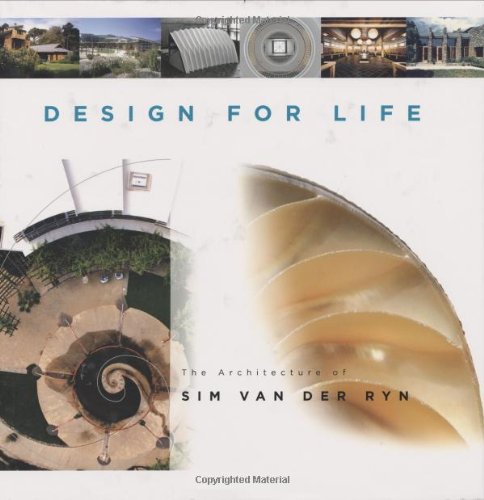
Imagen de portada de Amazon
Imagen de Amazon.com
Imagen de cubierta Syndetics
Portada de Syndetics
Imagen de OpenLibrary

Design for life : the architecture of Sim Van der Ryn. / Sim Van der Ryn txt

Por: Salt Lake City : Gibbs Smith, Publisher , 2005Edición: 1st editionDescripción: 183 p. ill.; col.; plans.; 26 cmTipo de contenido:
  • text
Tipo de medio:
  • unmediaded
Tipo de soporte:
  • volume
ISBN:
  • 9781586855307
  • 15868553010
Tema(s): Clasificación CDD:
  • 720/.47/092 22
Clasificación LoC:
  • NA737.V36 A2 2005
Contenidos:
Roots and seeds -- Branching out -- First generation ecological design -- Second generation ecological design -- Places of heart and spirit -- Making the great leap forward --
Resumen: Design for Life: The Architecture of Sim Van der Ryn surveys the work and principles of Sim Van der Ryn, a world leader in the field of sustainable architecture. Sharing his years of experience as a teacher and using his building designs as examples, the author shows us that buildings are not objects but organisms, and cities are not machines but complex ecosystems.
Valoración
    Valoración media: 0.0 (0 votos)
Existencias
Imagen de cubierta Tipo de ítem Biblioteca actual Biblioteca de origen Colección Ubicación en estantería Signatura topográfica Materiales especificados Info Vol URL Copia número Estado Notas Fecha de vencimiento Código de barras Reserva de ítems Prioridad de la cola de reserva de ejemplar Reservas para cursos
Libro CARIBET Biblioteca Arquitectura Colección General CARIBET General NA737.V36 A2 2005 (Navegar estantería(Abre debajo)) 1 Disponible 91000000013177
Total de reservas: 0

Descripciones mejoradas de Syndetics:

Design for Life: The Architecture of Sim Van der Ryn surveys the work and principles of Sim Van der Ryn, a world leader in the field of sustainable architecture. Sharing his years of experience as a teacher and using his building designs as examples, the author shows us that buildings are not objects but organisms, and cities are not machines but complex ecosystems.

Include index

Include Bibliography

Roots and seeds --
Branching out --
First generation ecological design --
Second generation ecological design --
Places of heart and spirit --
Making the great leap forward --

Design for Life: The Architecture of Sim Van der Ryn surveys the work and principles of Sim Van der Ryn, a world leader in the field of sustainable architecture. Sharing his years of experience as a teacher and using his building designs as examples, the author shows us that buildings are not objects but organisms, and cities are not machines but complex ecosystems.

Tabla de contenidos provista por Syndetics

  • Introduction
  • I Roots and Seeds
  • II Branching Out
  • III First Generation Ecological Design
  • IV Second Generation Ecological Design
  • V Places of Heart and Spirit
  • VI Making the Great Leap
  • Forward
  • Epilogue
  • Bibliography
  • Illustration Credits
  • Index

Extracto provisto por Syndetics

"At its boldest, architecture is a statement of an image of living, for the form living takes is the germ of an architecture." -Rob Straus, former student. Outlaw Building News, 1971 Where has beauty gone? Since our emergence as a species, humans have been making places and spaces. We've been designing them for the last thirty thousand years. All that practice has made us better at producing more material things, and doing it faster and cheaper. Our advancements in science and technology have provided the knowledge and tools that have allowed us to shape the material world in utterly fantastic ways. But we have lost our ability to create places of beauty, comfort, and durability that fit both the natural world and our own human nature. Architecture speaks volumes about the culture from which it springs. It is the physical manifestation of values, ideas, hopes, and dreams. Architecture is the human habitat, the environment of our own creation, the skin that separates us from the natural world. It is also a series of walls-physical and mental-that compartmentalize our perception of the world. It doesn't have to be. Sometime during the last century, architecture lost its soul. Modern culture developed the wealth, power, and technology to create structures that once seemed impossible. While the larger-than-life skyscrapers and the coldly postmodern structures of our time do inspire a detached sense of awe and wonder, very few appear to have qualities that truly move us. Buildings that we truly love are buildings that last. In our modern cities, there are very few that are loved. Beauty and spirit were integral to the works of earlier cultures and times. Today in Bali they still say, "We have no art; we just do everything well." When was the last time you were moved to tears by a building, or did not want to leave a place because it touched you at such a deep level? When was the last time you shivered, ecstatic, in a man-made place that tugged at something deep inside of you? We travel around the world to experience great works of architecture and cities of the past, but the architecture in which we spend most of our lives leaves us empty. Our buildings, our suburbs, and most of our cities are cold, lifeless, and disconnected from people. They are uninspiring. To inspire is to breathe life into. How can we make the buildings of our everyday lives fit our deepest human needs? We can design environments that inspire and nourish our souls, bringing architecture into deeper connection with our innermost self. How can we reconnect buildings and cities to the cycles and flows of the natural world that are the basis for all life on earth? The creation of buildings and the systems that support them-energy, water, waste, roads-is the largest industry in the United States and the industrialized world. This industry is the largest user of energy, materials, and open land and it is the largest polluter of air, water, and soil. We are still designing and building as though resources are unlimited, without regard to the waste and pollution caused by the construction and operation of buildings and the infrastructure necessary to support them. Excerpted from Design for Life: The Architecture of Sim Van der Ryn by Sim Van Der Ryn All rights reserved by the original copyright owners. Excerpts are provided for display purposes only and may not be reproduced, reprinted or distributed without the written permission of the publisher.

Reseñas proporcionadas por Syndetics

Library Journal Review

"Form follows flow" is the mantra of this highly personal autobiographical work about the life and career of Van der Ryn (architecture, Univ. of California, Berkeley; Sustainable Communities), considered the father of the modern green movement. Each of the six chapters of this richly illustrated monograph focuses on the various phases in his realizing, experimenting with, and developing sustainable architecture, which merges organic design with technology and ecology as well as integrating environment with habitat. The initial chapters, "Roots & Seeds" and "Branching Out," describe his early life, his training, and his emerging teaching career. The middle chapters, "First Generation Ecological Design" and "Second Generation Ecological Design," show the blossoming and fruition of his sustainable architecture projects. The concluding chapters, "Places of Heart & Spirit" and "Making the Great Leap Forward," show maturity in the design and function of religious and cultural centers like the San Francisco Zen Center and the radical Findhorn project in Scotland. The epilog ties the life and nature concepts together through Van der Ryn's own experiences and family life. Cohesive and user friendly, this book offers a fascinating look at life, design, and nature. Recommended for all types of libraries.-Stephen Allan Patrick, East Tennessee State Univ. Lib., Johnson City (c) Copyright 2010. Library Journals LLC, a wholly owned subsidiary of Media Source, Inc. No redistribution permitted.

Notas de autor provistas por Syndetics

Sim Van der Ryn is the president of Van der Ryn Architects, a northern California firm known worldwide for its work in sustainable architecture. He taught architecture and design at the University of California, Berkeley for more than thirty years, inspiring a new generation to create buildings and communities that are sensitive to place, climate, and the flow of human interactions. He is the author of six groundbreaking books about planning and design, including Sustainable Communities and Ecological Design. He lives and works in the San Francisco Bay area.
Compartir
logopucpr-y-vive

Contáctanos

¡Queremos saber de ti!

Tel. 787.841.2000 Ext. 1801

bibliotecavaldes@pucpr.edu

⁣Búscanos en las redes

© 2026 Desarrollado por Ignite Online • All Rights Reserved • Powered by Koha.