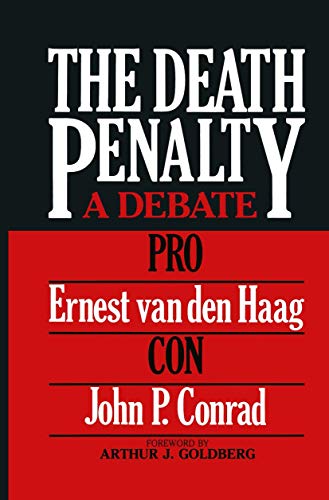

The death penalty a debate pro, Ernest van den Haag, con, John P. Conrad.
Detalles de publicación: New York Plenum Press c1983.Descripción: xiv, 305 p. 23 cmISBN:- 0306414163
- 364.6/6/0973 19
| Imagen de cubierta | Tipo de ítem | Biblioteca actual | Biblioteca de origen | Colección | Ubicación en estantería | Signatura topográfica | Materiales especificados | Info Vol | URL | Copia número | Estado | Notas | Fecha de vencimiento | Código de barras | Reserva de ítems | Prioridad de la cola de reserva de ejemplar | Reservas para cursos | |
|---|---|---|---|---|---|---|---|---|---|---|---|---|---|---|---|---|---|---|
| Libro | Biblioteca de Derecho Mons. Fremiot Torres Oliver Colección General biblioteca derecho | HV 8699 .U5 V36 1983 (Navegar estantería(Abre debajo)) | Disponible | 70000000014584 |
Descripciones mejoradas de Syndetics:
From 1965 until 1980, there was a virtual moratorium on executions for capital offenses in the United States. This was due primarily to protracted legal proceedings challenging the death penalty on constitutional grounds. After much Sturm und Drang, the Supreme Court of the United States, by a divided vote, finally decided that "the death penalty does not invariably violate the Cruel and Unusual Punishment Clause of the Eighth Amendment." The Court's decisions, however, do not moot the controversy about the death penalty or render this excellent book irrelevant. The ball is now in the court of the Legislature and the Executive. Leg islatures, federal and state, can impose or abolish the death penalty, within the guidelines prescribed by the Supreme Court. A Chief Executive can commute a death sentence. And even the Supreme Court can change its mind, as it has done on many occasions and did, with respect to various aspects of the death penalty itself, durlog the moratorium period. Also, the people can change their minds. Some time ago, a majority, according to reliable polls, favored abolition. Today, a substantial majority favors imposition of the death penalty. The pendulum can swing again, as it has done in the past.
Includes bibliographical references and index.
Tabla de contenidos provista por Syndetics
- Foreword(p. v)
- Preface(p. vii)
- Acknowledgments
- Introduction Before the Killing Stopped(p. 1)
- Introduction Death but Not Torture(p. 13)
- Chapter 1 The Retributivist's Case against Capital Punishment(p. 17)
- John P. Conrad(p. 17)
- Ernest Van Den Haag(p. 28)
- John P. Conrad(p. 36)
- Ernest Van Den Haag(p. 43)
- John P. Conrad(p. 45)
- Ernest Van Den Haag(p. 52)
- Ernest Van Den Haag(p. 53)
- Chapter 2 The Purpose of Punishment(p. 53)
- John P. Conrad(p. 57)
- Ernest Van Den Haag(p. 61)
- John P. Conrad(p. 62)
- Chapter 3 The Deterrent Effect of the Death Penalty(p. 63)
- Ernest Van Den Haag(p. 63)
- John P. Conrad(p. 66)
- Chapter 4 More on the Deterrent Effect of the Death Penalty(p. 67)
- Ernest Van Den Haag(p. 67)
- John P. Conrad(p. 70)
- Ernest Van Den Haag(p. 75)
- John P. Conrad(p. 77)
- Ernest Van Den Haag(p. 81)
- John P. Conrad(p. 82)
- Chapter 5 Does Deterrence Need Capital Punishment?(p. 83)
- John P. Conrad(p. 83)
- Ernest Van Den Haag(p. 95)
- John P. Conrad(p. 102)
- Ernest Van Den Haag(p. 109)
- John P. Conrad(p. 117)
- Ernest Van Den Haag(p. 127)
- Appendix to Chapter 5(p. 131)
- Chapter 6 Deterrence, the Death Penalty, and the Data(p. 133)
- John P. Conrad(p. 133)
- Ernest Van Den Haag(p. 142)
- John P. Conrad(p. 144)
- Ernest Van Den Haag(p. 153)
- John P. Conrad(p. 154)
- Ernest Van Den Haag(p. 157)
- Chapter 7 The Constitutional Question(p. 157)
- John P. Conrad(p. 162)
- Ernest Van Den Haag(p. 180)
- John P. Conrad(p. 184)
- Ernest Van Den Haag(p. 190)
- John P. Conrad(p. 191)
- Ernest Van Den Haag(p. 193)
- John P. Conrad(p. 195)
- Ernest Van Den Haag(p. 198)
- John P. Conrad(p. 199)
- Ernest Van Den Haag(p. 200)
- John P. Conrad(p. 201)
- Appendix to Chapter 7(p. 201)
- Ernest Van Den Haag(p. 201)
- Ernest Van Den Haag(p. 203)
- Chapter 8 Discrimination and Justice(p. 203)
- John P. Conrad(p. 207)
- Ernest Van Den Haag(p. 213)
- John P. Conrad(p. 218)
- Ernest Van Den Haag(p. 222)
- Ernest Van Den Haag(p. 223)
- Chapter 9 Justice and Equality(p. 223)
- John P. Conrad(p. 226)
- Ernest Van Den Haag(p. 229)
- John P. Conrad(p. 230)
- Ernest Van Den Haag(p. 230)
- John P. Conrad(p. 231)
- Chapter 10 Special Cases(p. 233)
- Ernest Van Den Haag(p. 233)
- John P. Conrad(p. 235)
- Ernest Van Den Haag(p. 240)
- Chapter 11 Popular Arguments(p. 241)
- Ernest Van Den Haag(p. 241)
- John P. Conrad(p. 248)
- Ernest Van Den Haag(p. 251)
- Chapter 12 Crimes of Passion(p. 253)
- Ernest Van Den Haag(p. 253)
- John P. Conrad(p. 256)
- Ernest Van Den Haag(p. 256)
- Chapter 13 Death, Rehabilitation, the Bible, and Human Dignity(p. 257)
- Ernest Van Den Haag(p. 257)
- John P. Conrad(p. 263)
- Ernest Van Den Haag(p. 268)
- John P. Conrad(p. 270)
- Ernest Van Den Haag(p. 271)
- Chapter 14 The Symbolic Meaning of the Death Penalty(p. 273)
- Ernest Van Den Haag(p. 273)
- John P. Conrad(p. 278)
- Ernest Van Den Haag(p. 281)
- Ernest Van Den Haag(p. 282)
- John P. Conrad(p. 282)
- Appendix to Chapter 14(p. 283)
- Chapter 15 The Abolitionist Rests(p. 289)
- Chapter 16 The Advocate Advocates(p. 297)
- Index(p. 301)