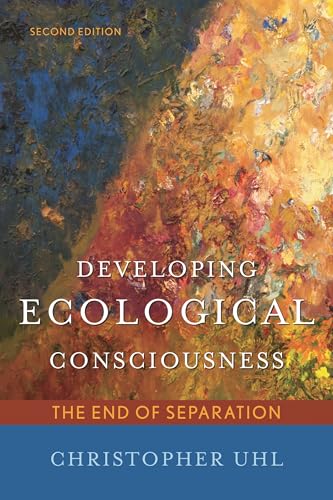

Developing ecological consciousness the end of separation Christopher Uhl.
Detalles de publicación: Lanham Rowman & Littlefield Publishers, Inc. c2013.Edición: Second editionDescripción: xv, 267 pages illustrations 23 cm Tipo de medio:- 9781442218314 (cloth : alk. paper)
- 9781442218321 (pbk. : alk. paper)
- 577 U31d2 23
- QH541 .U44 2013
| Imagen de cubierta | Tipo de ítem | Biblioteca actual | Biblioteca de origen | Colección | Ubicación en estantería | Signatura topográfica | Materiales especificados | Info Vol | URL | Copia número | Estado | Notas | Fecha de vencimiento | Código de barras | Reserva de ítems | Prioridad de la cola de reserva de ejemplar | Reservas para cursos | |
|---|---|---|---|---|---|---|---|---|---|---|---|---|---|---|---|---|---|---|
| Libro | Biblioteca Encarnación Valdés Colección General bev | 577 U31d2 (Navegar estantería(Abre debajo)) | Disponible | 80000002489162 |
Descripciones mejoradas de Syndetics:
Developing Ecological Consciousness is a marked departure from those standard environmental studies texts strongly focused on actions that humans need to take to fix the environment. Christopher Uhl explores the path to living in harmony with Earth, and believes it begins -- not with fixing the environment -- but with fixing ourselves -- specifically our perceptions about Earth.
Using findings from science and his own life experience Uhl explains how all our environmental and social problems -- e.g., climate change, species extinction, environmentally-linked cancers, genocide, deforestation -- are rooted in separation -- the severing of relationship between ourselves and the environment. As an antidote to separation, this book is an invitation to see everything -- Earth, Cosmos, Sun, Worm, Bee -- as well as each other and our very selves with "new eyes. This new look through the lens of relationship and interdependence reminds us of the larger ecological truth -- namely: that we are a part of, not apart from Earth. Indeed, at every level, from the sub-atomic to the cosmic, it is an interdependent relationship that defines reality.
Uhl places a large focus on healing throughout the book. As we break away from the old story of hyper-individualism, unrestrained growth, control and consumption, we move to a new story of human realization. Ultimately, this new story reveals that by making peace with ourselves and each other, we gain the capacity to make peace with Earth, delighting in the realization that Earth is our larger body, the sacred whole that we dwell within. Developing Ecological Consciousness successfully exposes the realization that must take place in order to rejoin the community of life; after all, the world was not made for us, but rather, it is we who have been made for the world.
Includes bibliographical references and index.
Tabla de contenidos provista por Syndetics
- Preface to New Edition(p. ix)
- Acknowledgments(p. xvii)
- Part I Earth, Our Home(p. 1)
- 1 Discovery: Belonging to Something Greater Than Ourselves(p. 5)
- 2 Coming to Awareness: A Living Planet(p. 29)
- 3 Cultivating Community: Intimacy with Earth's Web of Life(p. 55)
- Part II Assessing the Health of Earth(p. 85)
- 4 Listening: Gauging the Health of Earth(p. 89)
- 5 Courage: Facing Up to the Unraveling of the Biosphere(p. 117)
- 6 Living the Questions: Discovering the Causes of Earth Breakdown(p. 147)
- Part III Healing Ourselves, Healing Earth(p. 173)
- 7 The Old Story: Economism and Separation(p. 177)
- 8 Birthing a New Story: The Great Turning(p. 205)
- Epilogue(p. 237)
- Notes(p. 243)
- Index(p. 261)
- About the Author(p. 269)