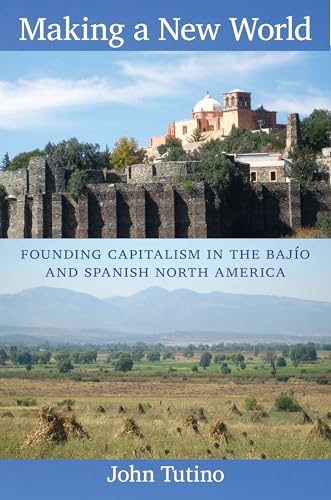

Making a new world founding capitalism in the Bajío and Spanish North America John Tutino.
Detalles de publicación: Durham [NC] Duke University Press 2011.Descripción: x, 698 p. ill., maps 24 cmISBN:- 9780822349747 (cloth : alk. paper)
- 9780822349891 (pbk. : alk. paper)
- 972.41 T966m 22
- F1246.6 .T88 2011
| Imagen de cubierta | Tipo de ítem | Biblioteca actual | Biblioteca de origen | Colección | Ubicación en estantería | Signatura topográfica | Materiales especificados | Info Vol | URL | Copia número | Estado | Notas | Fecha de vencimiento | Código de barras | Reserva de ítems | Prioridad de la cola de reserva de ejemplar | Reservas para cursos | |
|---|---|---|---|---|---|---|---|---|---|---|---|---|---|---|---|---|---|---|
| Libro | Biblioteca Encarnación Valdés Colección General bev | 972.41 T966m (Navegar estantería(Abre debajo)) | Disponible | 80000002505298 |
Descripciones mejoradas de Syndetics:
Making a New World is a major rethinking of the role of the Americas in early world trade, the rise of capitalism, and the conflicts that reconfigured global power around 1800. At its center is the Bajío, a fertile basin extending across the modern-day Mexican states of Guanajuato and Querétaro, northwest of Mexico City. The Bajío became part of a new world in the 1530s, when Mesoamerican Otomís and Franciscan friars built Querétaro, a town that quickly thrived on agriculture and trade. Settlement accelerated as regional silver mines began to flourish in the 1550s. Silver tied the Bajío to Europe and China; it stimulated the development of an unprecedented commercial, patriarchal, Catholic society. A frontier extended north across vast expanses settled by people of European, Amerindian, and African ancestry. As mining, cloth making, and irrigated cultivation increased, inequities deepened and religious debates escalated. Analyzing the political economy, social relations, and cultural conflicts that animated the Bajío and Spanish North America from 1500 to 1800, John Tutino depicts an engine of global capitalism and the tensions that would lead to its collapse into revolution in 1810.
Includes bibliographical references (p. 665-683) and index.
Prologue : making global history in the Spanish Empire -- Introduction : a new world: the Bajío, Spanish North America, and global capitalism -- Founding the Bajío: Otomí expansion, Chichimeca war, and commercial Querétaro, 1500-1660 -- Forging Spanish North America : northward expansion, mining amalgamations, and patriarchal communities, 1590-1700 -- New world revivals : silver boom, city lives, awakenings, and northward drives, 1680-1760 -- Reforms, riots, and repressions : the Bajío in the crisis of the 1760s -- Capitalist, priest, and patriarch: Don José Sánchez Espinosa and the great family enterprises of Mexico City, 1780-1810 -- Production, patriarchy, and polarization in the cities: Guanajuato, San Miguel, and Querétaro, 1770-1810 -- The challenge of capitalism in rural communities: production, ethnicity, and patriarchy from La Griega to Puerto de Nieto, 1780-1810 -- Enlightened reformers and popular religion: polarizations and mediations, 1770-1810 -- Conclusion: the Bajío and North America in the Atlantic crucible.
Notas de autor provistas por Syndetics
John Tutino teaches the history of Mexico and the Americas in the History Department and the School of Foreign Service at Georgetown University. He is the author of From Insurrection to Revolution in Mexico: Social Bases of Agrarian Violence, 1750-1940 , and a co-editor of Cycles of Conflict, Centuries of Change: Crisis, Reform, and Revolution in Mexico , also published by Duke University Press.