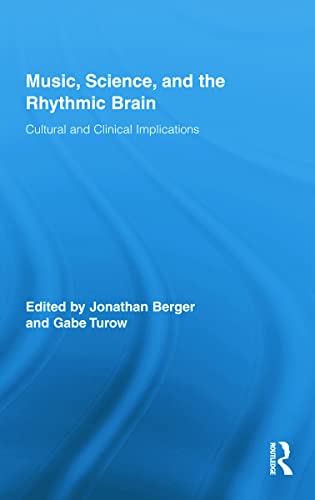

Music, science, and the rhythmic brain cultural and clinical implications edited by Jonathan Berger and Gabe Turow.
Series Routledge research in music ; 1Detalles de publicación: New York Routledge 2011.Descripción: xiv, 215 p. ill. 24 cmISBN:- 9780415890595 (alk. paper)
- 0415890594 (alk. paper)
- 781.11 M9872 22
- ML3820 .M876 2011
| Imagen de cubierta | Tipo de ítem | Biblioteca actual | Biblioteca de origen | Colección | Ubicación en estantería | Signatura topográfica | Materiales especificados | Info Vol | URL | Copia número | Estado | Notas | Fecha de vencimiento | Código de barras | Reserva de ítems | Prioridad de la cola de reserva de ejemplar | Reservas para cursos | |
|---|---|---|---|---|---|---|---|---|---|---|---|---|---|---|---|---|---|---|
| Libro | Biblioteca Encarnación Valdés Colección General bev | 781.11 M9872 (Navegar estantería(Abre debajo)) | Disponible | 80000002463399 |
Descripciones mejoradas de Syndetics:
This book studies the effects of repetitive musical rhythm on the brain and nervous system, and in doing so integrates diverse fields including ethnomusicology, psychology, neuroscience, anthropology, religious studies, music therapy, and human health. It presents aspects of musical rhythm and biological rhythms, and in particular rhythmic entrainment, in a way that considers cultural context alongside theoretical research and discussions of potential clinical and therapeutic implications. Considering the effects of drumming and other rhythmic music on mental and bodily functioning, the volume hypothesizes that rhythmic music can have a dramatic impact on mental states, sometimes catalyzing profound changes in arousal, mood, and emotional states via the stimulation of changes in physiological functions like the electrical activity in the brain. The experiments presented here make use of electroencephalography (EEG), galvanic skin response (GSR), and subjective measures to gain insight into how these mental states are evoked, what their relationship is to the music and context of the experience, and demonstrate that they are happening in a consistent and reproducible fashion, suggesting clinical applications. This comprehensive volume will appeal to scholars in cognition, ethnomusicology, and music perception who are interested in the therapeutic potential of music.
Includes bibliographical references and index.
Notas de autor provistas por Syndetics
Jonathan Berger is Professor of Music at Stanford University.
Gabe Turowis a Research Associate at The Center for Computer Research in Music and Acoustics and the Stanford Institute for Creativity and the Arts at Stanford University. In 2005, he co-founded the Stanford Annual International Symposium Series on Music, Rhythm, and the Brain, and in 2008, established the UCSF Children's Hospital Music Program. Turow is finishing his music therapy licensing process (MT-BC) and Neurologic Music Therapy (NMT) certification, both of which he expects to complete by the summer of 2011. He is currently an Artist in Residence at Branson High School, in Ross, CA where he teaches ceramics and music.
A professional instrument maker and ceramicist (StoneInstruments.com), his work is currently on display at the Parse gallery in New Orleans.