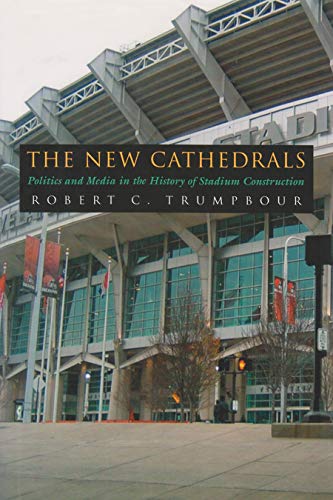

The New Cathedrals : politics and media in the history of stadium construction. / Robert C. Trumpbour. txt
Series Sports and entertainmentUnited States of America : Syracuse University Press , 2007Edición: First editionDescripción: xi, 373 p. 24 cmTipo de contenido:- text
- unmediaded
- volume
- 9780815631323
- 0815631324
- 725/.8043 22
- GV413 T78 2007
| Imagen de cubierta | Tipo de ítem | Biblioteca actual | Biblioteca de origen | Colección | Ubicación en estantería | Signatura topográfica | Materiales especificados | Info Vol | URL | Copia número | Estado | Notas | Fecha de vencimiento | Código de barras | Reserva de ítems | Prioridad de la cola de reserva de ejemplar | Reservas para cursos | |
|---|---|---|---|---|---|---|---|---|---|---|---|---|---|---|---|---|---|---|
| Libro | CARIBET Biblioteca Arquitectura Colección General CARIBET | General GV413 T78 2007 (Navegar estantería(Abre debajo)) | 1 | Disponible | 91000000025593 |
Descripciones mejoradas de Syndetics:
Stadium construction has altered the physical landscape of many major metropolitan areas throughout North America and has had a profound psychological and economic impact on these urban centers. The ways athletic facilities have been constructed, from the ritual-centered beginnings of stadium construction in ancient Greece to the large-scale construction of professional sports facilities in present day global centers, reveal a culture's values and priorities and how it defines its recreational needs.
Drawing on thorough and wide-ranging research, Robert C. Trumpbour examines the political institutions, commercial entities, civic leadership, and media organizations that influenced stadium construction. The author analyzes three significant recent historical periods: the Progressive Era, when modern fireproof stadiums were first built; the late 1960s and early 1970s, when multipurpose stadiums were built in downtown areas to promote urban redevelopment; and the late 1990s, when retro ballparks were designed to accommodate commercial and entertainment space. Charting this evolution,
Trumpbour convincingly argues that there has been a dramatic shift in the role of the media, with media access emerging as a vital element in setting the ground rules for the debate on stadium construction. Written in lucid, jargon-free prose, this book combines a detailed history of stadium construction with an analysis of current stadium issues.
Include index.
Includes bibliographical references (p. 349-357)
Contents :
Preface vii --
Introduction --
Stadium history: religious roots and the transition to secularism --
Stadium economics: separating myth from reality --
The media and stadium construction --
Cincinnati: let's build two --
Pittsburgh: power politics and steely persistence --
Boston: history, mystery, and political football --
New York, part one: stadium origins to the modern era --
New York, part two: the Olympics, the Jets, and Manhattan --
The new cathedrals as a reflection of our broader culture --
"Drawing on thorough and wide-ranging research, Robert C. Trumpbour examines the political institutions, commercial entities, civic leadership, and media organizations that influenced stadium construction. The author analyzes three significant recent historical periods: the Progressive Era, when modern fireproof stadiums were first built; the late 1960s and early 1970s, when multipurpose stadiums were built in downtown areas to promote urban redevelopment; and the late 1990s, when retro ballparks were designed to accommodate commercial and entertainment space. Charting this evolution, Trumpbour argues that there has been a dramatic shift in the role of the media, with media access emerging as a vital element in setting the ground rules for the debate on stadium construction." --