Reseñas proporcionadas por Syndetics
Library Journal Review
With a quick flip of these pages, freshi readers can avoid looking like clunks, and figure out if they should be pleased or insulted if told they're wearing a severe shirt. Thorne (innovations consultant, King's Coll., London) includes about 20 percent new material in this fourth edition. The approximately 7,000 entries were collected by monitoring broadcasts, printed material, and the Internet, as well as through personal research and Thorne's wide network of slang enthusiasts. Entries are heavily tilted toward British usage, though American and Australian slang appears, too. Insults, off-color expressions, and terms regarding sex, body parts, and bodily functions represent a significant percentage of the material. Scholars may find Thorne's 11-page preliminary discussion of the purpose and function of slang intriguing, and browsers can flip through the pages, stopping when a boldface word or boxed comment catches their eye. The definitions are clear and lively and the word usage itself is often quite humorous. VERDICT This book will attract readers who want to seem hep rather than hilljack with their nabes and BFFs. Most suitable for college libraries, or public libraries in large urban areas. Maggie Knapp, Trinity Valley Sch., Fort Worth, TX (c) Copyright 2014. Library Journals LLC, a wholly owned subsidiary of Media Source, Inc. No redistribution permitted.
CHOICE Review
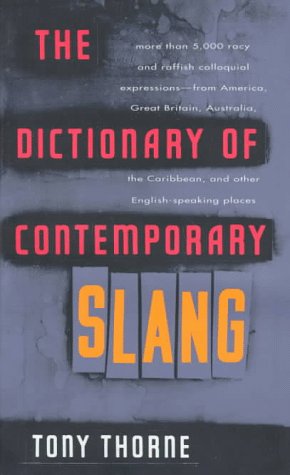
This fourth edition (1st ed., CH, Sep'92, 30-0060) of the Dictionary of Contemporary Slang is 20 percent new and continues its emphasis on the current language of young people, especially in the UK. Thorne (King's College London) collects words and phrases by listening to people, who are then asked to discuss and give examples of how the terms are used. This close connection between spoken language and ordinary people gives the collection immediacy and legitimacy. The dictionary indicates regional origins (e.g., British, American, Australian) "unless a word is used in all parts of the English-speaking world." In its nearly 500 pages, with over 7,000 definitions, words such as "addy," "barking moonbat," and "helioproctosis" sit aside more familiar terms such as "cougar" (in the older-woman sense) and "jalopy." Thorne is a noted British lexicographer, and his book is most useful for collections wanting the latest in British slang, including bawdy, vulgar, and repurposed words that currently enliven informal speech. --Pamela Palmer, University of Memphis
Booklist Review
The purpose of this dictionary is to "describe the core of English slang in use between 1950 and 1990." To this end, approximately 15,000 definitions "most likely to be encountered by anyone reading fiction or journalism, listening to popular music, watching films and television, or taking part in conversation" are provided. Originally published in Great Britain as The Bloomsbury Dictionary of Contemporary Slang, it contains slang that is used in the U.S. as well. Entries include part-of-speech designation, a regional label, definitions, and illustrative phrases or quotes (illustrative quotes are followed by a citation). Although there exist many dictionaries of slang, the focus of this one makes it different. It includes much slang from the categories of crime, sex, alcohol and drugs, peculiarities of physique and personality, colleges, schools, youth cults, the workplace, and the media and entertainment industries. This focus differs from the approach taken by Spears' Contemporary American Slang [RBB Je 1 91], which focuses on American collegiate wordplay for nonnative speakers of English, as well as from the scholarly approaches taken by Partridge's Concise Dictionary of Slang and Unconventional English [RBB Ap 1 91] and Chapman's New Dictionary of American Slang [RBB D 15 86], in which a stricter definition of slang is employed and more stringent referencing is provided. Although the review title's approach is similar to Spears' 1981 Slang and Euphemism (Jonathan David), its 1990 copyright date allows it to include more recent terms (e.g., aardvark, meaning hard work, which the author recorded being said by an undergraduate student at London University in 1988), as well as a plethora of Australian slang that has increasingly penetrated the English-speaking world. This compilation involved interviews with "teachers, colleagues and parents of slang users, and `connoisseurs' or collectors of slang"; eavesdropping on other people's conversations; reading magazines, newspapers, comic books, and novels; watching films and television broadcasts; and listening to/reading song lyrics. Potential selectors should be aware that the book contains graphic slang and blunt definitions. This dictionary fills a niche. It is not bound by strict definitions of what slang is, nor is it bound by conventions of citation and reference checking (e.g., it defines many words for which the only reference is the author's personal recording of it). Although not essential, it will have utility in academic, public, and, with the aforementioned caveat, school libraries. (Reviewed Oct. 15, 1991)