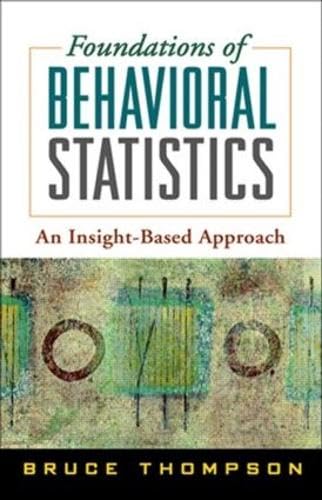

Foundations of behavioral statistics an insight-based approach Bruce Thompson.
Detalles de publicación: New York Guilford Press c2006.Descripción: xii, 457 p. ill. 26 cmISBN:- 1593852851 (hardcover)
- 9781593852856
- 150.15195 T4681f 22
- BF39 .T473 2006
| Imagen de cubierta | Tipo de ítem | Biblioteca actual | Biblioteca de origen | Colección | Ubicación en estantería | Signatura topográfica | Materiales especificados | Info Vol | URL | Copia número | Estado | Notas | Fecha de vencimiento | Código de barras | Reserva de ítems | Prioridad de la cola de reserva de ejemplar | Reservas para cursos | |
|---|---|---|---|---|---|---|---|---|---|---|---|---|---|---|---|---|---|---|
| Libro | Biblioteca Encarnación Valdés Colección General bev | 150.15195 T4681f (Navegar estantería(Abre debajo)) | Disponible | 80000002408980 |
Descripciones mejoradas de Syndetics:
With humor, extraordinary clarity, and carefully paced explanations and examples, Bruce Thompson shows readers how to use the latest techniques for interpreting research outcomes as well as how to make statistical decisions that result in better research. Utilizing the general linear model to demonstrate how different statistical methods are related to each other, Thompson integrates a broad array of methods involving only a single dependent variable, ranging from classical and robust location descriptive statistics, through effect sizes, and on through ANOVA, multiple regression, loglinear analysis and logistic regression. Special features include SPSS and Excel demonstrations that offer opportunities, in the book's datasets and on Thompson's website, for further exploration of statistical dynamics.
Includes bibliographical references (p. 431-448) and index.
Introductory terms and concepts -- Location -- Dispersion -- Shape -- Bivariate relationships -- Statistical significance -- Practical significance -- Multiple regression analysis : basic GLM concepts -- A GLM interpretation rubric -- One-way analysis of Variance (ANOVA) -- Multiway and other alternative ANOVA models -- The general linear model (GLM) : ANOVA via regression -- Some logistic models : model fitting in a logistic context.
Tabla de contenidos provista por Syndetics
- 1 Introductory Terms and Concepts(p. 1)
- Definitions of Some Basic Terms(p. 3)
- Levels of Scale(p. 13)
- Some Experimental Design Considerations(p. 24)
- Some Key Concepts(p. 30)
- Reflection Problems(p. 30)
- 2 Location(p. 31)
- Reasonable Expectations for Statistics(p. 32)
- Location Concepts(p. 33)
- Three Classical Location Descriptive Statistics(p. 36)
- Four Criteria for Evaluating Statistics(p. 46)
- Two Robust Location Statistics(p. 47)
- Some Key Concepts(p. 49)
- Reflection Problems(p. 49)
- 3 Dispersion(p. 53)
- Quality of Location Descriptive Statistics(p. 54)
- Important in Its Own Right(p. 54)
- Measures of Score Spread(p. 57)
- Variance(p. 62)
- Situation-Specific Maximum Dispersion(p. 67)
- Robust Dispersion Descriptive Statistics(p. 69)
- Standardized Score World(p. 70)
- Some Key Concepts(p. 72)
- Reflection Problems(p. 73)
- 4 Shape(p. 75)
- Two Shape Descriptive Statistics(p. 76)
- Normal Distributions(p. 86)
- Two Additional Univariate Graphics(p. 91)
- Some Key Concepts(p. 94)
- Reflection Problems(p. 95)
- 5 Bivariate Relationships(p. 97)
- Pearson's r(p. 99)
- Three Features of r(p. 101)
- Three Interpretation Contextual Factors(p. 110)
- Psychometrics of the Pearson r(p. 116)
- Spearman's rho(p. 118)
- Two Other r-Equivalent Correlation Coefficients(p. 124)
- Bivariate Normality(p. 128)
- Some Key Concepts(p. 130)
- Reflection Problems(p. 131)
- 6 Statistical Significance(p. 133)
- Sampling Distributions(p. 135)
- Hypothesis Testing(p. 142)
- Properties of Sampling Distributions(p. 150)
- Standard Error/Sampling Error(p. 154)
- Test Statistics(p. 156)
- Statistical Precision and Power(p. 169)
- Pcalculated(p. 177)
- Some Key Concepts(p. 182)
- Reflection Problems(p. 182)
- 7 Practical Significance(p. 185)
- Effect Sizes(p. 187)
- Confidence Intervals(p. 200)
- Confidence Intervals for Effect Sizes(p. 207)
- Some Key Concepts(p. 210)
- Reflection Problems(p. 211)
- 8 Multiple Regression Analysis: Basic GLM Concepts(p. 215)
- Purposes of Regression(p. 217)
- Simple Linear Prediction(p. 220)
- Case #1 Perfectly Uncorrelated Predictors(p. 232)
- Case #2 Correlated Predictors, No Suppressor Effects(p. 234)
- Case #3 Correlated Predictors, Suppressor Effects Present(p. 237)
- [beta] Weights versus Structure Coefficients(p. 240)
- A Final Comment on Collinearity(p. 244)
- Some Key Concepts(p. 245)
- Reflection Problems(p. 246)
- 9 A GLM Interpretation Rubric(p. 247)
- Do I Have Anything?(p. 248)
- Where Does My Something Originate?(p. 266)
- Stepwise Methods(p. 270)
- Invoking Some Alternative Models(p. 278)
- Some Key Concepts(p. 299)
- Reflection Problems(p. 300)
- 10 One-Way Analysis of Variance (ANOVA)(p. 303)
- Experimentwise Type I Error(p. 304)
- ANOVA Terminology(p. 309)
- The Logic of Analysis of Variance(p. 311)
- Practical and Statistical Significance(p. 317)
- The "Homogeneity of Variance" Assumption(p. 319)
- Post Hoc Tests(p. 325)
- Some Key Concepts(p. 329)
- Reflection Problems(p. 330)
- 11 Multiway and Other Alternative ANOVA Models(p. 333)
- Multiway Models(p. 333)
- Factorial versus Nonfactorial Analyses(p. 343)
- Fixed-, Random-, and Mixed-Effects Models(p. 345)
- Brief Comment on ANCOVA(p. 354)
- Some Key Concepts(p. 357)
- Reflection Problems(p. 358)
- 12 The General Linear Model (GLM): ANOVA via Regression(p. 359)
- Planned Contrasts(p. 360)
- Trend/Polynomial Planned Contrasts(p. 375)
- Repeated-Measures ANOVA via Regression(p. 380)
- GLM Lessons(p. 385)
- Some Key Concepts(p. 390)
- Reflection Problems(p. 391)
- 13 Some Logistic Models: Model Fitting in a Logistic Context(p. 393)
- Logistic Regression(p. 394)
- Loglinear Analysis(p. 413)
- Some Key Concepts(p. 423)
- Reflection Problems(p. 424)
- Appendix Scores (n = 100) with Near Normal Distributions(p. 427)
- References(p. 431)
- Index(p. 449)
- About the Author(p. 457)