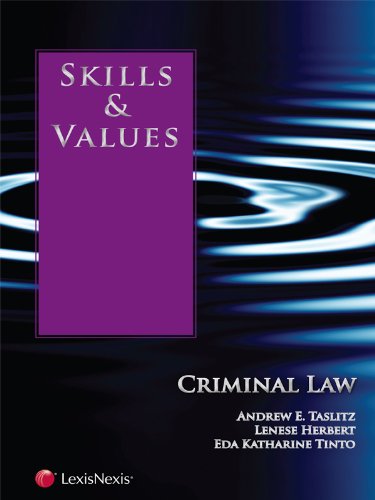

Skills and values. Criminal law Andrew E. Taslitz, Director, Criminal Justice Practice and Policy Institute, Washington College of Law, American University; Lenese C. Herbert, Professor of Law, Howard University School of Law; Eda Katharine Tinto, Benjamin N. Cardozo School of Law.
Editor: New Providence, NJ LexisNexis [2014]Descripción: xiii, 202 pages illustrations 26 cm Tipo de medio:- 9781422484753 (pbk.)
- 1422484750 (pbk.)
- Criminal law
- 345.73 23
- KF 9219 .T37 2014
| Imagen de cubierta | Tipo de ítem | Biblioteca actual | Biblioteca de origen | Colección | Ubicación en estantería | Signatura topográfica | Materiales especificados | Info Vol | URL | Copia número | Estado | Notas | Fecha de vencimiento | Código de barras | Reserva de ítems | Prioridad de la cola de reserva de ejemplar | Reservas para cursos | |
|---|---|---|---|---|---|---|---|---|---|---|---|---|---|---|---|---|---|---|
| Libro | Biblioteca de Derecho Mons. Fremiot Torres Oliver Colección General biblioteca derecho | KF 9219 .T37 2014 (Navegar estantería(Abre debajo)) | Disponible | 70000000897137 |
Descripciones mejoradas de Syndetics:
In order to better prepare students for the practice of law, legal education must bridge the gap between law school and lawyering by introducing lawyering skills and values to the law school curriculum. Skills and Values: Criminal Law fuses fact-creation and interpretation with traditional substantive law application in the same manner that practicing lawyers do, and exposes students to many of the essential tasks inherent in the practice of criminal law via an integrated approach, blending both traditional instruction with "Best Practices" reform, so that students may enjoy an interactive, skills-based, 21st-century approach to the study of Criminal Law.
Skills and Values: Criminal Law provides students an overview of key criminal substantive law and a series of exercises (composed of tasks) that includes complex fact patterns, relevant state or federal law (case and codified), and skills guides. This material enables students to explore actual legal issues and develop problem-solving skills in ways that arise in a criminal law practice, from both a defense and prosecution point of view. This approach is not typically found in a first year Criminal Law class. The combined use of common law, Model Penal Code, jury instructions, and "real" state and federal statutes is also a virtue. Real-world statutes add realism and frequently come with legislative history and applicable caselaw, enabling students to practice statutory interpretation with challenging novel issues as well as more mundane ones.
Charging and sentencing -- Statutory interpretation -- Actus Reus -- Mens Rea basics -- Mens Rea complications and failure of proof -- Defenses -- The proof process : burdens of production and persuasion and proof planning -- Homicide I -- Homicide II, manslaughter and felony murder -- Rape -- Attempt and solicitation -- Conspiracy -- Accomplice liability -- Self-defense -- Entrapment and outrageous government conduct -- Intoxication, insanity, and competency -- The death penalty.