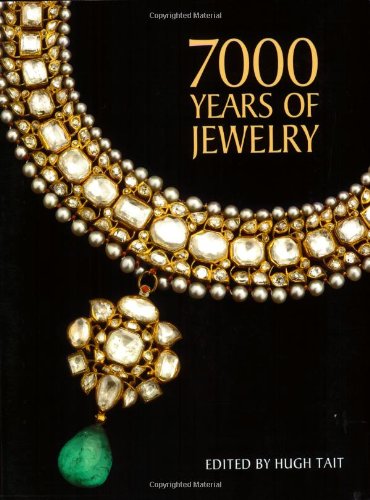

7000 years of jewelry edited by Hugh Tait.
Detalles de publicación: Richmond Hill, Ont. Firefly Books 2008.Descripción: 256 p. ill. (chiefly col.), maps 28 cmISBN:- 9781554073955 (pbk.)
- 1554073952 (pbk.)
- Seven thousand years of jewellery
- 739.27097/42142 22
- NK7306 .A15 2008
| Imagen de cubierta | Tipo de ítem | Biblioteca actual | Biblioteca de origen | Colección | Ubicación en estantería | Signatura topográfica | Materiales especificados | Info Vol | URL | Copia número | Estado | Notas | Fecha de vencimiento | Código de barras | Reserva de ítems | Prioridad de la cola de reserva de ejemplar | Reservas para cursos | |
|---|---|---|---|---|---|---|---|---|---|---|---|---|---|---|---|---|---|---|
| Referencia | Biblioteca Encarnación Valdés Sala de Referencia bev | 739.2709 S4973 (Navegar estantería(Abre debajo)) | Disponible | 80000002488859 |
Descripciones mejoradas de Syndetics:
"A mind-boggling feat, this survey of 7000 years of glittering memorabilia of lost empires, royal egos, superstition and sentiment."
--New York Times Book Review
The most comprehensive and beautifully illustrated history of jewelry.
The previous edition of this exhaustive survey was published to critical acclaim by the British Museum Press. Since publication, the museum has expanded its collection, with major acquisitions of pieces from Europe and Asia. The new edition includes a complete revision of the section on Europe after 1700, plus revisions to the sections on Celtic Europe, Roman Britain, cameos and finger rings.
The book explores the varied styles, techniques and materials used to make jewelry in many civilizations throughout the world and across the millennia. Egyptian necklaces, Celtic torcs, South American gold masks, Renaissance pendants and Art Nouveau buckles are examples of the range of the masterpieces described and illustrated with 400 superb photographs.
7000 Years of Jewelry takes readers on an impressive tour that includes, among other times and places:
The Middle East: 5000-2000 BC Egypt: 1500-900 BC Phoenician, Greek, Etruscan and Persian Lands: 850-325 BC China, Celtic Europe, Mexico and Peru: 600 BC-AD 600 The Mediterranean, India, Egypt, Roman Britain and Byzantium: 325 BC-AD 600 Europe, China, Korea and Japan: AD 300-1000 Mayan Central America: AD 600-1000 Central and South America: AD 500-1500 Europe, Islam, China, Korea and Java: AD 1000-1500 China, India, Tibet and Mongolia: AD 1500-1850 West Africa: AD 1500-1800 Europe: AD 1500-1950.More comprehensive than before, this reference remains the finest and most beautifully illustrated history of jewelry ever published.
Includes bibliographical references (p. 250-252) and index.
Tabla de contenidos provista por Syndetics
- List of Contributors
- Preface
- Introduction
- 1 The Middle East: 5000-2000 BC
- 2 The Middle East, Eastern Mediterranean and North of the Alps: 2000-1400 BC
- 3 Egypt: 1500-900 BC
- 4 Europe and Western Asia, 1400-600 BC
- 5 Phoenician, Greek, Etruscan and Persian Lands: 850-325 BC
- 6 China, Celtic Europe, Mexico and Peru: 600 BC-AD 600
- 7 The Mediterranean, Parthia, India, Egypt, Roman Britain and Byzantium: 325 BC-AD 600
- 8 Europe, China, Korea and Japan: AD 300-1000
- 9 Mayan Central America: AD 600-1000
- 10 Central and South America: AD 500-1500
- 11 Europe, Islam, China, Korea and Java: AD 1000-1500
- 12 Europe: AD 1500-1700
- 13 China, India, Tibet and Mongolia: AD 1500-1850
- 14 West Africa: AD 1500-1800
- 15 Europe: AD 1700-1950
- 16 Amulets
- 17 Cameos in Jewellery
- 18 Functional Finger-rings
- Select Glossary
- References for the illustrations
- Bibliography
- Further Reading
- Index
Extracto provisto por Syndetics
Notas de autor provistas por Syndetics
Hugh Tait, deputy keeper at the British Museum and an internationally acknowledged expert on the European decorative arts, was a Fellow of the Society of Antiquaries and a former president of the Society of Jewellery Historians. The author of 5,000 Years of Glass and editor of The Art of the Jeweller , he died in 2005.