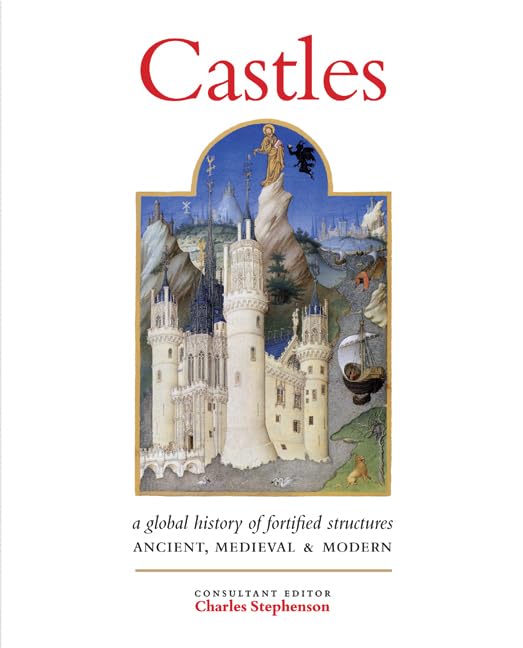

Castles : a history of fortified structures : ancient, medieval & modern. / consultant editor, Charles Stephenson. txt
New York : St. Martin's Griffin , 2011Edición: 1st U.S. editionDescripción: 288 p. ill.; col.; maps.; 26 cmTipo de contenido:- text
- unmediaded
- volume
- 9780312541408
- 0312541406
- 728.81 23
- NA7710 C37 2011
| Imagen de cubierta | Tipo de ítem | Biblioteca actual | Biblioteca de origen | Colección | Ubicación en estantería | Signatura topográfica | Materiales especificados | Info Vol | URL | Copia número | Estado | Notas | Fecha de vencimiento | Código de barras | Reserva de ítems | Prioridad de la cola de reserva de ejemplar | Reservas para cursos | |
|---|---|---|---|---|---|---|---|---|---|---|---|---|---|---|---|---|---|---|
| Libro | CARIBET Biblioteca Arquitectura Colección General CARIBET | General NA7710 C37 2011 (Navegar estantería(Abre debajo)) | 1 | Disponible | 91000000030304 |
Descripciones mejoradas de Syndetics:
While the word "castle" conjures up an image of the classic medieval stone edifice, resplendent with towers and turrets, battlements and barbicans, and the odd oubliette, the impulse to build defensive works is as old as civilization itself; and the evolution of such architecture not only encompasses global cultures but is also a physical expression of the changing face of military tactics and technology.
Castles takes a uniquely architectural approach to deconstructing all forms of fortification, showing how the work of architect, stonemason, and engineer evolved to repel the increasingly destructive power of an attack, from siege engine to artillery. While the medieval castle is analyzed in detail, the book addresses a broad chronology of defenses--from the earliest fortresses and walled cities of the ancient world through to the point in the 19th century when modern weapons forced armies underground. Castles uses stylish two-tone engravings to dissect a wealth of examples from both western and eastern cultures; "anatomies" that annotate the classic structures for both their architectural and military significance; and "Then and Now" features that offer unique comparisons between castles in their pomp as depicted in illuminated manuscripts, mosaics, maps, and paintings, and matching color photographs of those same castles as they appear today. This architectural review of soaring towers and redoubtable walls provides both a fascinating narrative and an essential visual reference for the general and military historian.
Include index
Include Bibliography
Introduction --
Section 1 The Ancient World --
Timeline --
Locater Map --
Chapter 1 Ancient Near East --
Chapter 2 Ancient Europe --
Section 2 Western Castles of the Middles Ages --
Timeline --
Locater Map --
Chapter 3 Early British medieval castles, 1066-1200 --
Chapter 4 Late British medieval castles, 1200-1500 --
Chapter 5 French medieval castles --
Section 3: Eastern castles of the Middle Ages & Early Modern Period --
Timeline --
Locater Map --
Chapter 6 Islamic & Crusader castles --
Chapter 7 Russian Kremlins --
Chapter 8 Indian fortresses --
Section 4: Castles of East Asia --
Timeline --
Locater Map --
Chapter 9 Chinese walls --
Chapter 10 Japanese castles --
Section 5: Modern Fortresses --
Timeline --
Locater Map --
Chapter 11 Responses to gunpowder --
Chapter 12 North American colonial forts --
Chapter 13 Eighteenth-century artillery fortresses --
Chapter 14 Modern navel fortresses --
Chapter 15 Polygonal forts --
Glossary --
Resources --
Gazetteer --
While the word "castle" conjures up an image of the classic medieval stone edifice, resplendent with towers and turrets, battlements and barbicans, and the odd oubliette, the impulse to build defensive works is as old as civilization itself; and the evolution of such architecture not only encompasses global cultures but is also a physical expression of the changing face of military tactics and technology. Castles takes a uniquely architectural approach to deconstructing all forms of fortification, showing how the work of architect, stonemason, and engineer evolved to repel the increasingly destructive power of an attack, from siege engine to artillery. While the medieval castle is analyzed in detail, the book addresses a broad chronology of defenses from the earliest fortresses and walled cities of the ancient world through to the point in the 19th century when modern weapons forced armies underground. Castles uses stylish two-tone engravings to dissect a wealth of examples from both western and eastern cultures; "anatomies" that annotate the classic structures for both their architectural and military significance; and "Then and Now" features that offer unique comparisons between castles in their pomp as depicted in illuminated manuscripts, mosaics, maps, and paintings, and matching color photographs of those same castles as they appear today. This architectural review of soaring towers and redoubtable walls provides both a fascinating narrative and an essential visual reference for the general and military historian.
Examines the development and function of castle, forts, walls, fortifications, and fortified cities throughout history.
Reseñas proporcionadas por Syndetics
Library Journal Review
Hackers should love this book. Nowadays, one can engineer a breach remotely-so much less trouble than getting through mighty, old-fashioned fortress walls! And they should be able to relate to the way fortification developed through history: just as the defender engineered the height of protection, the invader would devise a better means of trespass. The insurmountable contravention for castles was the development of guns and gunpowder. The insurmountable contravention when it comes to hacking remains to be seen. Stephenson, a historian and author (Moel Famau and the Jubilee Tower of King George III), does a splendid job of guiding the general reader through the global history and development of the fortified structure. Architectural examples from the ancient Middle East, Russia, and India are a nice addition to the Western medieval castles we typically see. Verdict Visually wonderful for the armchair traveler/historian, though the small-print captions and the print overlaying the illustrations can be a bit difficult on the eyes.-Nadine Dalton Speidel, Cuyahoga Cty. P.L., Parma, OH (c) Copyright 2011. Library Journals LLC, a wholly owned subsidiary of Media Source, Inc. No redistribution permitted.Notas de autor provistas por Syndetics
Consultant Editor CHARLES STEPHENSON is a historian and writer, whose recent military titles include: Servant to the King for His Fortifications: Paul Ive and the Practise of Fortification ; The Admiral's Secret Weapon ; Fortifications of the Channel Islands, 1941-45: Hitler's Impregnable Fortress ; and The Fortifications of Malta, 1530-1945 . He is currently working on a history of the Italo- Ottoman War of 1911-12.