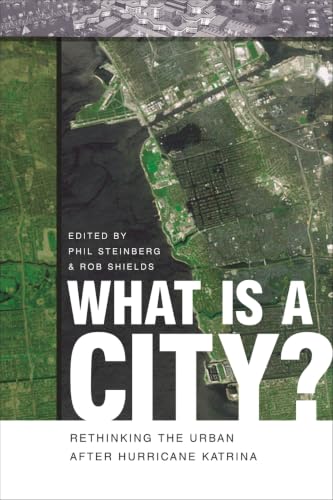

Whats is a city? : rethinking the urban after the hurricane Katrina. / Edited by Phil Steinberg & Rob Shields. txt
Athens ; London : The University of Georgia Press , 2008Descripción: viii, 233p. ill. ; maps ; 23cmTipo de contenido:- text
- unmediaded
- volume
- 9780820330945
- 307.21
- HT167 W43 2008
| Imagen de cubierta | Tipo de ítem | Biblioteca actual | Biblioteca de origen | Colección | Ubicación en estantería | Signatura topográfica | Materiales especificados | Info Vol | URL | Copia número | Estado | Notas | Fecha de vencimiento | Código de barras | Reserva de ítems | Prioridad de la cola de reserva de ejemplar | Reservas para cursos | |
|---|---|---|---|---|---|---|---|---|---|---|---|---|---|---|---|---|---|---|
| Libro | CARIBET Biblioteca Arquitectura Colección General CARIBET | General HT167 W43 2008 (Navegar estantería(Abre debajo)) | 1 | Disponible | 91000000038141 |
Descripciones mejoradas de Syndetics:
The devastation brought upon New Orleans by Hurricane Katrina and the subsequent levee system failure has forced urban theorists to revisit the fundamental question of urban geography and planning: What is a city? Is it a place of memory embedded in architecture, a location in regional and global networks, or an arena wherein communities form and reproduce themselves?
Planners, architects, policymakers, and geographers from across the political spectrum have weighed in on how best to respond to the destruction wrought by Hurricane Katrina. The thirteen contributors to What Is a City? are a diverse group from the disciplines of anthropology, architecture, geography, philosophy, planning, public policy studies, and sociology, as well as community organizing. They believe that these conversations about the fate of New Orleans are animated by assumptions and beliefs about the function of cities in general. They unpack post-Katrina discourse, examining what expert and public responses tell us about current attitudes not just toward New Orleans, but toward cities. As volume coeditor Phil Steinberg points out in his introduction, "Even before the floodwaters had subsided . . . scholars and planners were beginning to reflect on Hurricane Katrina and its disastrous aftermath, and they were beginning to ask bigger questions with implications for cities as a whole."
The experience of catastrophe forces us to reconsider not only the material but the abstract and virtual qualities of cities. It requires us to revisit how we think about, plan for, and live in them.
Includes index.
Includes bibliographical references (p. 203-222) and index.
CONTENTS :
Acknowledgements vii --
Part One: Introductions
1. What Is a City? Katrina’ s Answer Phil Steinberg 3 --
2. New Orleans’ Culture of Resistance Jordan Flaherty 30 --
Part Two: Materialities --
Introduction 57 --
With an essay by Fernando Lara: “Explicit Ruins: Architecture Is More Visible When It Fails” --
3. On Flexible Urbanism 63 Geoff Manaugh and Nicola Twilley --
4. Delta City Rob Shields 78 --
Part Three: Mobilities --
Introduction 95 --
5. Mobility and the Regional Context of Urbanism Disaster Hugh Bartling 99 --
6. Uneven Mobilities and Urban Theory: The Power of Fast and Slow Matthew Tiessen 112 --
Part Four: Memories --
Introduction 125 --
7. Remembering the Forgetting of New Orleans Daina Cheyenne Harvey 129 --
8. Repair and the Scaffold of Memory Elizabeth V. Spelman 40 --
Part Five: Divisions and Connections --
Introduction 155 --
9. Repositioning the Theorist in the Lower Ninth ward C. Tabor Fisher 159 --
10. Understanding New Orleans: Creole Urbanism Jacob A. Wagner 172 --
11. On Street Life and Urban Disasters: Lessons from a “Third World” City Jonathan Shapiro Anjaria 186 --
References 203 --
Contributors 223 --
Index 225 --
Tabla de contenidos provista por Syndetics
- Acknowledgments(p. vii)
- Part 1 Introductions
- 1 What Is a City? Katrina's Answers(p. 3)
- 2 New Orleans' Culture of Resistance(p. 30)
- Part 2 Materialities
- Introduction: "Explicit Ruins: Architecture Is More Visible When It Fails"(p. 57)
- 3 On Flexible Urbanism(p. 63)
- 4 Delta City(p. 78)
- Part 3 Mobilities
- Introduction(p. 95)
- 5 Mobility and the Regional Context of Urban Disaster(p. 99)
- 6 Uneven Mobilities and Urban Theory: The Power of Fast and Slow(p. 112)
- Part 4 Memories
- Introduction(p. 125)
- 7 Remembering the Forgetting of New Orleans(p. 129)
- 8 Repair and the Scaffold of Memory(p. 140)
- Part 5 Divisions and Connections
- Introduction(p. 155)
- 9 Repositioning the Theorist in the Lower Ninth Ward(p. 159)
- 10 Understanding New Orleans: Creole Urbanism(p. 172)
- 11 On Street Life and Urban Disasters: Lessons from a "Third World" City(p. 186)
- References(p. 203)
- Contributors(p. 223)
- Index(p. 225)
Reseñas proporcionadas por Syndetics
CHOICE Review
Using New Orleans as a case study through which to explore theory and policy, this edited volume is an intense, considered, and valuable conversation about urbanism. Lewis Mumford's five conceptions of cities frame a sustained discussion about the production and politics of space. The authors also invoke other urban theorists such as Michel de Certeau, David Harvey, Henri Lefebvre, and Sharon Zukin, making this a natural companion to Andy Merrifield's Metromarxism (2002). The 11 chapters balance particularities with generalizations intelligently, leaving readers with a sense that each essay was written explicitly for this collection, and that the authors took their task seriously. Perspectives range from technical to theoretical, all the while building a sense of urgency about New Orleans and an understanding of cities everywhere. The authors celebrate New Orleans as a site of struggle whose history and culture were born of resistance to various forms of oppression. The city emerges as an exceptional case even as readers are urged to look at their own neighborhoods for examples of "forgotten place identities" that make up the complexities of "creole urbanism." A wonderful book that takes the politics of space, urbanism/cities, and New Orleans seriously, and with great effect. Summing Up: Highly recommended. All levels/libraries. A. B. Audant CUNY Kingsborough Community CollegeNotas de autor provistas por Syndetics
Phil Steinberg (Editor)PHIL STEINBERG is an associate professor of geography at Florida State University. He is the author of The Social Construction of the Ocean and coauthor of Managing the Infosphere .
Rob Shields (Editor)
ROB SHIELDS is a Henry Marshall Tory Chair in the Departments of Sociology and Art and Design at the University of Alberta. His books include Places on the Margin and Lefebvre, Love and Struggle .