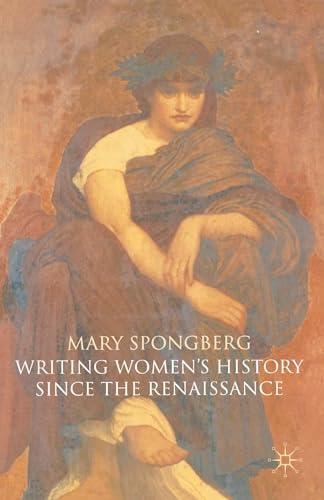

Writing women's history since the Renaissance Mary Spongberg.
Detalles de publicación: New York Palgrave Macmillan 2002.Descripción: xii, 308 p. 23 cmISBN:- 0333726677 (cloth)
- 0333726685 (paper)
- 305.409 S763w 21
- HQ1121 .S64 2002
| Imagen de cubierta | Tipo de ítem | Biblioteca actual | Biblioteca de origen | Colección | Ubicación en estantería | Signatura topográfica | Materiales especificados | Info Vol | URL | Copia número | Estado | Notas | Fecha de vencimiento | Código de barras | Reserva de ítems | Prioridad de la cola de reserva de ejemplar | Reservas para cursos | |
|---|---|---|---|---|---|---|---|---|---|---|---|---|---|---|---|---|---|---|
| Libro | Biblioteca Encarnación Valdés Colección General bev | 305.409 S763w (Navegar estantería(Abre debajo)) | Disponible | 80000002420597 |
Descripciones mejoradas de Syndetics:
The complaint of Catherine Morland in Jane Austen's Northanger Abbey , that history has 'hardly any women at all' is not an uncommon one. Yet there is evidence to suggest that women have engaged in historical writing since ancient times.
This study traces the history of women's historical writing, reclaiming the lives of individual women historians, recovering women's historical writings from the past and focusing on how gender has shaped the genre of history. Mary Spongberg brings together for the first time an extensive survey of the progress of women's historical writing from the Renaissance to the present, demonstrating the continuities between women's historical writings in the past and the development of a distinctly woman-centred historiography.
Writing Women's History since the Renaissance also examines the relationship between women's history and the development of feminist consciousness, suggesting that the study of history has alerted women to their unequal status and enabled them to use history to achieve women's rights. Whether feminist or anti-feminist, women who have had their historical writings published have served as role models for women seeking a voice in the public sphere and have been instrumental in encouraging the growth of a feminist discourse.
Includes bibliographical references and index.
Tabla de contenidos provista por Syndetics
- Acknowledgements(p. x)
- Introduction: 'Hardly Any Women At All?'? Women Writers and the Gender of History(p. 1)
- Gendering History(p. 1)
- Gender and Genre(p. 5)
- Women Writing History(p. 8)
- Part I Men's History
- 1 The Classical Inheritance(p. 15)
- The Classical Heritage(p. 16)
- Ancient Historians and the Gendering of History(p. 20)
- 2 'All Histories Are Against You': Women and the History Men(p. 34)
- Reforming History(p. 35)
- The Historical Defence of Women(p. 38)
- The Science of History(p. 44)
- Enlightened History?(p. 46)
- The Romantic Reaction(p. 51)
- The History Men(p. 57)
- Part II Women's History
- 3 'Above Their Sex'? Women's History 'before' Feminism(p. 63)
- History as Feminine Pedagogy(p. 64)
- Before Feminism(p. 65)
- Reforming Women(p. 67)
- Local Heroines(p. 77)
- The History Women(p. 80)
- 4 History's Romantic Heroines: Women's History and Revolutionary Feminism(p. 86)
- The Salon(p. 87)
- Revolutionary Feminism(p. 89)
- Foreign Correspondence(p. 93)
- Romantic Revolutionaries(p. 101)
- The Staelian Legacy(p. 105)
- 5 'Heroines of Domestic Life': Women's History and Female Biography(p. 109)
- Domestic Woman(p. 110)
- Domestic Heroism(p. 113)
- Female Biography(p. 115)
- History as Domestic Science(p. 118)
- Feminising History(p. 124)
- 6 Women's History and the 'Woman Question'(p. 130)
- Women's History and Feminist Consciousness(p. 131)
- Before Suffrage(p. 134)
- First-wave Feminism(p. 136)
- First-wave Feminism and the Social Sciences(p. 142)
- The Social Sciences and Social History(p. 145)
- 7 Amateurs or Professionals? Women's History in the Academy(p. 150)
- Women and Higher Education(p. 151)
- The European Experience(p. 155)
- The Impact of War(p. 160)
- Women's History in the Academy(p. 165)
- History and the Feminine Mystique(p. 167)
- 8 'Clio's Consciousness Raised'? Women's Liberation and Women's History(p. 172)
- The Emergence of Women's Liberation(p. 173)
- Radical History?(p. 176)
- Women's Historians and Women's Liberation(p. 179)
- Clio's Consciousness Raised?(p. 184)
- 9 Liberating Women's History? Feminism and the Reconstruction of History(p. 189)
- Radical Feminism and the History of Women's Oppression(p. 189)
- Victim History?(p. 192)
- The Culture of True Womanhood(p. 194)
- The Class Challenge(p. 199)
- Women's Culture and Cultural Feminism(p. 203)
- 10 Surpassing the History of Men: Women's History and Lesbian History(p. 209)
- Sex Wars(p. 209)
- Women's History and the Lesbian Continuum(p. 212)
- The Elusive Qustion of Female Friendship(p. 213)
- Lesbian Sex and Sexology(p. 217)
- Sex Radical, Butch/Femme(p. 221)
- Doing 'It'?(p. 225)
- Making Things Perfectly Queer?(p. 227)
- Conclusion: Dealing with Difference(p. 229)
- All the Women Were White?(p. 231)
- Dealing with Difference(p. 236)
- Poststructuralist Postscript(p. 239)
- Notes(p. 241)
- Index(p. 293)