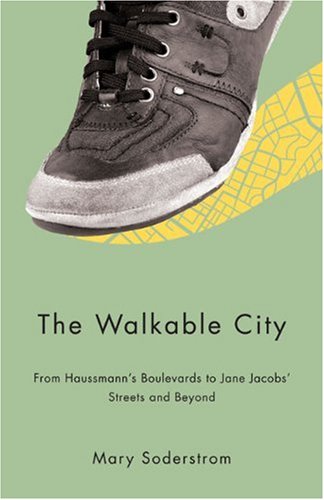

The walkable city : from Haussmann's boulevards to Jane Jacobs' streets and beyond / Mary Soderstrom. txt
Montreal : Véhicule Press, 2008Descripción: 243 p. ill. 22 cmTipo de contenido:- text
- unmediaded
- volume
- 9781550652437
- 1550652435
- 711/.4 22
- NA9053.S7 S63 2008
| Imagen de cubierta | Tipo de ítem | Biblioteca actual | Biblioteca de origen | Colección | Ubicación en estantería | Signatura topográfica | Materiales especificados | Info Vol | URL | Copia número | Estado | Notas | Fecha de vencimiento | Código de barras | Reserva de ítems | Prioridad de la cola de reserva de ejemplar | Reservas para cursos | |
|---|---|---|---|---|---|---|---|---|---|---|---|---|---|---|---|---|---|---|
| Libro | CARIBET Biblioteca Arquitectura Colección General CARIBET | General NA9053.S7 S67 2008 (Navegar estantería(Abre debajo)) | 1 | Disponible | 91000000000877 |
Descripciones mejoradas de Syndetics:
The idea that a city might not be walkable would never occur to anyone who lived before 1800. Over the past 200 years there have been dramatic changes to our cities. With the very best intentions, Baron George Eugène Haussmann ruthlessly transformed Paris in the mid-19th century. Its broad boulevards and grand vistas are the direct result of Haussmann's thinking about how to adapt cities to a new age. In North America cities were "redeveloped" to accommodate the automobile and automobile-dependent suburbs. The city was no longer walkable, and in the 1960s activist-writer Jane Jacobs began to critique many of the ideas about how cities should be organized.
Taking us on walks through cities like Paris, New York, Toronto, North Vancouver and Singapore, Mary Soderstrom examines how cites have changed the lives of ordinary citizens--in positive and negative ways. Making the city walkable again is crucial. The author looks to the future and suggests ways in which we can reorganize our lives and our cities.
Includes bibliographical references and index.
Sect. 1. Starting Out in Search of the Walkable City --
Ch. 1. Looking for a House: A Sort-of Introduction --
Ch. 2. These Feet Were Made for Walking: How It All Began --
Sect. 2. Walking the Walk --
Ch. 3. Baron's Paris --
Ch. 4. Jane Jacobs in New York and Toronto --
Sect. 3 Walking the Walk II. Perambulations in the Real World --
Ch. 5. Rue Mouffetard, Paris: From Before the Romans to Haussmann's Day --
Ch. 6. Greenland Drive, Toronto: A Prototype of North America's Suburbs --
Ch. 7. Avenue Vincent-Auriol, Paris: The City after Haussmann --
Ch. 8. Vellore Park Road, Vaughan, Ontario: Taking Cues from Jane Jacobs but Getting It Wrong --
Ch. 9. El Camino Real, Carlsbad, California: The Mall as Substitute --
Ch. 10. Keith Road, North Vancouver, B.C.: Logging Road to Trail to the Future --
Ch. 11. Quick Turn Around the Block: The Walkable City in Other Parts of the World --
Sect. 4. Talking the Talk: How to Get There from Here --
Ch. 12. Form Follows Finance: Lessons from It's a Wonderful Life --
Ch. 13. End of the World in Washington Square --
Ch. 14. What We Need on the Journey: How to Avoid the Worst --
Ch. 15. House We Bought.
"Taking us on walks through cities like Paris, New York, Toronto, North Vancouver and Singapore, Mary Aoderstom examines how cities have changed ordinary citizens - in positive and negative ways. Making the city walkable again is crucial. The author looks to the future and suggests ways in which can recognize our lives and our cities." -- Couv. p. [4].