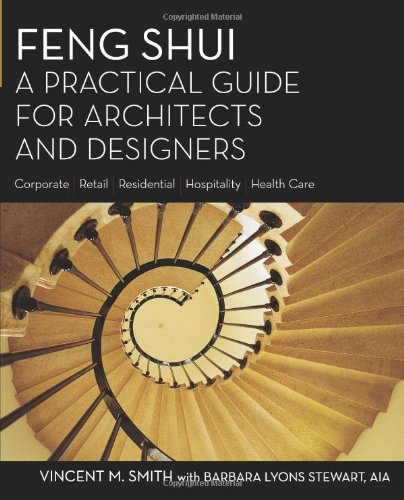

Feng shui a practical guide for architects and designers Vincent M. Smith with Barbara Lyons Stewart.
United States of America kaplan AEC Education 2006Descripción: xviii, 266 p. ill. 23 cmTipo de contenido:- text
- unmediaded
- volume
- 9781419535703
- 1419535706
- 133.3/337 22
- BF1779.F4 S6 2006
| Imagen de cubierta | Tipo de ítem | Biblioteca actual | Biblioteca de origen | Colección | Ubicación en estantería | Signatura topográfica | Materiales especificados | Info Vol | URL | Copia número | Estado | Notas | Fecha de vencimiento | Código de barras | Reserva de ítems | Prioridad de la cola de reserva de ejemplar | Reservas para cursos | |
|---|---|---|---|---|---|---|---|---|---|---|---|---|---|---|---|---|---|---|
| Libro | CARIBET Biblioteca Arquitectura Colección General CARIBET | General BF1779.F4 S6 2006 (Navegar estantería(Abre debajo)) | 1 | Disponible | 91000000018184 |
Descripciones mejoradas de Syndetics:
What do Citibank, theWall Street Journal, and the Donald Trump Hotels and Casino Resorts have in common? They all have used the universal principles of feng shui, the traditional Chinese discipline of spatial energies, to improve their environments and enhance their businesses. In the past few years, feng shui has crossed cultures to become an effective tool for the nation's top architects and designers--and their clients.Feng Shui: A Practical Guide for Architects and Designersby Vincent M. Smith with Barbara Lyons Stewartis the very first book geared specifically to the architectural and design disciplines. This useful guide equips architects and designers with the tools to create well-designed, comfortable environments that enhance clients' lives.The authors present a history of feng shui, explain its fundamental principles of balance and energy flow, emphasize how these principles are applicable to any architectural style or setting, and connect the theory of feng shui to environmental psychology. Design professionals learn how feng shui practice can help guide the selection of sites, building layout, materials, finishes, landscaping, graphics, lighting, and color. The''ll also find clear plans for a wide range of projects, including residential, commercial, corporate, health care, and hospitality.Highlights:Why feng shui can be used to increase productivity and reduce stress How to use feng shui for selecting residential or commercial building sites How to avoid or correct mistakes in space planning and design How to apply feng shui principles to a wide variety of projects
Include index.
Includes bibliographical references (p. 257-260)
A history and overview of feng shui -- Basic feng shui principles -- The feng shui approach to architectural and design elements -- Guidelines for site selection -- An introduction to feng shui solutions for architectural and design projects -- Residential projects -- Office projects -- Other project types -- The transcendental aspects of feng shui.
Tabla de contenidos provista por Syndetics
- Acknowledgments(p. vii)
- Preface: An Architect's Perspective(p. ix)
- Introduction: Feng Shui, a Universal Philosophy of Environmental Psychology and the Squint Test(p. xv)
- 1 A History and Overview of Feng Shui(p. 1)
- 2 Basic Feng Shui Principles(p. 13)
- A The Flow of Energy: Chi(p. 14)
- B The Balance of Energies: Yin and Yang(p. 31)
- C The Commanding Position(p. 36)
- D The Bagua(p. 41)
- E The Five Elements(p. 47)
- F The Primary Purpose(p. 51)
- 3 The Feng Shui Approach to Architectural and Design Elements(p. 53)
- A Colors(p. 54)
- B Shapes(p. 68)
- C Materials(p. 77)
- D Lighting(p. 83)
- E Sound(p. 88)
- F Signage(p. 92)
- G Art and Decorative Objects(p. 96)
- H Plants and Landscaping(p. 109)
- I Water Features(p. 114)
- 4 Guidelines for Site Selection(p. 123)
- A General Guidelines(p. 123)
- B Residential Site Selection Guidelines(p. 132)
- C Business Site Selection Guidelines(p. 134)
- 5 An Introduction to Feng Shui Solutions for Architectural and Design Projects(p. 137)
- A Information Gathering(p. 137)
- B Metaphors(p. 139)
- C Checklists: Site Planning and Schematic Design(p. 139)
- 6 Residential Projects(p. 143)
- A Single Family Residences(p. 143)
- B Multifamily Housing(p. 164)
- 7 Office Projects(p. 173)
- A Office Parks(p. 173)
- B Office Buildings(p. 177)
- C Office Spaces(p. 183)
- 8 Other Project Types(p. 211)
- A Hospitality(p. 211)
- B Health Care(p. 223)
- C Retail(p. 238)
- D Public Restrooms(p. 244)
- 9 The Transcendental Aspects of Feng Shui(p. 249)
- A Meditation(p. 250)
- B Good or Bad Energies?(p. 252)
- C Changing Patterns of Belief and Behavior(p. 253)
- D The Three Secrets Reinforcement(p. 254)
- E The Exchange of Energy(p. 255)
- Summary(p. 256)
- Bibliography(p. 257)
- Index(p. 261)