Imagen de Amazon.com

Portada de Syndetics
Imagen de OpenLibrary
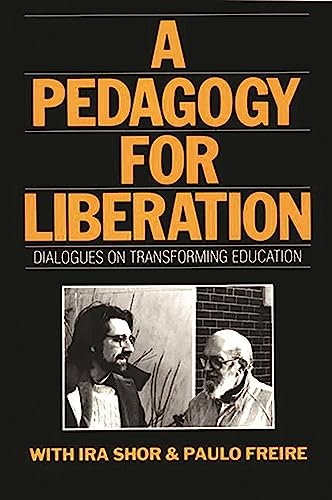
A pedagogy for liberation dialogues on transforming education Ira Shor & Paulo Freire.
Detalles de publicación: South Hadley, Mass. Bergin & Garvey Publishers 1987.Descripción: ix, 203 p. 24 cmISBN:- 089789104X
- 0897891058 (pbk.)
- 370/.973 19
- LB41 .S554 1987
| Imagen de cubierta | Tipo de ítem | Biblioteca actual | Biblioteca de origen | Colección | Ubicación en estantería | Signatura topográfica | Materiales especificados | Info Vol | URL | Copia número | Estado | Notas | Fecha de vencimiento | Código de barras | Reserva de ítems | Prioridad de la cola de reserva de ejemplar | Reservas para cursos | |
|---|---|---|---|---|---|---|---|---|---|---|---|---|---|---|---|---|---|---|
| Libro | Biblioteca Encarnación Valdés Colección General bev | 370.973 S559p (Navegar estantería(Abre debajo)) | Disponible | 80000000522386 |
Total de reservas: 0
Descripciones mejoradas de Syndetics:
... one of the most important books for American teachers. . . . If you teach, read it on one of the days when you want to quit. You'll either keep teaching or quit with a clearer head. Democratic Schools
Highly recommended. . . . Written in a rather interesting manner--primarily as a conversation--this book serves nicely as an informal yet rigorous treatment of critical pedagogy. There is a satisfactory blend of theoretical investigation and practical personal anecdote. . . . The text is well researched. Choice
Includes index.
Bibliography: p. 189-192.
Reseñas proporcionadas por Syndetics
CHOICE Review
Written in a rather interesting manner-primarily as a conversation-this book serves nicely as an informal yet rigorous treatment of critical pedagogy. The concepts are easily followed and, given its form, well developed. There is a satisfactory blend of theoretical investigation and practical, personal anecdote. This mix is particularly useful to those who need aid in concretizing the rather dense and difficult notions that underscore liberatory pedagogy. The book examines many ideas, ranging from an analysis of the current conservative trends in educational reform to answering questions most often posed by teachers who would like to become more democratic educators. The relationship of education to class, gender, and larger economic forces is also explored in a practical and lucid way. The text is well researched. Highly recommended for library acquisition, particularly for those libraries trying to maintain a thorough collection in the area of educational sociology, policy studies, curriculum, and pedagogy at graduate and upper-division undergraduate levels.-M.J. Carbone, Muhlenberg CollegeNotas de autor provistas por Syndetics
or /f Ira /i
ire /f Paulo /i