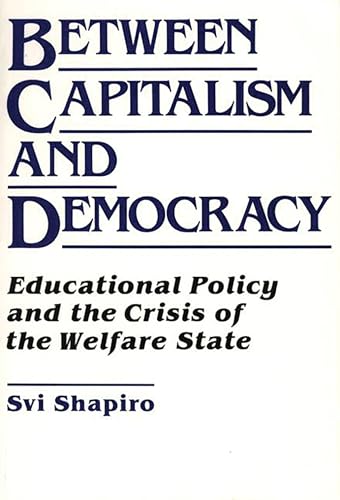

Between capitalism and democracy educational policy and the crisis of the welfare state Svi Shapiro ; introduction by Henry A. Giroux and Paulo Freire.
Idioma: Español Series Critical studies in education seriesDetalles de publicación: New York Bergin & Garvey 1990.Descripción: xvii, 198 pISBN:- 0897891503
- 379.73 20
- LC89 .S485 1990
| Imagen de cubierta | Tipo de ítem | Biblioteca actual | Biblioteca de origen | Colección | Ubicación en estantería | Signatura topográfica | Materiales especificados | Info Vol | URL | Copia número | Estado | Notas | Fecha de vencimiento | Código de barras | Reserva de ítems | Prioridad de la cola de reserva de ejemplar | Reservas para cursos | |
|---|---|---|---|---|---|---|---|---|---|---|---|---|---|---|---|---|---|---|
| Libro | Biblioteca Encarnación Valdés Colección General bev | 379.73 S529b (Navegar estantería(Abre debajo)) | Disponible | 80000000608136 |
Descripciones mejoradas de Syndetics:
This volume of radical studies in the sociology and politics of education specifically addresses educational policies and the crisis of the welfare state--one of the central political facts of our time--and opens up new areas in the critical social analysis of education. Shapiro explores the interconnection between educational policy and the structure of economic, political, and cultural life in the United States, arguing that in spite of its practical and ideological autonomy, the educational region is not immune to the kinds of disruption and dislocation found elsewhere in society. Minority discrimination, urban decay, and the uneven results of the labor market as well as other conditions force new issues and questions onto the ideological policy agenda. However, in his cogent assesment of the state of public discourse, Shapiro discovers an absence, with one important exception, of reference to critical themes in mainstream political debate. He delineates the displacement into the educational area of crises that confront the lumpen class in America and that are experienced as economic deprivation, political disempowerment, and cultural disintegration and then speculates as to why a political agenda that speaks to the interrelatedness of the social crisis and the educational crisis remains unconstructed.
The bulk of the eight chapters study a proposed political agenda for education that is resonant with the cultural concerns and social needs of subordinate and intermediary groups--a left agenda--that addresses three key areas: first, the crisis of values and meanings that consumption capitalism makes inevitable; second, the sense of disempowerment experienced by both subordinate and intermediary groups in American society; and finally, the issue of social justice based on the author's creatively expanded definition of the issues inherent to this concept including hunger here and abroad, the distribution of wealth and economic power, inadequate supply of shelter and medical care, and infant mortality. This important work with its invaluable analyses and proposals should be read by those concerned with the possibilities of radical intervention in public education during a period of conservative restoration. Must reading for students and scholars concerned with both the social analysis and critical study of education.
Includes bibliographical references
Tabla de contenidos provista por Syndetics
- Introduction Education and the Politics Of Democratic Struggle(p. xi)
- Preface(p. xv)
- Acknowledgments(p. xix)
- 1 From Critical Theory to the Politics Of Educational Change(p. 1)
- 2 Education and the Cultural Contradictions Of Capitalism(p. 29)
- 3 Education as a "Complex Unity"(p. 57)
- Conclusion(p. 74)
- 4 Educational Reform and Liberal Democracy(p. 79)
- Conclusion(p. 100)
- 5 Crisis of the State and Educational Politics In the '80s(p. 103)
- 6 The Making of Conservative Educational Policy(p. 119)
- Introduction the Welfare State and the Politicization Of Social Demands(p. 139)
- 7 The Dialectic of the Welfare-Educational State, I(p. 139)
- 8 Crisis and Hope The Dialectic of the Welfare-Educational State, II(p. 154)
- Conclusion the Dialectic of the Welfare-Educational State(p. 164)
- Notes(p. 169)
- Selected Bibliography(p. 183)
- Index(p. 187)
- About the Author(p. 199)