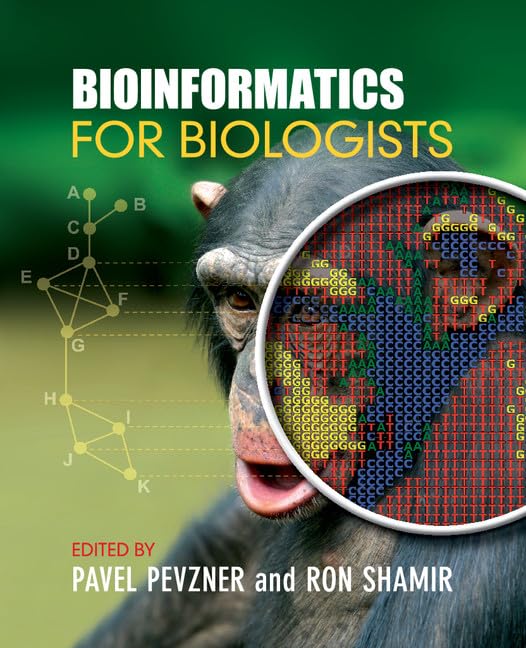

Bioinformatics for biologists edited by Pavel Pevzner and Ron Shamir.
Detalles de publicación: Cambridge New York Cambridge University Press 2011.Descripción: xxix, 362 p. ill. (some col.) 26 cmISBN:- 9781107011465 (hbk.)
- 9781107648876 (pbk.)
- 572.8 B6154 23
- QH324.2 .B5474 2011
- SCI029000
| Imagen de cubierta | Tipo de ítem | Biblioteca actual | Biblioteca de origen | Colección | Ubicación en estantería | Signatura topográfica | Materiales especificados | Info Vol | URL | Copia número | Estado | Notas | Fecha de vencimiento | Código de barras | Reserva de ítems | Prioridad de la cola de reserva de ejemplar | Reservas para cursos | |
|---|---|---|---|---|---|---|---|---|---|---|---|---|---|---|---|---|---|---|
| Libro | Biblioteca Encarnación Valdés Colección General bev | 572.8 B6154 (Navegar estantería(Abre debajo)) | Disponible | 80000002466533 |
Descripciones mejoradas de Syndetics:
The computational education of biologists is changing to prepare students for facing the complex datasets of today's life science research. In this concise textbook, the authors' fresh pedagogical approaches lead biology students from first principles towards computational thinking. A team of renowned bioinformaticians take innovative routes to introduce computational ideas in the context of real biological problems. Intuitive explanations promote deep understanding, using little mathematical formalism. Self-contained chapters show how computational procedures are developed and applied to central topics in bioinformatics and genomics, such as the genetic basis of disease, genome evolution or the tree of life concept. Using bioinformatic resources requires a basic understanding of what bioinformatics is and what it can do. Rather than just presenting tools, the authors - each a leading scientist - engage the students' problem-solving skills, preparing them to meet the computational challenges of their life science careers.
Includes bibliographical references and index
"The computational education of biologists is changing to prepare students for facing the complex datasets of today's life science research. In this concise textbook, the authors' fresh pedagogical approaches lead biology students from first principles towards computational thinking. A team of renowned bioinformaticians take innovative routes to introduce computational ideas in the context of real biological problems. Intuitive explanations promote deep understanding, using little mathematical formalism. Self-contained chapters show how computational procedures are developed and applied to central topics in bioinformatics and genomics, such as the genetic basis of disease, genome evolution or the tree of life concept. Using bioinformatic resources requires a basic understanding of what bioinformatics is and what it can do. Rather than just presenting tools, the authors - each a leading scientist - engage the students' problem-solving skills, preparing them to meet the computational challenges of their life science careers"-- Provided by publisher.
Tabla de contenidos provista por Syndetics
- Preface
- Acknowledgements
- Introduction
- Part I Genomes
- 1 Identifying the genetic basis of disease
- 2 Pattern identification in a haplotype block
- 3 Genome reconstruction: a puzzle with a billion pieces
- 4 Dynamic programming: one algorithmic key for many biological locks
- 5 Measuring evidence: who's your daddy?
- Part II Gene Transcription and Regulation
- 6 How do replication and transcription change genomes?
- 7 Modeling regulatory motifs
- 8 How does influenza virus jump from animals to humans?
- Part III Evolution
- 9 Genome rearrangements
- 10 The crisis of the tree of life concept and the search for order in the phylogenetic forest
- 11 Reconstructing the history of large-scale genomic changes: biological questions and computational challenges
- Part IV Phylogeny
- 12 Figs, wasps, gophers, and lice: a computational exploration of coevolution
- 13 Big cat phylogenies, consensus trees, and computational thinking
- 14 Algorithm design for large-scale phylogeny
- Part V Regulatory Networks
- 15 Biological networks uncover evolution, disease, and gene functions
- 16 Regulatory network inference
- Index