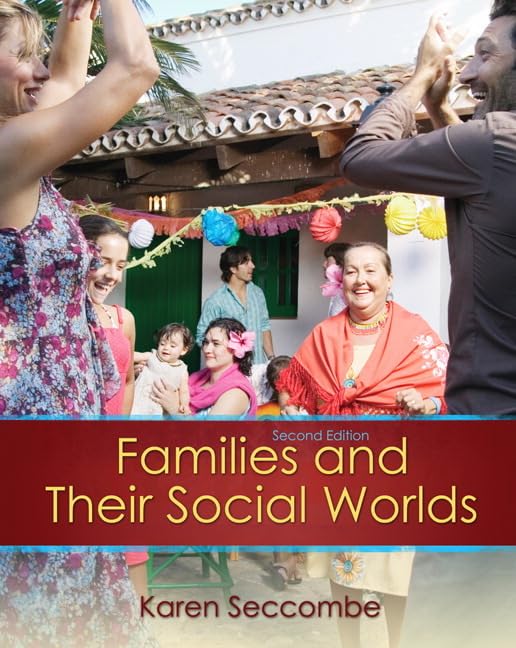

Families and their social worlds Karen Seccombe.
Detalles de publicación: Boston Pearson Allyn & Bacon c2012.Edición: 2nd edDescripción: xxv, 534 p. ill. (chiefly col.), col. map 26 cmISBN:- 9780205797745
- 0205797741
- 306.85 S444f2 22
- HQ503 .S38 2012
| Imagen de cubierta | Tipo de ítem | Biblioteca actual | Biblioteca de origen | Colección | Ubicación en estantería | Signatura topográfica | Materiales especificados | Info Vol | URL | Copia número | Estado | Notas | Fecha de vencimiento | Código de barras | Reserva de ítems | Prioridad de la cola de reserva de ejemplar | Reservas para cursos | |
|---|---|---|---|---|---|---|---|---|---|---|---|---|---|---|---|---|---|---|
| Libro | Biblioteca Encarnación Valdés Colección General bev | 306.85 S444f2 (Navegar estantería(Abre debajo)) | Disponible | 80000002482886 |
Descripciones mejoradas de Syndetics:
Exploring the private side of family life together with the public, institutional nature of the "the Family" through a sociological lens.
Families and Their Social Worlds shows that many family concerns are actually social issues that need to be addressed through sound social policies. The author encourages readers to think about families beyond their own personal experiences, and even beyond family structure in the United States. Her goal is to impart a passion for critical thinking as readers see that families exist within social worlds. Important policy considerations are imbedded in each chapter to illustrate what is currently being done, and perhaps even more importantly, what can be done to strengthen families and intimate relationships.Includes bibliographical references and indexes.
Families and the sociological imagination -- Families throughout the world: marriage, family, and kinship -- Families throughout history -- Sex, gender, and families -- Social stratification, social class, and families -- Race, ethnicity, and families -- Courtship, intimacy, and partnering -- Marriage: a personal relationship and social institution -- Becoming a parent -- Raising children -- Families and the work they do -- Aging families -- Violence and abuse -- Divorce, repartnering, and remarriage -- Summing it up: families and the sociological imagination.
Tabla de contenidos provista por Syndetics
- In This Section
- 1 Brief Table of Contents
- 2 Comprehensive Table of Contents
- Brief Table of Contents
- Chapter 1 Families and the Sociological Imagination
- Chapter 2 Families Throughout the World: Marriage, Family, and Kinship
- Chapter 3 Families Throughout History
- Chapter 4 Sex, Gender, and Families
- Chapter 5 Social Stratification, Social Class, and Families
- Chapter 6 Race, Ethnicity, and Families
- Chapter 7 Courtship, Intimacy, and Partnering
- Chapter 8 Marriage: A Personal Relationship and Social Institution
- Chapter 9 Becoming a Parent
- Chapter 10 Raising Children
- Chapter 11 Families and the Work They Do
- Chapter 12 Aging Families
- Chapter 13 Violence and Abuse
- Chapter 14 Divorce and RePartnering
- Chapter 15 Summing It Up: Families and the Sociological Imagination
- Comprehensive Table of Contents
- Part I Understanding Families and Their Social Worlds
- Chapter 1 Families and the Sociological Imagination
- What Are Families?
- The Sociological Imagination
- Familes and Social Change
- The State and Family Policy
- Themes of This Book
- Conclusion
- Chapter 2 Families Throughout the World: Marriage, Family, and Kinship
- Functions of the Family: Variations and Universals
- Differences in Marriage and Family Pattern
- Patterns of Power and Authority
- Patterns of Kinship, Descent, and Inheritance
- Patterns of Residence
- Modernization Theory: Social Change and Families
- World Systems Theory: Social Change and Families
- Families Around the World
- Conclusion
- Chapter 3 Families Throughout History
- Why Study Family History?
- Families in Preindustrial Socities
- Family Life in Preindustrial United States
- American Families in the Nineteenth Century
- Families in the Twentieth Centry: the Rise of the "Modern" Family
- Recent Family Issues and Their Historical Roots
- Conclusion
- Chapter 4 Sex, Gender, and Families
- Sex and Gender: What's the Difference?
- Where Do We Learn Gender?
- The Pitfalls of Masculinity
- Institutional Sex Discrimination: Patriarchy
- Does Patriarchy Exist in Western Nations?
- Implications for Families
- Social Policy and Family Resilience
- Conclusion
- Chapter 5 Social Stratification, Social Class, and Families
- Social Class and Family Relationships
- What Is Social Stratification?
- Social Class in the United States
- Family Focus, How Calss Matters: Health, Health Insurance, and Family Well-Being
- Families in Poverty
- Social Policy and Family Resilience
- Conclusion
- Chapter 6 Race, Ethnicity, and Families
- Increasing Diversity in the United States
- Immigration
- Defining Basic Concepts
- How Do Race and Ethnicity Influence Family and Close Relationships?
- Hispanic and Latino Families
- Black Families
- Asian American Families
- Native American and Alaska Native Families
- Interracial and Interethnic Families
- Social Policy and Family Resilience
- Conclusion
- Part II Negotiating Family Relationships
- Chapter 7 Courtship, Intimacy, and Partnering
- Courtship and Mate Selection
- Love
- Sexuality
- Heterosexual Cohabitation
- Gay and Lesbian Commitment and Cohabitation
- Social Policy and Family Resilience
- Conclusion
- Chapter 8 Marriage: A Personal Relationship and Social Institution
- The Universality of Marriage
- The Changing Nature of Marriage
- Benefits of Marriage
- Marital Happiness, Satisfaction, and Success
- The Marriage Movement
- Social Policy and Family Resilience
- Conclusion
- Chapter 9 Becoming a Parent
- Population and Fertility Trends Worldwide
- Fertility Rates in the United States
- Deciding to Parent
- The Social Construction of Childbirth
- The Transition to Parenthood
- Social Policy and Family Resilience
- Conclusion
- Chapter 10 Raising Children
- Comparative Focus on Childhood and Parenting
- Socialization
- Parenting Styles and Practices
- Parenting Contexts
- Social Policy and Family Resilience
- Conclusion
- Chapter 11 Families and the Work They Do
- The Changing Economy and Work
- Life in a Recession
- The Division of Household Labor
- Juggling Work and Family Life
- Child Care? Who's Minding the Children?
- Social Policy and Famli Resilience
- Conclusion
- Chapter 12 Aging Families
- Changing Demographics
- Historical Perspectives
- Prevailing Theories of Aging
- The Economics of Aging
- The Aging Couple
- Relationships with Children and Grandchildren
- Retirement
- Health
- Social Policy and Family Resilience
- Conclusion
- Part III Social Problems and Families
- Chapter 13 Violence and Abuse
- Gender-Based Violence: An International Human Rights Issue
- Intimate Partner Violence
- Child Abuse
- Elder Abuse
- Explanations for Violence and Abuse Among Intimates
- Social Policy and Family Resilience
- Conclusion
- Chapter 14 Divorce and RePartnering
- Measuring Divorce
- Cross Cultural Comparisons
- Historical Trends in the United States
- Factors Associated with Divorce
- The Stations of the Divorce Experience
- Consequences of Divorce for Children
- RePartnering and Remarriage
- Stepfamily Relationships
- Social Policy and Family Resilience
- Conclusion
- Part IV What Have We Learned?
- Chapter 15 Summing It Up: Families and the Sociological Imagination
- The Sociological Imagination
- Using the Sociological Imagination: Themes of the Text Revisited
- Future Trends: Where Are Families Heading?
- Conclusion
Notas de autor provistas por Syndetics
Karen Seccombe is a professor in the School of Community Health at Portland State University, located in Portland, Oregon. She received her B.A. in sociology at California State University, Chico, her M.S.W. in health and social welfare policy from the University of Washington, and her Ph.D. in sociology from Washington State University. Her research focuses on poverty, welfare, access to health care, and the effects of social inequality on families. She is the author of Marriage and Family: You and Society (Pearson ); "So You Think I Drive a Cadillac?": Welfare Recipients' Perspectives on the System and its Reform , 3rd edition (Allyn and Bacon); Families in Poverty (Allyn and Bacon); Just Don't Get Sick: Access to Health Care in the Aftermath of Welfare Reform , with Kim Hoffman (Rutgers University Press), and Marriages and Families: Relationships in Social Context , with Rebecca L. Warner (Wadsworth). She is a National Council on Family Relations fellow, and a member of the American Sociological Association, and the Pacific Sociological Association, where she has held elective offices. Karen lives in Portland with her husband Richard, a health economist, her ten-year-old daughter, Natalie Rose, and her eight-year-old daughter, Olivia Lin. In her spare time she enjoys hiking near their cabin in the Oregon Cascades, walking the sandy beaches of the Oregon coast, exploring the kid-friendly playgrounds, attractions, and restaurants in Portland and surrounding areas, and traveling just about anywhere-the San Juan Islands are high on her list.