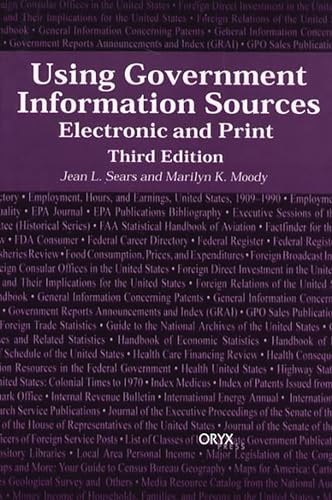

Using government information sources electronic and print Jean L. Sears and Marilyn K. Moody.
Detalles de publicación: Phoenix, Ariz.. Oryx Press c2001.Edición: 3rd edDescripción: 536 p. ill. 29 cmISBN:- 1573562882 (alk. paper)
- 015.73053 S4395u3 21
- Z1223.Z7 S4 2001 J83
| Imagen de cubierta | Tipo de ítem | Biblioteca actual | Biblioteca de origen | Colección | Ubicación en estantería | Signatura topográfica | Materiales especificados | Info Vol | URL | Copia número | Estado | Notas | Fecha de vencimiento | Código de barras | Reserva de ítems | Prioridad de la cola de reserva de ejemplar | Reservas para cursos | |
|---|---|---|---|---|---|---|---|---|---|---|---|---|---|---|---|---|---|---|
| Referencia | Biblioteca Encarnación Valdés Sala de Referencia bev | 015.73053 S4395u3 (Navegar estantería(Abre debajo)) | Disponible | 80000002409111 |
Descripciones mejoradas de Syndetics:
In the six years since the second edition of the bestselling Oryx information guide, Using Government Information Sources, was published, a lot has changed in the searching process. Much government information is now found exclusively on the Internet and there are many more print resources available. The new third edition, by Jean L. Sears and Marlyn K. Moody, is the extensively revised edition of this popular and useful title. Designed for beginning as well as experienced researchers, this resource will guide users to the best government information sources both print and electronic. Each chapter is grouped into four search strategy categories: the subject search, the agency search, the statistical search, and special techniques. New to this edition is a chapter on Housing and Construction Statistics.
Includes bibliographical references and index.
Introduction -- Search strategy and government information sources -- The basics of searching : the subject search -- Foreign policy -- Foreign countries -- Occupations and jobs -- Selling to the government -- Business aids -- Directories -- Tax information -- Travel information -- Audiovisual information -- Copyright information -- Climate -- Elections -- Maps -- Genealogy -- Agriculture -- Health -- Education -- Geology -- Environment -- Astronomy and space : the agency search -- Government programs and grants -- Regulations and administrative actions -- Administrative decisions -- The President : the statistical search -- Population statistics -- Vital statistics -- Economic indicators -- Business and industry statistics -- Housing and construction statistics -- Income -- Earnings -- Employment -- Prices -- Consumer expenditures -- Foreign trade statistics -- Crime and criminal justice statistics -- Defense and military statistics -- Energy statistics -- Projections -- State and local government statistics -- Transportation statistics : special techniques -- Legislative history -- Judicial reports -- Budget analysis -- Treaties -- Technical reports -- Patents and trademarks -- Standards and specifications -- Historical searches.
Tabla de contenidos provista por Syndetics
- List of Illustrations(p. ix)
- Preface to the Third Edition(p. xi)
- Acknowledgments(p. xi)
- Chapter 1 Introduction(p. 1)
- Chapter 2 Search Strategy and Government Information Sources(p. 5)
- Chapter 3 The Basics of Searching(p. 10)
- The Subject Search(p. 23)
- Chapter 4 Foreign Policy(p. 25)
- Chapter 5 Foreign Countries(p. 35)
- Chapter 6 Occupations and Jobs(p. 42)
- Chapter 7 Selling to the Government(p. 50)
- Chapter 8 Business Aids(p. 58)
- Chapter 9 Directories(p. 64)
- Chapter 10 Tax Information(p. 70)
- Chapter 11 Travel Information(p. 77)
- Chapter 12 Audiovisual Information(p. 84)
- Chapter 13 Copyright Information(p. 88)
- Chapter 14 Climate(p. 91)
- Chapter 15 Elections(p. 102)
- Chapter 16 Maps(p. 111)
- Chapter 17 Genealogy(p. 119)
- Chapter 18 Agriculture(p. 128)
- Chapter 19 Health(p. 141)
- Chapter 20 Education(p. 160)
- Chapter 21 Geology(p. 174)
- Chapter 22 Environment(p. 181)
- Chapter 23 Astronomy and Space(p. 195)
- The Agency Search(p. 201)
- Chapter 24 Government Programs and Grants(p. 203)
- Chapter 25 Regulations and Administrative Actions(p. 215)
- Chapter 26 Administrative Decisions(p. 225)
- Chapter 27 The President(p. 232)
- The Statistical Search(p. 243)
- Chapter 28 Population Statistics(p. 245)
- Chapter 29 Vital Statistics(p. 261)
- Chapter 30 Economic Indicators(p. 271)
- Chapter 31 Business and Industry Statistics(p. 279)
- Chapter 32 Housing and Construction Statistics(p. 297)
- Chapter 33 Income(p. 308)
- Chapter 34 Earnings(p. 318)
- Chapter 35 Employment(p. 328)
- Chapter 36 Prices(p. 338)
- Chapter 37 Consumer Expenditures(p. 345)
- Chapter 38 Foreign Trade Statistics(p. 352)
- Chapter 39 Crime and Criminal Justice Statistics(p. 364)
- Chapter 40 Defense and Military Statistics(p. 373)
- Chapter 41 Energy Statistics(p. 380)
- Chapter 42 Projections(p. 389)
- Chapter 43 State and Local Government Statistics(p. 395)
- Chapter 44 Transportation Statistics(p. 403)
- Special Techniques(p. 419)
- Chapter 45 Legislative History(p. 421)
- Chapter 46 Judicial Reports(p. 433)
- Chapter 47 Budget Analysis(p. 439)
- Chapter 48 Treaties(p. 446)
- Chapter 49 Technical Reports(p. 455)
- Chapter 50 Patents and Trademarks(p. 463)
- Chapter 51 Standards and Specifications(p. 476)
- Chapter 52 Historical Searches(p. 482)
- Chapter 53 National Archives(p. 502)
- Appendix Selected Nongovernment Addresses(p. 511)
- Index(p. 517)
Reseñas proporcionadas por Syndetics
CHOICE Review
The third edition of this very useful work, in the title of which "electronic" now precedes "print," is updated to incorporate the growth of the Web into "the premiere method for the dissemination of government information." A large number of official government Web sites, some unofficial sites, and online commercial tools are included, with Web page title, URL, and sample screen shots of typical pages. Some subject chapters have been rearranged or consolidated. Each source is defined as print and/or Web, in uppercase. E. F. Konerding Wesleyan UniversityBooklist Review
The U.S. government produces an enormous volume of documentation. This excellent, now-standard guide covers U.S. government information sources plus commercial services that focus on these sources. The primary purpose of the work is to guide users to the most useful. "Only the most basic and important sources are listed," chosen for their "reference value, general interest value, currentness, and availability." First published in two volumes in 1985-1986, the second edition (1994) was widely reviewed and well received. RBB praised it for its "current, concise, and expert guidance" and called it "a valuable and up-to-date resource." The third edition maintains the high standards of the second. Since 1994, many more resources have become available via the Web, and these are noted with both URLs and PURLs (persistent URLs, when available). The volume is organized around basic types of searches: "The Subject Search," "The Agency Search," "The Statistical Search," and "Special Techniques." Known-item searches are also addressed in the introductory chapters on search strategy and the basics of searching. The 20 chapters under "The Subject Search" include not only topical searches but format searches, that is, searches for types of material such as directories, "audiovisual information," and maps. The topical chapters include the range of topics of primary interest to the U.S. government, such as foreign policy, the countries of the world, taxation, climate, agriculture, health, the environment, and astronomy and space. A chapter on genealogy focuses on the uses of government sources for this type of research. The four agency search chapters are designed to guide searches for U.S. government agencies that offer particular programs or grants or that issue regulations and decisions. The office of the president merits a separate chapter in this section. Statistics are such an important type or format of government data that they merit 17 chapters on topics about which the government collects and presents statistical data, such as population, economic indicators, housing, crime, defense, and transportation. There is also a chapter on "state and local government statistics," but in keeping with the overall scope of the work, this focuses on U.S. government statistics relating to state and local governments, as opposed to data produced by local governments. The nine chapters on "Special Techniques" focus on the approaches needed for special formats and types of data, such as legislative histories, judicial reports, treaties, technical reports, patents, and standards. The final chapters address searches for historical information and the National Archives. The typical search chapter begins with a brief characterization of the chapter's focus and a description of recommended search strategies, listing specific steps that may be helpful. The heart of each search chapter consists of checklists of publications from various sources or of various types. Checklist citations are quite complete. Each checklist is followed by a discussion of the sources, providing guidance about their use. The chapter concludes with pointers to related chapters and a list of relevant Government Printing Office subject bibliographies. The volume concludes with an appendix of "Selected Nongovernment Addresses," generally for publishers of guides or indexes to U.S. government information, and an alphabetical index. The index has several weaknesses. For example, many sources are discussed in multiple chapters, and these entries are followed by too many page references, exceeding accepted standards of index preparation. It is also weak as a subject index. The best subject approach to the volume is via the table of contents. Indexing problems aside, this is a most valuable and helpful resource for all users of U.S. government information sources and for the librarians who help them.Notas de autor provistas por Syndetics
JEAN L. SEARS is currently the head of the Government Documents Department at Miami University Libraries in Oxford, Ohio. She has worked in the government information field for more than 25 years, and previously she was the president of the Ohio Government Documents Round Table as well as a recipient of their Clyde award for outstanding achievement or service in the field of government information. Ms. Sears holds a master of science in librarianship from Western Michigan University.
MARILYN K. MOODY is presently director of the Science and Engineering Library at the University at Buffalo (SUNY) and will soon take over as the Associate University Librarian for Information and Research Services at the University of California, Santa Barbara. Ms. Moody has written numerous articles for a variety of library and information science journals and is the editor of Internet Reference Services Quarterly. A popular speaker, Ms. Moody has given many workshops and presentations on electronic government information, using the Internet and the Web, and the digital library. Ms. Moody holds a masters degree in library science from the University of Illinois.