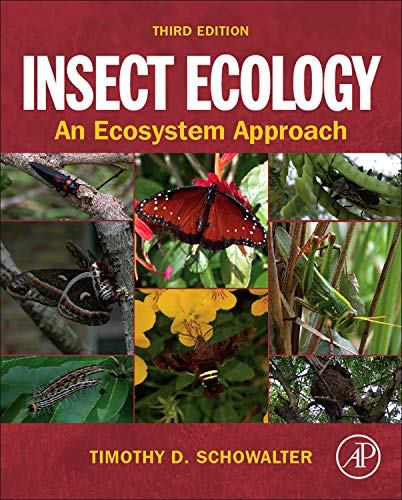

Insect ecology an ecosystem approach Timothy D. Schowalter.
Detalles de publicación: Amsterdam ; Boston Academic Press 2011.Edición: 3rd edDescripción: xv, 633 p. ill. (some col.), maps (some col.) 24 cmISBN:- 9780123813510
- 0123813514
| Imagen de cubierta | Tipo de ítem | Biblioteca actual | Biblioteca de origen | Colección | Ubicación en estantería | Signatura topográfica | Materiales especificados | Info Vol | URL | Copia número | Estado | Notas | Fecha de vencimiento | Código de barras | Reserva de ítems | Prioridad de la cola de reserva de ejemplar | Reservas para cursos | |
|---|---|---|---|---|---|---|---|---|---|---|---|---|---|---|---|---|---|---|
| Libro | Biblioteca Mons. Iñaki Mallona (Arecibo) Colección General ab | 595.717 S364i3 (Navegar estantería(Abre debajo)) | Disponible | 60000010144944 |
Descripciones mejoradas de Syndetics:
The third edition of Insect Ecology: An Ecosystem Approach provides a modern perspective of insect ecology that integrates two approaches traditionally used to study insect ecology: evolutionary and ecosystem. This integration substantially broadens the scope of insect ecology and contributes to prediction and resolution of the effects of current environmental changes, as these affect and are affected by insects. The third edition includes an updated and expanded synthesis of feedback and interactions between insects and their environment. This updated material and a new chapter on applications of insect ecology to social and environmental issues effectively demonstrates how evolutionary and ecosystem approaches complement each other, with the intent of stimulating further integration of these approaches in experiments that address insect roles in ecosystems. Effective management of ecosystem resources depends on evaluation of the complex, often complementary, effects of insects on ecosystem conditions, as well as insect responses to changing conditions.
Previous ed.: 2006.
Includes bibliographical references (p. [525]-606) and indexes.
Tabla de contenidos provista por Syndetics
- Chapter 1 Overview
- Section I Ecology of Individual Insects
- Chapter 2 Responses to Abiotic Conditions
- Chapter 3 Resource Acquisition
- Chapter 4 Resource Allocation
- Section II Population Ecology
- Chapter 5 Population Systems
- Chapter 6 Population Dynamics
- Chapter 7 Biogeography
- Section III Community Ecology
- Chapter 8 Species Interactions
- Chapter 9 Community Structure
- Chapter 10 Community Dynamics
- Section IV Ecosystem Level
- Chapter 11 Ecosystem Structure and Function
- Chapter 12 Herbivory
- Chapter 13 Pollination, Seed Predation and Seed Dispersal
- Chapter 14 Decomposition and Pedogenesis
- Chapter 15 Insects as Regulators of Ecosystem Processes
- Section V Applications and Synthesis
- Chapter 16 Applications
- Chapter 17 Synthesis