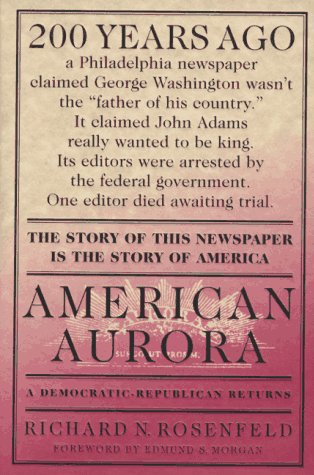
Imagen de portada de Amazon
Imagen de Amazon.com
Imagen de cubierta Syndetics
Portada de Syndetics
Imagen de OpenLibrary

American Aurora a Democratic-Republican returns :the suppressed history of our nation's beginnings and the heroic newspaper that tried to report it / Richard N. Rosenfeld ; foreword by Edmund S. Morgan .

Por: Colaborador(es): Detalles de publicación: New York St. Martin's Press 1997.Edición: 1st. edDescripción: xi, 988 p ill., map, music 25 cmISBN:
  • 0312150520
Títulos uniformes: Tema(s): Clasificación LoC:
  • PN 4899 .P5 A977 1997
Valoración
    Valoración media: 0.0 (0 votos)
Existencias
Imagen de cubierta Tipo de ítem Biblioteca actual Biblioteca de origen Colección Ubicación en estantería Signatura topográfica Materiales especificados Info Vol URL Copia número Estado Notas Fecha de vencimiento Código de barras Reserva de ítems Prioridad de la cola de reserva de ejemplar Reservas para cursos
Libro Biblioteca de Derecho Mons. Fremiot Torres Oliver Colección General biblioteca derecho PN 4899 .P5 A977 1997 (Navegar estantería(Abre debajo)) Disponible 70000000549068
Total de reservas: 0

Descripciones mejoradas de Syndetics:

Richard Rosenfeld's dramatic epic traces the incendiary history of the young American nation in the 1790s, and chronicles the birth and near-death of civil liberties in that turbulent decade. Rosenfeld, who has exhaustively examined the Philadelphia Aurora, has chosen as his heroes its two young editors, Benjamin Bache, Benjamin Franklin's grandson, and William Duane, who fearlessly Waged a decade-long campaign to keep America's Founding Fathers true to their original mission. They claimed that George Washington was not the true "father of his country, " but a completely incompetent commander-in-chief, and that John Adams, his presidential successor, wanted a monarchy and was plotting to be king. As a result of their inflammatory articles, both editors were arrested. Bache died awaiting trial, and the paper was briefly silenced. Nonetheless, the Aurora was eventually successful in persuading the nation to oust Adams and to usher in a Jeffersonian democracy, of which Benjamin Franklin, the truefather of our country, could only dream. Revisionist, daring, and brilliantly conceived, this is a work of enormous power that indisputably rewrites the early history of our nation and champions the civil liberties on which the country was founded.

Text written by Richard N. Rosenfelt as if he were the Aurora publisher/editor William Duane, interwoven with excerpts Aurora general advertiser (published in Philadelphia) and for other sources.

Includes bibliographical references (p. 910-956) and index.

Reseñas proporcionadas por Syndetics

Library Journal Review

Contemporary Americans longing for a return to civility in public life will be quite amazed when they read the press accounts of the early years of the Republic. Independent scholar Rosenfeld, in an innovative approach to the historical record, uses daily clips from Philadelphia newspapers to portray the early struggles over civil liberties. The Aurora, edited first by Benjamin Bache, grandson of Benjamin Franklin, and then by William Duane, led the fight for greater freedoms. Competitor papers, The Porcupine's Gazette and Gazette of the United States, advocated greater government powers. The arguments between the different factions, including editors and politicians, were heated, vituperative, and sometimes physical. In addition to press accounts, letters from leading figures of the time and the Annals of Congress are quoted. Rosenfeld creates a fictional voice for editor Duane, who tells the story in the present tense and provides context for the original source material. A remarkable and innovative work of history that belongs in most libraries.‘Judy Solberg, George Washington Univ., Washington D.C. (c) Copyright 2010. Library Journals LLC, a wholly owned subsidiary of Media Source, Inc. No redistribution permitted.

Publishers Weekly Review

Despised by presidents George Washington and John Adams, who tried to suppress it, the Philadelphia Aurora, an outspoken newspaper founded in 1790, charged that the Founding Fathers had adopted a British-style constitution to avoid Benjamin Franklin's plan for a true democracy. Rosenfeld, an associate fellow at Yale's Timothy Dwight College, stirringly recreates the Aurora's battles for press freedoms and grassroots democracy by interpolating excerpts from the paper, prickly rebuttals from opposing gazettes, letters, eyewitness accounts and early government documents. Decked out with period engravings and banner headlines, the impassioned, heavily annotated narrative is told as quasi-autobiography in the assumed first-person voice of Aurora editor William Duane, a historian self-exiled from George III's England. His co-editor, "Young Lightening-Rod" Benjamin Bache, who was Ben Franklin's grandson and Thomas Paine's publisher, was arrested in 1798 on charges of sedition. Mobs of Federalist supporters attacked his home, where his wife was pregnant with her fourth child. Bache died of yellow fever in prison awaiting trail; Duane continued at the paper's helm until 1822, fighting for Jeffersonian democracy. A crazy-quilt of a book, this time-capsule into a vigorous age of independent journalism significantly revises our understanding of America's beginnings. (Apr.) (c) Copyright PWxyz, LLC. All rights reserved

Booklist Review

It is easy to bemoan the lack of civility in public discourse today, but Rosenfeld shows that our so-called founding fathers were not so polite themselves. Lost in sanitized textbooks are the daily details of the rancorous and often personal debate over the future of a new nation. Rosenfeld uses the Aurora, published in the late 1790s in Philadelphia by the grandson of Benjamin Franklin, as primary-source material. Benjamin Franklin Bache was a strident supporter of republican ideals, radical democracy, and the French Revolution. His attacks on the Federalists were scurrilous, calling George Washington incompetent and John Adams a power-hungry monarchist. James Tagg has provided an excellent analysis of Bache's role in history in Benjamin Franklin Bache and the Philadelphia Aurora (1991), but Rosenfeld lets Bache and his successor William Duane speak in their own voices. A lively selection for active history collections. --David Rouse
Compartir
logopucpr-y-vive

Contáctanos

¡Queremos saber de ti!

Tel. 787.841.2000 Ext. 1801

bibliotecavaldes@pucpr.edu

⁣Búscanos en las redes

© 2026 Desarrollado por Ignite Online • All Rights Reserved • Powered by Koha.