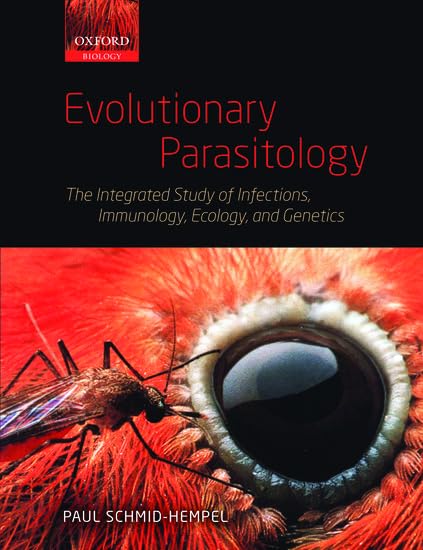

Evolutionary parasitology the integrated study of infections, immunology, ecology and genetics Paul Schmid Hempel.
Detalles de publicación: New York Oxford University Press 2011.Edición: 1th edDescripción: 516 p. il. 24.5 cmISBN:- 9780199229482 (Hbk.)
- 9780199229499 (Pbk.)
| Imagen de cubierta | Tipo de ítem | Biblioteca actual | Biblioteca de origen | Colección | Ubicación en estantería | Signatura topográfica | Materiales especificados | Info Vol | URL | Copia número | Estado | Notas | Fecha de vencimiento | Código de barras | Reserva de ítems | Prioridad de la cola de reserva de ejemplar | Reservas para cursos | |
|---|---|---|---|---|---|---|---|---|---|---|---|---|---|---|---|---|---|---|
| Libro | Biblioteca Mons. Iñaki Mallona (Arecibo) Colección General ab | 571.999 S348e (Navegar estantería(Abre debajo)) | Disponible | 60000010146345 |
Descripciones mejoradas de Syndetics:
Parasites are everywhere. And they affect almost every aspect imaginable in the life of their hosts. Parasites influence host physiology, behaviour, life histories, and the structure of entire ecosystems. To cope with these constant threats, the host's immune system has evolved to become one of the most complex organs known. But parasites, too, have found their own ways to overcome defences and to manipulate their hosts for their own interests. As a result, hosts and parasite are constantly forced to adapt to one another, sometimes very rapidly, sometimes changes occur only over eons. But this struggle always has far reaching consequences for the biology of both parties. For the first time, this book gives a comprehensive overview over the many facets of host-parasite interactions, from the molecular bases to individual strategies and to the ecological and evolutionary consequences. It is informed by the progress in our understanding that has occurred over the past decades. No longer do we view well-adapted parasites to become harmless but, quite to the contrary, parasite virulence is, determined, both, by the processes that lead to harm and by the evolutionary costs and benefits of this damage. Similarly, parasitism is no longer regarded as being inevitably bad, rather it can be a major factor maintaining diversity in populations and communities, selecting for beautiful plumages of birds, or making us more social. Evolutionary Parasitology deals with a wide range of topics, from immunology, genetics, sexual selection, to population dynamics, ecology and co-evolution. Readers from different fields and with different backgrounds will find a rich source to meet their interests and to expand their insights into neighbouring disciplines.
Includes bibliographical references and index.