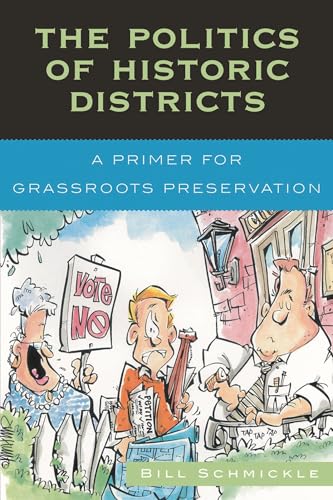

The Politics of Historic Districts : a primer for grassroots preservation. / William E. Schmickle. txt
Lanham : AltaMira Press , 2007Descripción: x, 269 p. ill. ; 23 cmTipo de contenido:- text
- unmediaded
- volume
- 0759107556
- 9780759107557
- 0759107564
- 9780759107564
- 9780759107557
- 9780759107564
- 307.1/2160973 22
- HT167 S263 2007
| Imagen de cubierta | Tipo de ítem | Biblioteca actual | Biblioteca de origen | Colección | Ubicación en estantería | Signatura topográfica | Materiales especificados | Info Vol | URL | Copia número | Estado | Notas | Fecha de vencimiento | Código de barras | Reserva de ítems | Prioridad de la cola de reserva de ejemplar | Reservas para cursos | |
|---|---|---|---|---|---|---|---|---|---|---|---|---|---|---|---|---|---|---|
| Libro | CARIBET Biblioteca Arquitectura Colección General CARIBET | General HT167 S263 2007 (Navegar estantería(Abre debajo)) | 1 | Disponible | 91000000000547 |
Descripciones mejoradas de Syndetics:
The worst thing in politics is to be right and to lose. This how-to guide will give citizens who are fighting to designate a local historic district the political know-how to win the support of fellow residents and city hall. Everything is here: learning to think politically, mastering the political process; planning and strategy; campaign organizing and leadership; framing a practical vision; anticipating and handling the opposition; conducting community meetings; skirmishing with property rightists; managing issues, petitions, and public opinion; dealing with public officials; strategizing for public hearings; and winning the vote for district designation. The Politics of Historic Districts is an indispensable resource whose practical, hands-on lessons are informed by extensive research and the author's own experiences in winning a district designation, chairing a historic preservation commission, and teaching political science. By showing how and why communities make political decisions to designate historic districts, Bill Schmickle encourages preservationists to ignore the traditional tensions between preservation and political action and points the way to a fuller understanding of the politics that shape local historic districts.
Includes bibliographical references and index.
Acknowledgments ix --
Introduction : what d'ya know? 1 --
1. Before you take another step 5 --
2. Thinking politically about historic district designation 11 --
3. How it starts 18 --
4. A walk through the designation process 24 --
5. On planning and strategy 36 --
6. Our strategic line : a community in / within conflict 44 --
7. Makers, breakers, takers, and shapers : the political field of play 49 --
8. Leadership and organization 58 --
9. Working with shapers 65 --
10 A practical vision 73 --
11. Thinking politically about design guidelines 82 --
12. It's personal 87 --
13. Sticks and stones 93 --
14. The campaign kickoff 95 --
15. Community meeting arrangements 101 --
16. Your community presentation 109 --
17. FAQs : frequently asked questions 115 --
18. Thinking politically about Q&A : the moving pattern of opponents' challenges 118 --
19. Our reframing Q&A strategy 127 --
20. Answering opposition questions I : from "distrust of them" to the "pivotal shift" 131--
21. Answering opposition questions II : from the "pivotal shift" to "distrust of us" 145 --
22. Skirmishing with radical property rightists 159 --
23. Petition politics 171 --
24. Reaching out to the opposition 182 --
25. Moving on to city hall 187 --
26. Behind the scenes intelligence 193 --
27. Working with the press 201 --
28. A civic vision 212 --
29. The politics of public hearings 218 --
30. A conversation with a lobbyist 225 --
31. A checklist for one on one meetings 233 --
32. Our public hearing presentation 237 --
33. The politics of compromise 246 --
34. Winning the vote 254 --
Index 257 --
About the Author 269 --
Tabla de contenidos provista por Syndetics
- Acknowledgments(p. ix)
- Introduction: What D'ya Know?(p. 1)
- 1 Before You Take Another Step(p. 5)
- 2 Thinking Politically about Historic District Designation(p. 11)
- 3 How It Starts(p. 18)
- 4 A Walk through the Designation Process(p. 24)
- 5 On Planning and Strategy(p. 36)
- 6 Our Strategic Line: A Community in/within Conflict(p. 44)
- 7 Makers. Breakers, Takers, and Shapers: The Political Field of Play(p. 49)
- 8 Leadership and Organization(p. 58)
- 9 Working with Shapers(p. 65)
- 10 A Practical Vision(p. 73)
- 11 Thinking Politically about Design Guidelines(p. 82)
- 12 It's Personal(p. 87)
- 13 Sticks and Stones(p. 93)
- 14 The Campaign Kickoff(p. 95)
- 15 Community Meeting Arrangements(p. 101)
- 16 Your Community Presentation(p. 109)
- 17 FAQs: Frequently Asked Questions(p. 115)
- 18 Thinking Politically about Q&A: The Moving Pattern of Opponents' Challenges(p. 118)
- 19 Our Reframing Q&A Strategy(p. 127)
- 20 Answering Opposition Questions I: From "Distrust of Them" to the "Pivotal Shift"(p. 131)
- 21 Answering Opposition Questions II: From the "Pivotal Shift" to "Distrust of Us"(p. 145)
- 22 Skirmishing with Radical Property Rightists(p. 159)
- 23 Petition Politics(p. 171)
- 24 Reaching Out to the Opposition(p. 182)
- 25 Moving on to City Hall(p. 187)
- 26 Behind-the-Scenes Intelligence(p. 193)
- 27 Working with the Press(p. 201)
- 28 A Civic Vision(p. 212)
- 29 The Politics of Public Hearings(p. 218)
- 30 A Conversation with a Lobbyist(p. 225)
- 31 A Checklist for One-on-One Meetings(p. 233)
- 32 Our Public Hearing Presentation(p. 237)
- 33 The Politics of Compromise(p. 246)
- 34 Winning the Vote(p. 254)
- Index(p. 257)
- About the Author(p. 269)