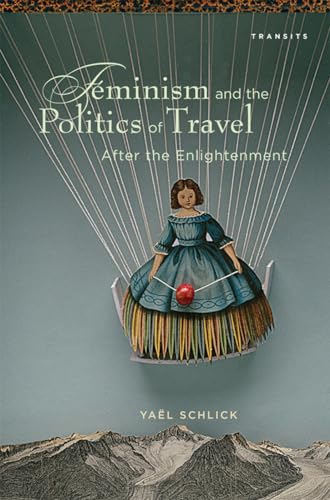

Feminism and the politics of travel after the Enlightenment Yaël Schlick.
Series TransitsDetalles de publicación: Lanham, Md. Bucknell University Press 2012.Descripción: x, 223 p. 23 cmISBN:- 9781611484281 (cloth : alk. paper)
- 9781611484298 (electronic)
- 910.4082/09032
- G460 .S343 2012
| Imagen de cubierta | Tipo de ítem | Biblioteca actual | Biblioteca de origen | Colección | Ubicación en estantería | Signatura topográfica | Materiales especificados | Info Vol | URL | Copia número | Estado | Notas | Fecha de vencimiento | Código de barras | Reserva de ítems | Prioridad de la cola de reserva de ejemplar | Reservas para cursos | |
|---|---|---|---|---|---|---|---|---|---|---|---|---|---|---|---|---|---|---|
| Libro | Biblioteca Encarnación Valdés Colección General bev | 910.408209 S344f (Navegar estantería(Abre debajo)) | Disponible | 80000002471244 |
Descripciones mejoradas de Syndetics:
Taking the Enlightenment and the feminist tradition to which it gave rise as its historical and philosophical coordinates, Feminism and the Politics of Travel After the Enlightenment explores travel as a "technology of gender." It also investigates the way travel's utopian dimension and feminism's utopian ideals have intermittently fed off each other in productive ways. With broad historical and theoretical understanding, Yaël Schlick analyzes the intersections of travel and feminism in writings published during the late eighteenth and nineteenth centuries, a period of intense feminist vindication during which women's very presence in the public sphere, their access to education, and their political participation were contentious issues. Schlick examines the gendering of travel and its political implications in Rousseau's Emile, and in works by Mary Wollstonecraft, Stéphanie-Félicité de Genlis, Frances Burney, Germaine de Staël, Suzanne Voilquin, Flora Tristan, Gustave Flaubert, and George Sand, arguing that travel is instrumental in furthering diverse feminist agendas. The epilogue alerts us to the continuation of the utopian strain of the voyage and its link to feminism in modern and contemporary travelogues by writers like Mary Kingsley, Robyn Davidson and Sara Wheeler.that travel is instrumental in furthering diverse feminist agendas. The epilogue alerts us to the continuation of the utopian strain of the voyage and its link to feminism in modern and contemporary travelogues by writers like Mary Kingsley, Robyn Davidson and Sara Wheeler.
Includes bibliographical references (p. [181]- [217]) and index.
Tabla de contenidos provista por Syndetics
- Acknowledgments(p. ix)
- Introduction: Travel, Knowledge, Utopia(p. 1)
- Part I Travel and Domesticity
- 1 The Sex of Travel: Sexual Contract and Enlightenment Travel in Jean-Jacques Rousseau and Mary Wollstonecraft(p. 19)
- 2 Travel and Talent: The Culture-of Domesticity in Stéphanie-Félicité de Genlis, Germaine de Staël, and Frances Burney(p. 51)
- Part II Travel and New Communities
- 3 Traveling Theories and Political Formation: The Feminist Peregrinations of Flora Tristan(p. 87)
- 4 Travel as Praxis: Suzanne Voilquin and the Saint-Simonian "Call to the Woman"(p. 119)
- Part III Travel and History
- 5 Spatial Literacy and the Female Traveler: The Politics of Map-Reading in Gustave Flaubert and George Sand(p. 147)
- Epilogue: Moving Forward(p. 173)
- Notes(p. 181)
- Bibliography(p. 207)
- Index(p. 219)
- About the Author(p. 223)