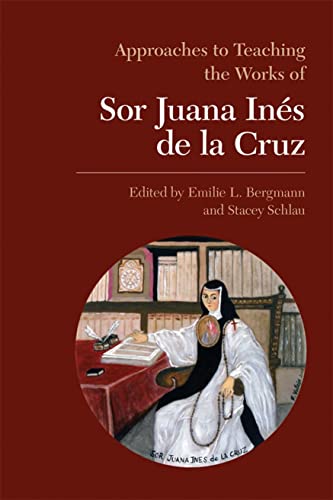

Approaches to teaching the works of Sor Juana Inés de la Cruz edited by Emilie L. Bergmann and Stacey Schlau.
Series Approaches to teaching world literature ; 98Detalles de publicación: New York Modern Language Association of America 2007.Descripción: xii, 312 p. 23 cmISBN:- 9780873528160 (pbk. : alk. paper)
- Sor Juana Inés de la Cruz
- M 861.3 A6527 22
- PQ7296.J6 Z566 2007
| Imagen de cubierta | Tipo de ítem | Biblioteca actual | Biblioteca de origen | Colección | Ubicación en estantería | Signatura topográfica | Materiales especificados | Info Vol | URL | Copia número | Estado | Notas | Fecha de vencimiento | Código de barras | Reserva de ítems | Prioridad de la cola de reserva de ejemplar | Reservas para cursos | |
|---|---|---|---|---|---|---|---|---|---|---|---|---|---|---|---|---|---|---|
| Libro | Biblioteca Encarnación Valdés Colección General bev | M 861.3 A6527 (Navegar estantería(Abre debajo)) | Disponible | 80000002499682 |
Descripciones mejoradas de Syndetics:
Sor Juana Inés de la Cruz--a witty, intellectually formidable, and prolific author--stands as an icon of women's early writing and of colonial New Spain. Living in the capital city of seventeenth-century Mexico, she was located in the center of her world, but, as a self-taught, illegitimate, Creole woman and as a nun subject to the authority of male religious leaders, she was also socially marginal within that world. Like other early modern women she took up the pen to challenge gendered norms of the time. In style and content her works, which draw on baroque stylistics, classical rhetoric, and the natural sciences, are key documents in the development of Western literature.
Part 1 of this 98th volume in the Approaches to Teaching series evaluates the most useful materials among the wealth of resources available for teaching Sor Juana, reviews Spanish- and English-language editions of her work, highlights audiovisual and electronic resources for teaching, and recommends critical and historical studies of her writings and her period.
The essays in part 2, "Approaches," aim to help teachers navigate with students not only the complex networks of meaning found in Sor Juana's works but also her complicated social world. Contributors discuss gender and religion in colonial society; the element of the baroque in Sor Juana's writing; the variety of ways Sor Juana subverted generic forms to render social criticism; and the relations between her writing and the twenty-first century.
Includes bibliographical references (p. [273] - 302) and indexes.
Tabla de contenidos provista por Syndetics
- Preface to the Series(p. ix)
- Preface to the Volume(p. xi)
- Acknowledgments(p. xiii)
- Introduction(p. 1)
- Part 1 Materials
- Editions(p. 9)
- Spanish Editions(p. 9)
- English Translations(p. 9)
- Editions Used in This Book
- The Instructor's Library(p. 14)
- Audiovisual and Electronic Resources(p. 18)
- Part 2 Approaches
- Introduction(p. 21)
- Backgrounds: Gender, Power, and Religion in Colonial Society
- Seventeenth-Century New Spain: A Historical Overview(p. 28)
- Sor Juana and Company: Intellectuals and Early Feminists(p. 37)
- Power and Resistance in the Colonial Mexican Convent(p. 47)
- Women's Spiritual Lives: The History, Politics, and Culture of Religious Women and Their Institutions in Colonial Society(p. 55)
- Sacred Allusions: Theology in Sor Juana's Work(p. 65)
- The "Mexican" Sor Juana(p. 77)
- Colonial No More: Reading Sor Juana from a Transatlantic Perspective(p. 86)
- Across the Atlantic: Sor Juana, La respuesta, and the Hispanic Women's Canon(p. 95)
- Sor Juana as a Baroque Writer: A Colonial Latin American Woman's Ways of Knowing
- Gendered Ways of Seeing with Sor Juana: "Situating Knowledge" in New Spain(p. 103)
- Seventeenth-Century Pansapphism: Comparing "Exceptional Women" of the Americas and Europe(p. 112)
- "Guileful Deception of Sense": Semantic Fields and Sor Juana's Baroque Poetry(p. 119)
- Sor Juana's Dream: In Search of a Scientific Vision(p. 127)
- Spectacles of Power and Figures of Knowledge in Sor Juana's Allegorical Neptune(p. 135)
- Conventional Genres, Subversive Gestures
- Sor Juana in Text and in Performance: Confronting Meaning(p. 144)
- Sor Juana's Loas: Hybridity in a Historical Context(p. 153)
- The House of Trials and the Trials of Master's-Level Research(p. 161)
- Sor Juana's Petrarchan Poetics(p. 170)
- Sor Juana; or, The Traps of Translation(p. 178)
- The Answer to Sor Filotea: A Rhetorical Approach(p. 186)
- Sor Juana Ines de la Cruz: Three Hundred Years of Controversy and Counting(p. 193)
- The Final Silence of Sor Juana: The Abysmal Remove of Her Closing Night(p. 201)
- Teaching Sor Juana in the Twenty-First Century
- Sor Juana's Love Poems Addressed to Women(p. 209)
- Visual Technologies as Pedagogical Artifacts: Teaching Sor Juana in a Virtual World(p. 220)
- Sor Juana, Food, and the Life of the Mind(p. 229)
- Musical Settings of Sor Juana's Works and Music in Works of Sor Juana(p. 238)
- Sor Juana, an Official Habit: Twentieth-Century Mexican Culture(p. 247)
- Traces of Sor Juana in Contemporary Mexicana and Chicana/Latina Writers(p. 256)
- Notes on Contributors(p. 265)
- Survey Participants(p. 271)
- Works Cited(p. 273)
- Index of Names(p. 303)
- Index of Works(p. 311)
Notas de autor provistas por Syndetics
Emilie L. Bergmann is professor of Spanish at University of California, Berkeley. She coedited Mirrors and Echoes: Women's Writing in Twentieth-Century Spain (2007) and ¿Entiendes? Queer Readings, Hispanic Writings (1995) and coauthored Women, Culture, and Politics in Latin America (1990). She has published on visual culture, gender, sexuality, and the maternal in early modern literature including the poetry of Sor Juana Inés de la Cruz, and on twentieth-century Spanish women's writing. Stacey Schlau is professor of Spanish and women's studies at West Chester University. Her books include, authored with Electra Arenal, Untold Sisters: Hispanic Nuns in Their Own Works (1989); the critical edition, Viva al siglo, muerta al mundo: Obras escogidas de María de san Alberto (1568-1640) ; and Spanish American Women's Use of the Word: Colonial through Contemporary Narratives (2001). She has published articles on seventeenth- through twentieth-century Spanish and Spanish American women writers, especially of narrative, and is working on a book of women and the Hispanic inquisitions.